Inorganic Chemistry PYQ — Page 9
JEE Main Chemistry — Inorganic Chemistry previous year questions with solutions.
All Inorganic Chemistry Questions (1476)
First ionisation enthalpy values of first four group 15 elements are given below. Choose the correct value for the element that is a main component of apatite family :
The large difference between the melting and boiling points of oxygen and sulphur may be explained on the basis of
Match List - I with List - II. \begin{array}{llll} & List - I & & List - II \\(A) & Bronze & (I) &\mathrm{Cu}, \mathrm{Ni} \\(B) & Brass & (II) &\mathrm{Fe}, \mathrm{Cr}, \mathrm{Ni}, \mathrm{C} \\(C) & UK silver coin & (III) &\mathrm{Cu}, \mathrm{Zn} \\(D) & Stainless steel & (IV) &\mathrm{Cu}, \mathrm{Sn}\end{array} Choose the correct answer from the options given below :
Consider the following reactions 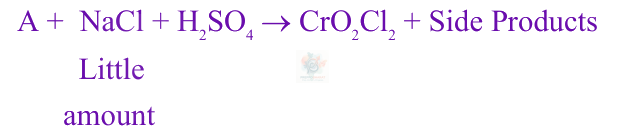 $\begin{aligned}<br />& \mathrm{CrO}_2 \mathrm{Cl}_{2(\text { Vapour })}+\mathrm{NaOH} \rightarrow \mathrm{~B}+\mathrm{NaCl}+\mathrm{H}_2 \mathrm{O} \\ & \mathrm{~B}+\mathrm{H}^{+} \rightarrow \mathrm{C}+\mathrm{H}_2 \mathrm{O}<br />\end{aligned}$ The number of terminal ' O ' present in the compound ' C ' is ______.
Match the LIST-I with LIST-II $\begin{array}{|l|l|c|l|}\hline & \begin{array}{c} \text{LIST-I} \\ \text{(Complex/} \\ \text{Species)} \end{array} & & \begin{array}{c} \text{LIST-II} \\ \text{(Shape & magnetic} \\ \text{moment)} \end{array} \\ \hline \text{A.} & {\left[\mathrm{Ni}(\mathrm{CO})_4\right]} & \text{I.} & \text{Tetrahedral, 2.8 BM} \\ \hline \text{B.} & {\left[\mathrm{Ni}(\mathrm{CN})_4\right]^{2-}} & \text{II.} & \text{Square planar, 0 BM} \\ \hline \text{C.} & {\left[\mathrm{NiCl}_4\right]^{2-}} & \text{III.} & \text{Tetrahedral, 0 BM} \\ \hline \text{D.} & {\left[\mathrm{MnBr}_4\right]^{2-}} & \text{IV.} & \text{Tetrahedral, 5.9 BM} \\ \hline \end{array}$ Choose the correct answer from the options given below :
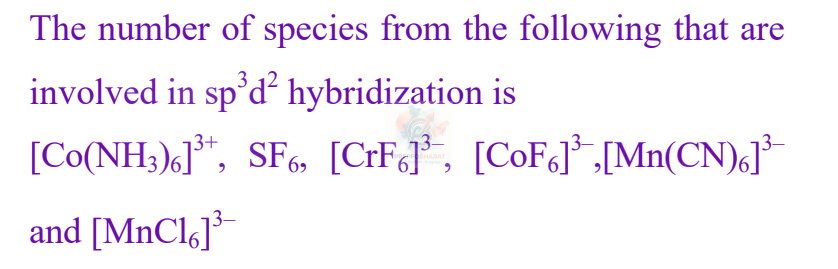
The number of paramagnetic complex among $\left[\mathrm{FeF}_6\right]^{3-},\left[\mathrm{Fe}(\mathrm{CN})_6\right]^{3-},\left[\mathrm{Mn}(\mathrm{CN})_6\right]^{3-},\left[\mathrm{Co}\left(\mathrm{C}_2 \mathrm{O}_4\right)_3\right]^{3-}$, $\left[\mathrm{MnCl}_6\right]^{3-}$ and $\left[\mathrm{CoF}_6\right]^{3-}$, which involved $\mathrm{d}^2 \mathrm{sp}^3$ hybridization is ____
Consider the following low-spin complexes $\mathrm{K}_3\left[\mathrm{Co}\left(\mathrm{NO}_2\right)_6\right], \mathrm{K}_4\left[\mathrm{Fe}(\mathrm{CN})_6\right]$, $\mathrm{K}_3\left[\mathrm{Fe}(\mathrm{CN})_6\right], \mathrm{Cu} u_2\left[\mathrm{Fe}(\mathrm{CN})_6\right] \text { and } \mathrm{Zn}_2\left[\mathrm{Fe}(\mathrm{CN})_6\right]$ The sum of the spin-only magnetic moment values of complexes having yellow colour is. _____ B.M. (answer in nearest integer)
Match List - I with List - II. 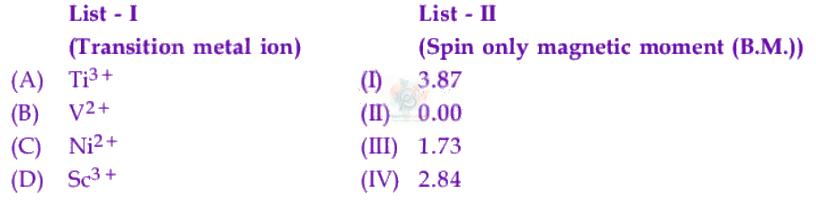 Choose the correct answer from the options given below :
One mole of the octahedral complex compound $\mathrm{Co}\left(\mathrm{NH}_3\right)_5 \mathrm{Cl}_3$ gives 3 moles of ions on dissolution in water. One mole of the same complex reacts with excess of $\mathrm{AgNO}_3$ solution to yield two moles of $\mathrm{AgCl}_{(\mathrm{s})}$. The structure of the complex is:
Identify the homoleptic complex(es) that is/are low spin. (A) $\left[\mathrm{Fe}(\mathrm{CN})_5 \mathrm{NO}\right]^{2-}$ (B) $\left[\mathrm{CoF}_6\right]^{3-}$ (C) $\left[\mathrm{Fe}(\mathrm{CN})_6\right]^{4-}$ (D) $\left[\mathrm{Co}\left(\mathrm{NH}_3\right)_6\right]^{3+}$ (E) $\quad\left[\mathrm{Cr}\left(\mathrm{H}_2 \mathrm{O}\right)_6\right]^{2+}$ Choose the correct answer from the options given below :
In which of the following complexes the CFSE, $\Delta_{\mathrm{o}}$ will be equal to zero?
Match the LIST-I with LIST-II 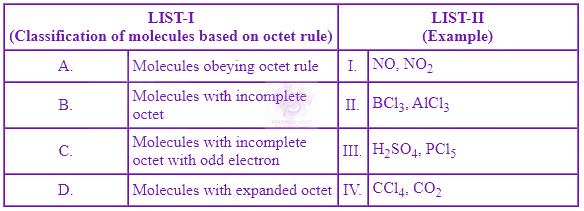 Choose the correct answer from the options given below:
Given below are two statements : Statement (I) : The first ionisation enthalpy of group 14 elements is higher than the corresponding elements of group 13. Statement (II) : Melting points and boiling points of group 13 elements are in general much higher than those of the corresponding elements of group 14. In the light of the above statements, choose the most appropriate answer from the options given below :
$\mathrm{CrCl}_3 \cdot \mathrm{xNH}_3$ can exist as a complex. 0.1 molal aqueous solution of this complex shows a depression in freezing point of $0.558^{\circ} \mathrm{C}$. Assuming $100 \%$ ionisation of this complex and coordination number of Cr is 6 , the complex will be (Given $\mathrm{K}_{\mathrm{f}}=1.86 \mathrm{~K} \mathrm{~kg} \mathrm{~mol}^{-1}$ )
Given below are two statements : Statement I : A homolepitc octahedral complex, formed using monodentate ligands, will not show stereoisomerism. Statement II : cis- and trans- platin are heteroleptic complexes of Pd. In the light of the above statements, choose the correct answer from the options given below.
Consider the following elements $\mathrm{In}, \mathrm{Tl}, \mathrm{Al}, \mathrm{Pb}, \mathrm{Sn}$ and Ge . The most stable oxidation states of elements with highest and lowest first ionisation enthalpies, respectively, are
Choose the correct tests with respective observations. (A) \(\mathrm{CuSO}_4\) (acidified with acetic acid) \(+ \mathrm{K}_4\left[\mathrm{Fe}(\mathrm{CN})_6\right] \rightarrow\) Chocolate brown precipitate. (B) \(\mathrm{FeCl}_3+\mathrm{K}_4\left[\mathrm{Fe}(\mathrm{CN})_6\right] \rightarrow\) Prussian blue precipitate. (C) \(\mathrm{ZnCl}_2+\mathrm{K}_4\left[\mathrm{Fe}(\mathrm{CN})_6\right]\), neutralised with \(\mathrm{NH}_4 \mathrm{OH}\) \(\rightarrow\) White or bluish white precipitate. (D) \(\mathrm{MgCl}_2+\mathrm{K}_4\left[\mathrm{Fe}(\mathrm{CN})_6\right] \rightarrow\) Blue precipitate. (E) \(\mathrm{BaCl}_2+\mathrm{K}_4\left[\mathrm{Fe}(\mathrm{CN})_6\right]\), neutralised with NaOH \(\rightarrow\) White precipitate. Choose the correct answer from the options given below :
Among the following cations, the number of cations which will give characteristic precipitate in their identification tests with $\mathrm{K}_4\left[\mathrm{Fe}(\mathrm{CN})_6\right]$ is _____. $\mathrm{Cu}^{2+}, \mathrm{Fe}^{3+}, \mathrm{Ba}^{2+}, \mathrm{Ca}^{2+}, \mathrm{NH}_4^{+}, \mathrm{Mg}^{2+}, \mathrm{Zn}^{2+}$
A molecule with the formula \(\mathrm{AX}_4 \mathrm{Y}\) has all it's elements from p-block. Element A is rarest, monoatomic, non-radioactive from its group and has the lowest ionization enthalpy value among A, X and Y. Elements X and Y have first and second highest electronegativity values respectively among all the known elements. The shape of the molecule is :
The correct set of ions (aqueous solution) with same colour from the following is:
In $\mathrm{SO}_2, \mathrm{NO}_2^{-}$and $\mathrm{N}_3^{-}$the hybridizations at the central atom are respectively :
The correct increasing order of stability of the complexes based on \(\Delta_{\mathrm{o}}\) value is : I. \(\left[\mathrm{Mn}(\mathrm{CN})_6\right]^{3-}\) II. \(\left[\mathrm{Co}(\mathrm{CN})_6\right]^{4-}\) III. \(\left[\mathrm{Fe}(\mathrm{CN})_6\right]^{4-}\) IV. \(\left[\mathrm{Fe}(\mathrm{CN})_6\right]^{3-}\)
Formation of $\mathrm{Na}_4\left[\mathrm{Fe}(\mathrm{CN})_5 \mathrm{NOS}\right]$, a purple coloured complex formed by addition of sodium nitroprusside in sodium carbonate extract of salt indicates the presence of :