Inorganic Chemistry PYQ — Page 8
JEE Main Chemistry — Inorganic Chemistry previous year questions with solutions.
All Inorganic Chemistry Questions (1476)
The correct option with order of melting points of the pairs \((\mathrm{Mn}, \mathrm{Fe}),(\mathrm{Tc}, \mathrm{Ru})\) and \((\mathrm{Re}, \mathrm{Os})\) is :
Given below are two statements : Statement (I): The metallic radius of Al is less than that of Ga. Statement (II) : The ionic radius of \(\mathrm{Al}^{3+}\) is less than that of \(\mathrm{Ga}^{3+}\). In the light of the above statements, choose the most appropriate answer from the options given below :
Find the compound ' A ' from the following reaction sequences. $\mathrm{A} \xrightarrow{\text { aqua-regia }} \mathrm{B} \xrightarrow[\text { (2) } \mathrm{AcOH}]{\text { (1) } \mathrm{KNO}_2 \mid \mathrm{NH}_4 \mathrm{OH}} \text { yellow ppt }$
The spin-only magnetic moment value of $\mathrm{M}^{\mathrm{n+-}}$ ion formed among $\mathrm{Ni}, \mathrm{Zn} \mathrm{Mn}$ and Cu that has the least enthalpy of atomisation is ________. (in nearest integer) Here n is equal to the number of diamagnetic complexes among $\mathrm{K}_2\left[\mathrm{NiCl}_4\right],\left[\mathrm{Zn}\left(\mathrm{H}_2 \mathrm{O}\right)_6\right] \mathrm{Cl}_2$, $\mathrm{K}_3\left[\mathrm{Mn}(\mathrm{CN})_6\right] \text { and }\left[\mathrm{Cu}\left(\mathrm{PPh}_3\right)_3 \mathrm{I}\right]$
Arrange the following compounds in increasing order of their dipole moment : $\mathrm{HBr}, \mathrm{H}_2 \mathrm{~S}, \mathrm{NF}_3$ and $\mathrm{CHCl}_3$
Which one of the following complexes will have $\Delta_0=0$ and $\mu=5.96$ B.M.?
Among, $\mathrm{Sc}, \mathrm{Mn}, \mathrm{Co}$ and Cu , identify the element with highest enthalpy of atomisation. The spin only magnetic moment value of that element in its +2 oxidation state is _____ BM (in nearest integer).
A group 15 element forms $\mathrm{d} \pi-\mathrm{d} \pi$ bond with transition metals. It also forms hydride, which is a strongest base among the hydrides of other group members that form $\mathrm{d} \pi-\mathrm{d} \pi$ bond. The atomic number of the element is ____.
Identify the coordination complexes in which the central metal ion has $d^4$ configuration. 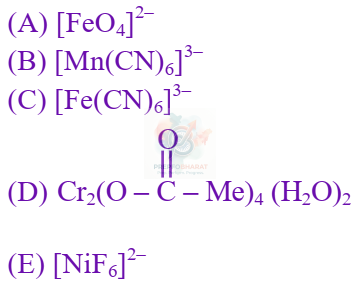 Choose the correct answer from the options given below :
Match the LIST-I with LIST-II 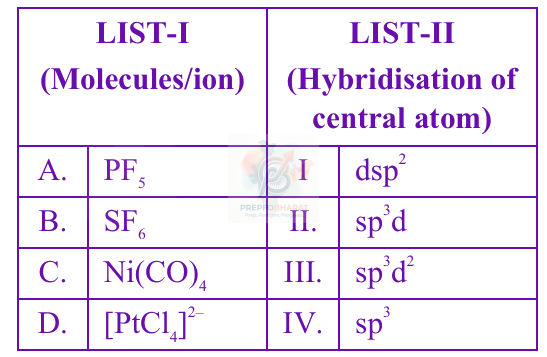 Choose the correct answer from the options given below :
The d-orbital electronic configuration of the complex among $\quad\left[\mathrm{Co}(\mathrm{en})_3\right]^{3+}, \quad\left[\mathrm{CoF}_6\right]^{3-}$, $\left[\mathrm{Mn}\left(\mathrm{H}_2 \mathrm{O}\right)_6\right]^{2+}$ and $\left[\mathrm{Zn}\left(\mathrm{H}_2 \mathrm{O}\right)_6\right]^{2+}$ that has the highest CFSE is :
$\mathrm{KMnO}_4$ acts as an oxidising agent in acidic medium. ' X ' is the difference between the oxidation states of Mn in reactant and product. ' Y ' is the number of ' d ' electrons present in the brown red precipitate formed at the end of the acetate ion test with neutral ferric chloride. The value of $\mathrm{X}+\mathrm{Y}$ is ______.
The incorrect decreasing order of atomic radii is
The correct order of $\left[\mathrm{FeF}_6\right]^{3-},\left[\mathrm{CoF}_6\right]^{3-},\left[\mathrm{Ni}(\mathrm{CO})_4\right]$ and $\left[\mathrm{Ni}(\mathrm{CN})_4\right]^{2-}$ complex species based on the number of unpaired electrons present is :
The sum of sigma \((\sigma)\) and pi \((\pi)\) bonds in Hex-1,3-dien-5-yne is _______.
The complex that shows Facial - Meridional isomerism is:
Which of the following linear combination of atomic orbitals will lead to formation of molecular orbitals in homonuclear diatomic molecules [internuclear axis in $z$-direction] ? A. $2 \mathrm{p}_{\mathrm{z}}$ and $2 \mathrm{p}_{\mathrm{x}}$ B. 2 s and $2 \mathrm{p}_{\mathrm{x}}$ C. $3 \mathrm{~d}_{\mathrm{xy}}$ and $3 \mathrm{~d}_{\mathrm{x}^2-y^2}$ D. 2 s and $2 \mathrm{p}_{\mathrm{z}}$ E. $2 p_z$ and $3 d_x{ }^2-y^2$ Choose the correct answer from the options given below:
The metal ions that have the calculated spin only magnetic moment value of 4.9 B.M. are A. $\mathrm{Cr}^{2+}$ B. $\mathrm{Fe}^{2+}$ C. $\mathrm{Fe}^{3+}$ D. $\mathrm{Co}^{2+}$ E. $\mathrm{Mn}^{3+}$ Choose the correct answer from the options given below
Match List - I with List - II. 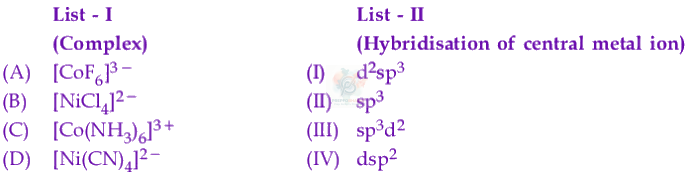 Choose the correct answer from the options given below :
The number of unpaired electrons responsible for the paramagnetic nature of the following complex species are respectively: $\left[\mathrm{Fe}(\mathrm{CN})_6\right]^{3-},\left[\mathrm{FeF}_6\right]^{3-},\left[\mathrm{CoF}_6\right]^{3-},\left[\mathrm{Mn}(\mathrm{CN})_6\right]^{3-}$
Pair of transition metal ions having the same number of unpaired electrons is :
An element ' \(E^{\prime}\) has the ionisation enthalpy value of \(374 \mathrm{~kJ} \mathrm{~mol}^{-1}\). ' \(E\) ' reacts with elements \(\mathrm{A}, \mathrm{B}, \mathrm{C}\) and D with electron gain enthalpy values of \(-328,-349,-325\) and \(-295 \mathrm{~kJ} \mathrm{~mol}^{-1}\), respectively. The correct order of the products EA, EB, EC and ED in terms of ionic character is :
Match the LIST-I withLIST-II.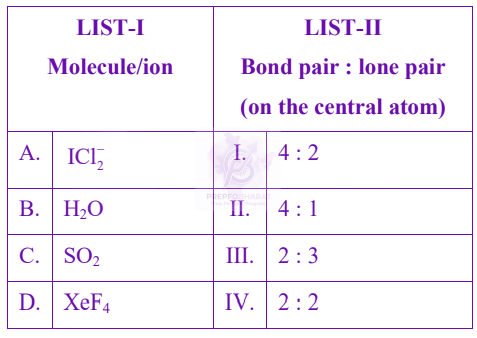 Choose the correct answer from the options given below :
Given below are two statements : Statement I : Nitrogen forms oxides with +1 to +5 oxidation states due to the formation of $\mathrm{p} \pi-\mathrm{p} \pi$ bond with oxygen. Statement II : Nitrogen does not form halides with +5 oxidation state due to the absence of d-orbital in it. In the light of given statements, choose the correct answer from the options given below.