Inorganic Chemistry PYQ — Page 7
JEE Main Chemistry — Inorganic Chemistry previous year questions with solutions.
All Inorganic Chemistry Questions (1476)
Match List-I with List-II. $\begin{array}{llll} & \text{List-I} & & \text{List-II} \\(A) & \mathrm{Al}^{3+} < \mathrm{Mg}^{2+} < \mathrm{Na}^{+} < \mathrm{F}^{-} & (I) & \text{Ionisation Enthalpy} \\(B) & \mathrm{B} < \mathrm{C} < \mathrm{O} < \mathrm{N} & (II) & \text{Metallic character} \\(C) & \mathrm{B} < \mathrm{Al} < \mathrm{Mg} < \mathrm{K} & (III) & \text{Electronegativity} \\(D) & \mathrm{Si} < \mathrm{P} < \mathrm{S} < \mathrm{Cl} & (IV) & \text{Ionic radii}\end{array}$ Choose the correct answer from the options given below :
Which of the following molecules(s) show/s paramagnetic behavior? (A) $\mathrm{O}_2$ (B) $\mathrm{N}_2$ (C) $\mathrm{F}_2$ (D) $\mathrm{S}_2$ (E) $\mathrm{Cl}_2$ Choose the correct answer from the options given below :
Given below are two statements : Statement (I): Experimentally determined oxygen-oxygen bond lengths in the $\mathrm{O}_3$ are found to be same and the bond length is greater than that of a $\mathrm{O}=\mathrm{O}$ (double bond) but less than that of a single $(O-O)$ bond. Statement (II) : The strong lone pair-lone pair repulsion between oxygen atoms is solely responsible for the fact that the bond length in ozone is smaller than that of a double bond $(\mathrm{O}=\mathrm{O})$ but more than that of a single bond $(\mathrm{O}-\mathrm{O})$. In the light of the above statements, choose the correct answer from the options given below :
Which of the following statement is true with respect to $\mathrm{H}_2 \mathrm{O}, \mathrm{NH}_3$ and $\mathrm{CH}_4$ ? A. The central atoms of all the molecules are $\mathrm{sp}^3$ hybridized. B. The $\mathrm{H}-\mathrm{O}-\mathrm{H}, \mathrm{H}-\mathrm{N}-\mathrm{H}$ and $\mathrm{H}-\mathrm{C}-\mathrm{H}$ angles in the above molecules are $104.5^{\circ}, 107.5^{\circ}$ and $109.5^{\circ}$, respectively. C. The increasing order of dipole moment is $\mathrm{CH}_4 \lt \mathrm{NH}_3 \lt \mathrm{H}_2 \mathrm{O}$. D. Both $\mathrm{H}_2 \mathrm{O}$ and $\mathrm{NH}_3$ are Lewis acids and $\mathrm{CH}_4$ is a Lewis base. E. A solution of $\mathrm{NH}_3$ in $\mathrm{H}_2 \mathrm{O}$ is basic. In this solution $\mathrm{NH}_3$ and $\mathrm{H}_2 \mathrm{O}$ act as Lowry-Bronsted acid and base respectively. Choose the correct answer from the options given below:
Niobium ( Nb ) and ruthenium $(\mathrm{Ru})$ have " $x$ " and " $y$ " number of electrons in their respective 4 d orbitals. The value of $x+y$ is ______ -.
The molecules having square pyramidal geometry are
The number of molecules/ions that show linear geometry among the following is ________ $\mathrm{SO}_2, \mathrm{BeCl}_2, \mathrm{CO}_2, \mathrm{~N}_3^{-}, \mathrm{NO}_2, \mathrm{~F}_2 \mathrm{O}, \mathrm{XeF}_2, \mathrm{NO}_2^{+}, \mathrm{I}_3^{-}, \mathrm{O}_3$
Among \(\mathrm{SO}_2, \mathrm{NF}_3, \mathrm{NH}_3, \mathrm{XeF}_2, \mathrm{ClF}_3\) and \(\mathrm{SF}_4\), the hybridization of the molecule with non-zero dipole moment and highest number of lone-pairs of electrons on the central atom is
Given below are two statements : Statement I: $\mathrm{H}_2 \mathrm{Se}$ is more acidic than $\mathrm{H}_2 \mathrm{Te}$. Statement II : $\mathrm{H}_2 \mathrm{Se}$ has higher bond enthalpy for dissociation than $\mathrm{H}_2 \mathrm{Te}$. In the light of the above statements, choose the correct answer from the options given below.
The metal ion whose electronic configuration is not affected by the nature of the ligand and which gives a violet colour in non-luminous flame under hot condition in borax bead test is
Which of the following ions is the strongest oxidizing agent? (Atomic Number of $\mathrm{Ce}=58, \mathrm{Eu}=63, \mathrm{~Tb}=65, \mathrm{Lu}=71$ )
The number of paramagnetic metal complex species among $\left[\mathrm{Co}\left(\mathrm{NH}_3\right)_6\right]^{3+}, \quad\left[\mathrm{Co}\left(\mathrm{C}_2 \mathrm{O}_4\right)_3\right]^{3-}$, $\left[\mathrm{MnCl}_6\right]^{3-},\left[\mathrm{Mn}(\mathrm{CN})_6\right]^{3-},\left[\mathrm{CoF}_6\right]^{3-},\left[\mathrm{Fe}(\mathrm{CN})_6\right]^{3^{3-}}$ and $\left[\mathrm{FeF}_6\right]^{3-}$ with same number of unpaired electrons is ________.
Total number of sigma ($\sigma$) and $\mathrm{pi}(\pi)$ bonds respectively present in hex-1-en-4-yne are :
Choose the incorrect trend in the atomic radii $(\mathrm{r})$ of the elements :
Given below are two statements Statement I : The N-N single bond is weaker and longer than that of $\mathrm{P}-\mathrm{P}$ single bond Statement II : Compounds of group 15 elements in +3 oxidation states readily undergo disproportionation reactions. In the light of above statements, choose the correct answer from the options given below
Given below are two statements : Statement (I) : An element in the extreme left of the periodic table forms acidic oxides. Statement (II) : Acid is formed during the reaction between water and oxide of a reactive element present in the extreme right of the periodic table. In the light of the above statements, choose the correct answer from the options given below :
Given below are two statements : Statement (I) : In octahedral complexes, when \(\Delta_{\mathrm{o}} \lt \mathrm{P}\) high spin complexes are formed. When \(\Delta_{\mathrm{o}} \gt \mathrm{P}\) low spin complexes are formed. Statement (II) : In tetrahedral complexes because of \(\Delta_{\mathrm{t}} \lt \mathrm{P}\), low spin complexes are rarely formed. In the light of the above statements, choose the most appropriate answer from the options given below :
Given below are two statements: Statement (I) : for $\mathrm{ClF}_3$, all three possible structures may be drawn as follows. 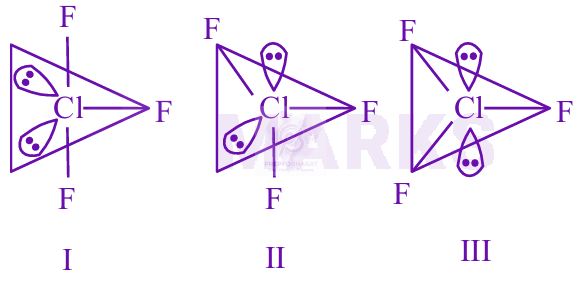 Statement (II) : Structure III is most stable, as the orbitals having the lone pairs are axial, where the $\ell \mathrm{p}-\mathrm{bp}$ repulsion is minimum. In the light of the above statements, choose the most appropriate answer from the options given below:
The number of valence electrons present in the metal among $\mathrm{Cr}, \mathrm{Co}, \mathrm{Fe}$ and Ni which has the lowest enthalpy of atomisation is
The elements of Group 13 with highest and lowest first ionisation enthalpies are respectively:
The spin only magnetic moment ( $\mu$ ) value (B.M.) of the compound with strongest oxidising power among $\mathrm{Mn}_2 \mathrm{O}_3, \mathrm{TiO}$ and VO is ____ B.M. (Nearest integer).
Given below are the pairs of group 13 element showing their relation in terms of atomic radius. $(\mathrm{B} \lt \mathrm{Al}),(\mathrm{Al} \lt \mathrm{Ga}),(\mathrm{Ga} \lt \mathrm{In}) \text { and }(\mathrm{In} \lt \mathrm{Tl})$ Identify the elements present in the incorrect pair and in that pair find out the element (X) that has higher ionic radius $\left(\mathrm{M}^{3+}\right)$ that the other one. The atomic number of the element $(\mathrm{X})$ is
Lanthanoid ions with $4 f^7$ configuration are : (A) $\mathrm{Eu}^{2+}$ (B) $\mathrm{Gd}^{3+}$ (C) $\mathrm{Eu}^{3+}$ (D) $\mathrm{Tb}^{3+}$ (E) $\mathrm{Sm}^{2+}$ Choose the correct answer from the options given below :
The molar mass of the water insoluble product formed from the fusion of chromite ore \(\left(\mathrm{FeCr}_2 \mathrm{O}_4\right)\) with \(\mathrm{Na}_2 \mathrm{CO}_3\) in presence of \(\mathrm{O}_2\) is _______ \(\mathrm{g} \mathrm{mol}^{-1}\).