Inorganic Chemistry PYQ — Page 46
JEE Main Chemistry — Inorganic Chemistry previous year questions with solutions.
All Inorganic Chemistry Questions (1476)
The following ligand is: 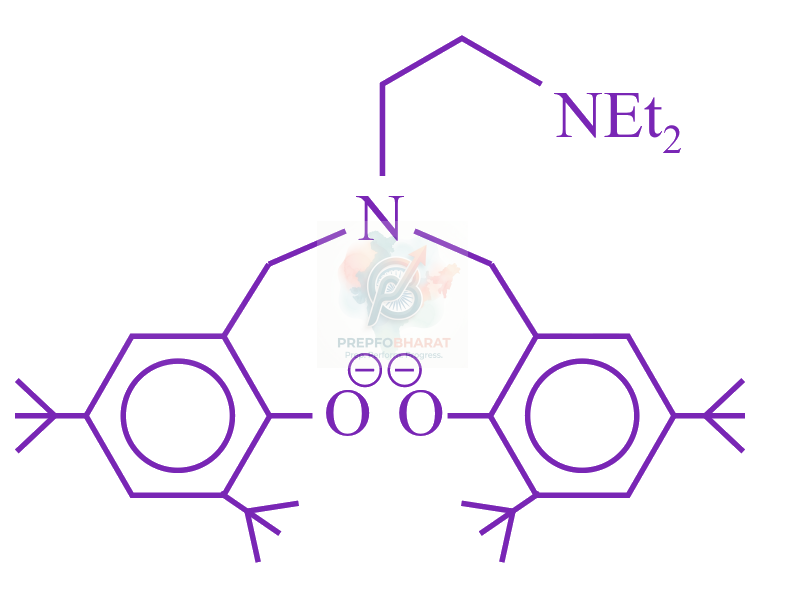
The type of hybridization and no. of lone pair(s) of electron of $Xe$ in $XeO{F}_{4}$ , respectively, are:
The metal that gives hydrogen gas upon treatment with both the acid as well as the base is
The number of water molecules not coordinated to copper ion directly in $CuS{O}_{4}\cdot 5{H}_{2}O,$ is
The incorrect statement is.
The correct statements among I to III are: (I) Valence bond theory cannot explain the color exhibited by transition metal complexes. (II) Valence bond theory can predict quantitatively the magnetic properties of transition metal complexes. (III) Valence bond theory cannot distinguish ligands as weak and strong field ones.
Two complexes $[\mathrm{Cr}{({H}_{2}O)}_{6 }]{\mathrm{Cl}}_{3} (A)$ and $[\mathrm{Cr}{({\mathrm{NH}}_{3})}_{6}]{\mathrm{Cl}}_{3}(B)$ are violet and yellow coloured, respectively, The incorrect statement regarding them is:
In general, the properties that decrease and increase down a group in the periodic table, respectively, are :
Two pi and half sigma bonds are present in:
The lanthanide ion that would show colour is:
The degenerate orbitals of ${[Cr{({H}_{2}O)}_{6}]}^{3+}$ are
The basic structural unit of feldspar, zeolites mica, and asbestos is:
The crystal field stabilization energy (CFSE) of $[Fe{({H}_{2}O)}_{6}]C{l}_{2}$ and ${K}_{2}[NiC{l}_{4}]$, respectively, are:
Match the catalysts (Column $I$) with products (Column $\mathrm{II}$)<table class="pyq-table"><tbody><tr><th></th><th>Column I</th><th></th><th>Column II</th></tr><tr><td></td><td>Catalyst</td><td></td><td>Product</td></tr><tr><td>A.</td><td>${V}_{2}{O}_{5}$</td><td>P.</td><td>Polyethylene</td></tr><tr><td>B.</td><td>$TiC{l}_{4}/Al{(Me)}_{3}$</td><td>Q.</td><td>Ethanal</td></tr><tr><td>C.</td><td>$PdC{l}_{2}$</td><td>R.</td><td>${H}_{2}S{O}_{4}$</td></tr><tr><td>D.</td><td>Iron Oxide</td><td>S.</td><td>$N{H}_{3}$</td></tr></tbody></table>
The size of the iso-electronic species $C{l}^{-}$ , Ar and $C{a}^{2+}$ is affected by:
Consider the hydrated ions of $T{i}^{2+}, {V}^{2+}, T{i}^{3+}$ and $S{c}^{3+}$ . The correct order of their spin-only magnetic moments is:
Among the following species, the diamagnetic molecule is:
The coordination numbers of $Co$ and $Al$ in $[Co(Cl){(en)}_{2}]Cl$ and ${K}_{3}[Al{({C}_{2}{O}_{4})}_{3}],$ respectively are: (en $=$ ethane-1, 2-diamine)
Aluminium is usually found in $+3$ oxidation state. In contrast, thallium exists in $+1$ and $+3$ oxidation states. This is due to:
The maximum number of possible oxidation states of actinoids are shown by:
The oxoacid of sulphur that does not contain bond between sulphur atom is:
The compound that inhibits the growth of tumors is:
The correct order of the first ionization enthalpies is:
The number of bridging CO ligand(s) and Co-Co bond(s) in $\mathrm{Co}_{2}(\mathrm{CO})_{8},$ respectively are: