Inorganic Chemistry PYQ — Page 47
JEE Main Chemistry — Inorganic Chemistry previous year questions with solutions.
All Inorganic Chemistry Questions (1476)
The magnetic moment of an octahedral homoleptic $\mathrm{Mn}(\mathrm{II})$ complex is $5.9 B.M.$ . The suitable ligand for this complex is:
The IUPAC symbol for the element with atomic number $119$ would be:
The number of $2$-centre-$2$-electron and $3$-centre-$2$-electron bonds in ${B}_{2}{H}_{6}$, respectively, are:
The complex ion that will lose its crystal field stabilization energy upon oxidation of metal to $+3$ state is: 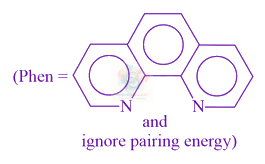
The $C-C$ bond length is maximum in:
According to molecular orbital theory, which of the following is true with respect to ${\mathrm{Li}}_{2}^{+}$ and ${\mathrm{Li}}_{2}^{-}$ ?
The major product of the following reaction is, 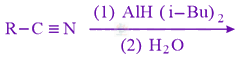
The total number of isomers for a square planar complex: $[\mathrm{MCl}(F)({\mathrm{NO}}_{2})(\mathrm{SCN})]$ is:
Among the following reactions of hydrogen with halogens, the one that requires a catalyst is:
The correct statements among I to III regrading group 13 element oxides are, (I) Boron trioxide is acidic. (II) Oxides of aluminum and gallium are amphoteric. (III) Oxides of indium and thallium are basic.
An organic compound ‘A’ is oxidized with $N{a}_{2}{O}_{2}$ followed by boiling with $HN{O}_{3}.$ The resultant solution is then treated with ammonium molybdate to yield a yellow percipitate. Based on a above observation, the element present in the given compound is:
Diborane $({B}_{2}{H}_{6})$ reacts independently with ${O}_{2}$ and ${H}_{2}O$ to produce, respectively:
The correct order of the atomic radii of $\mathrm{C}, \mathrm{Cs}, \mathrm{Al},$ and $\mathrm{S}$ is:
The element that does not show catenation is
The pair of metal ions that can give a spin only magnetic moment of $3.9 BM$ for the complex $[M{({H}_{2}O)}_{6}]C{l}_{2}$ , is:
Correct statements among regarding silicones are: $(a)$ They are polymers with hydrophobic character. $(b)$ They are biocompatible. $(c)$ In general, they have high thermal stability and low dielectric strength. $(d)$ Usually, they are resistant to oxidation and used as greases.
Three complexes, ${[CoCl{(N{H}_{3})}_{5}]}^{2+}(I), {[Co{(N{H}_{3})}_{5}{H}_{2}O]}^{3+}(II)$ and ${[Co{(N{H}_{3})}_{6}]}^{3+}(III)$ absorb light in the visible region. The correct order of the wavelength of light absorbed by them is:
Complete removal of both the axial ligands (along the $z-axis$ ) from an octahedral complex leads to which of the following splitting patterns? (relative orbital energies not on scale).
The element that usually does NOT show variable oxidation states is:
A reaction of cobalt $(\mathrm{III})$ chloride and ethylenediamine in a $1:2$ mole ratio generates two isomeric products $A$ (violet-coloured) and $B$ (green-coloured). $A$ can show optical activity, but, $B$ is optically inactive. What type of isomers do $A$ and $B$ represent?
$HF$ has highest boiling point among hydrogen halides, because it has:
The maximum possible denticities of a ligand given below towards a common transition and inner-transition metal ion, respectively, are: 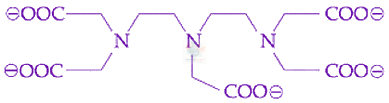
The group number, number of valence electrons, and valency of an element with atomic number $15,$ respectively, are:
Good reducing nature of ${H}_{3}P{O}_{2}$ is attributed to the presence of: