Inorganic Chemistry PYQ — Page 48
JEE Main Chemistry — Inorganic Chemistry previous year questions with solutions.
All Inorganic Chemistry Questions (1476)
The correct order of the spin –only magnetic moment of metal ions in the following low-spin complexes, ${[V{(CN)}_{6}]}^{4-},{[Fe{(CN)}_{6}]}^{4-},{[Ru{(N{H}_{3})}_{6}]}^{3+}$ and ${[Cr{(N{H}_{3})}_{6}]}^{2+},$ is:
The ion that has ${sp}^{3}{d}^{2}$ hybridization for the central atom is:
In comparison to boron, berylium has:
When the first electron gain enthalpy $( \Delta {H}_{ eg} )$ of oxygen is $-141 kJ/mol$ , its second electron gain enthalpy is:
The compound used in the treatment of lead poisoning is:
The correct order of atomic radii is:
The element with $Z=120$ (not yet discovered) will be a/an
The amorphous form of silica is:
Wilkinson catalyst is
Xenon hexafluoride on partial hydrolysis produces compounds ' $\mathrm{X}$ ' and ' $\mathrm{Y}$ '. Compounds ' $\mathrm{X}$ ' and ' $\mathrm{Y}$ ' and the oxidation state of $\mathrm{Xe}$ are respectively :
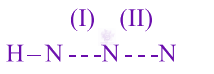 In hydrogen azide, the bond orders of bonds (I) and (II) are ______.
According to molecular orbital theory, which of the following molecule will not be available?
In the molecular orbital diagram for the molecular ion ${N}_{2}^{+}$ , the number of electrons in the ${\sigma }_{2p}$ molecular orbital is
When metal $M$is treated with $\mathrm{NaOH}$, a white gelatinous precipitate $X$is obtained, which is soluble in excess of $\mathrm{NaOH}$. Compound $X$when heated strongly gives an oxide which is used in chromatography as an adsorbent. The metal $M$is
Xenon hexafluoride on partial hydrolysis produces compounds 'X' and 'Y' and the respective oxidation states of Xe are:
The correct order of spin-only magnetic moments among the following is: (Atomic number: $\mathrm{Mn}=$ $25, \mathrm{Co}=27, \mathrm{Ni}=28, \mathrm{Zn}=30$ )
The incorrect geometry is represented by:
The correct combination is
In Wilkinson's catalyst, the hybridization of central metal ion and its shape are respectively:
In $\mathrm{XeO}_3 \mathrm{~F}_2$, the number of bond pair(s), $\pi$-bond(s) and lone pair(s) on Xe atom respectively are:
A white sodium salt dissolves readily in water to give a solution which is neutral to litmus. When silver nitrate solution is added to the before mentioned solution, a white precipitate is obtained which does not dissolve in dilute nitric acid. The anion is:
The compound that does not produce nitrogen gas by thermal decomposition is:
In a complexometric titration of metal ion with ligand $M (Metal ion)+L(Ligand)\rightarrow C (Complex)$ end point is estimated spectrophotometrically (through light absorption). If 'M' and 'C' do not absorb light and only 'L' absorbs then the titration plot between absorbed light $(A)$ versus volume of ligand 'L' $(V)$ would look like:
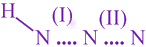 In the above compound, the bond orders of bonds $(I)$ and $(\mathrm{II})$ are: