Inorganic Chemistry PYQ — Page 4
JEE Main Chemistry — Inorganic Chemistry previous year questions with solutions.
All Inorganic Chemistry Questions (1476)
A salt with few drops of conc. HCl gives apple green colour in flame test. The group precipitate of the salt is dissolved in acetic acid and treated with $K_2CrO_4$ to give yellow precipitate. When the sodium carbonate extract of the salt solution is heated with conc. $HNO_3$ and ammonium molybdate, it resulted a canary yellow precipitate. The cation and anion present in the salt are respectively,
Among the following oxides of 3 d elements, the number of mixed oxides are $\_\_\_\_$。 $\mathrm{Ti}_{2} \mathrm{O}_{3}, \mathrm{~V}_{2} \mathrm{O}_{4}, \mathrm{Cr}_{2} \mathrm{O}_{3}, \mathrm{Mn}_{3} \mathrm{O}_{4}, \mathrm{Fe}_{3} \mathrm{O}_{4}, \mathrm{Fe}_{2} \mathrm{O}_{3}, \mathrm{Co}_{3} \mathrm{O}_{4}$
$\left[\mathrm{Ni}\left(\mathrm{PPh}_{3}\right)_{2} \mathrm{Cl}_{2}\right]$ is a paramagnetic complex. Identify the INCORRECT statements about this complex. A. The complex exhibits geometrical isomerism. B. The complex is white in colour. C. The calculated spin-only magnetic moment of the complex is 2.84 BM . D. The calculated CFSE (Crystal Field Stabilization Energy) of Ni in this complex is $-0.8 \Delta_{\mathrm{o}}$. E. The geometrical arrangement of ligands in this complex is similar to that in $\mathrm{Ni}(\mathrm{CO})_{4}$. Choose the correct answer from the options given below :
Which of the following represents the correct trend for the mentioned property ? A. $\mathrm{F}>\mathrm{P}>\mathrm{S}>\mathrm{B}$ $\ \ \ $ - $\ \ \ $ First Ionization Energy B. $\mathrm{Cl}>\mathrm{F}>\mathrm{S}>\mathrm{P}$ $\ \ \ $ - $\ \ \ $ Electron Affinity C. $\mathrm{K}>\mathrm{Al}>\mathrm{Mg}>\mathrm{B}$ $\ \ \ $ - $\ \ \ $ Metallic character D. $\mathrm{K}_{2} \mathrm{O}>\mathrm{Na}_{2} \mathrm{O}>\mathrm{MgO}>\mathrm{Al}_{2} \mathrm{O}_{3} \quad$ $\ \ \ $ - $\ \ \ $ Basic character Choose the correct answer from the options given below :
Which of the following are true about the energy of the given d-orbitals of a tetrahedral complex? A. $d_{xy} = d_{xz} > d_{x^2-y^2}$ B. $d_{xy} = d_{yz} > d_{z^2}$ C. $d_{x^2-y^2} > d_{z^2} > d_{xz}$ D. $d_{x^2-y^2} = d_{z^2} < d_{xz}$ Choose the correct answer from the given below:
Pairs of elements with the same number of electrons in their respective 4f orbital are [Atomic number. Eu-63, Gd-64, Dy-66, Ho-67, Tm-69, Yb-70, Lu-71, Hf-72] A. (Eu and Gd) B. (Dy and Ho) C. (Yb and Hf) D. (Lu and Tm) Choose the correct answer from the options given below:
Treatment of a gas '$X$' with a freshly prepared ferrous sulphate solution gives a compound '$Y$' as a brown ring. The compounds $X$ and $Y$ are.
Given below are two statements: Statement I: The number of pairs, from the following, in which both the ions are coloured in aqueous solution is 3. $\left[\mathrm{Sc}^{3+}, \mathrm{Ti}^{3+}\right],\left[\mathrm{Mn}^{2+}, \mathrm{Cr}^{2+}\right],\left[\mathrm{Cu}^{2+}, \mathrm{Zn}^{2+}\right]$ and $\left[\mathrm{Ni}^{2+}, \mathrm{Ti}^{4+}\right]$ Statement II: $\mathrm{Th}^{4+}$ is the strongest reducing agent among $\mathrm{Th}^{4+}, \mathrm{Ce}^{4+}, \mathrm{Gd}^{3+}$ and $\mathrm{Eu}^{2+}$. In the light of the above statements, choose the correct answer from the options given below
Identify the CORRECT set of details from the following: A. $\left[\mathrm{Co}\left(\mathrm{NH}_{3}\right)_{6}\right]^{3+}$ : Inner orbital complex; $\mathrm{d}^{2} \mathrm{sp}^{3}$ hybridized B. $\left[\mathrm{MnCl}_{6}\right]^{3-}$ : Outer orbital complex; $\mathrm{sp}^{3} \mathrm{~d}^{2}$ hybridized C. $\left[\mathrm{CoF}_{6}\right]^{3-}$ : Outer orbital complex; $\mathrm{d}^{2} \mathrm{sp}^{3}$ hybridized D. $\left[\mathrm{FeF}_{6}\right]^{3-}$ : Outer orbital complex; $\mathrm{sp}^{3} \mathrm{~d}^{2}$ hybridized E. $\left[\mathrm{Ni}(\mathrm{CN})_{4}\right]^{2-}$ : Inner orbital complex; $\mathrm{sp}^{3}$ hybridized Choose the correct answer from the options given below:
Elements X and Y belong to Group 15. The difference between the electronegativity values of ' X ' and phosphorus is higher than that of the difference between phosphorus and ' Y '. ' X ' \& ' Y ' are respectively
Consider three metal chlorides $\mathrm{x}, \mathrm{y}$ and z, where x is water soluble at room temperature, y is sparingly soluble in water at room temperature and z is soluble in hot water. $\mathrm{x}, \mathrm{y}$ and z are respectively
$5.33$ g of $CrCl_3 \cdot 6H_2O$, which is a $1 : 3$ electrolyte, is dissolved in water and is passed through a cation exchanger. The chloride ions in the eluted solution, on treatment with $AgNO_3$ results in $8.61$ g of $AgCl$. The ratio of moles of complex reacted and moles of $AgCl$ formed is _______ $\times 10^{-2}$. (Nearest integer) [Molar mass in g mol$^{-1}$ Cr : $52$, Ag : $108$, Cl : $35.5$, H : $1$, O : $16$]
Given below are two statements : Statement I: Elements ' $X$ ' and ' $Y$ ' are the most and least electronegative elements, respectively among $\mathrm{N}, \mathrm{As}, \mathrm{Sb}$ and P. The nature of the oxides $\mathrm{X}_{2} \mathrm{O}_{3}$ and $\mathrm{Y}_{2} \mathrm{O}_{3}$ is acidic and amphoteric, respectively. Statement II : $\quad \mathrm{BCl}_{3}$ is covalent in nature and gets hydrolysed in water. It produces $\left[\mathrm{B}(\mathrm{OH})_{4}\right]^{-}$ and $\left[\mathrm{B}\left(\mathrm{H}_{2} \mathrm{O}\right)_{6}\right]^{3+}$ in aqueous medium. In the light of the above statements, choose the correct answer from the options given below :
A chromium complex with a formula $\mathrm{CrCl}_{3} \cdot 6 \mathrm{H}_{2} \mathrm{O}$ has a spin only magnetic moment value of 3.87 BM and its solution conductivity corresponds to $1: 2$ electrolyte. 2.75 g of the complex solution was initially passed through a cation exchanger. The solution obtained after the process was reacted with excess of $\mathrm{AgNO}_{3}$. The amount of AgCl formed in the above process is $\_\_\_\_$ g. (Nearest integer) [Given: Molar mass in $\mathrm{g} \mathrm{mol}^{-1} \mathrm{Cr}: 52 ; \mathrm{Cl}: 35.5, \mathrm{Ag}: 108, \mathrm{O}: 16, \mathrm{H}: 1$]
Given below are two statements : Statement I : Among $\left.\left[\mathrm{Cu}\left(\mathrm{NH}_{3}\right)_{4}\right]^{2+},\left[\mathrm{Ni}(\mathrm{en})_{3}\right)\right]^{2+},\left[\mathrm{Ni}\left(\mathrm{NH}_{3}\right)_{6}\right]^{2+}$ and $\left[\mathrm{Mn}\left(\mathrm{H}_{2} \mathrm{O}\right)_{6}\right]^{2+}$, $\left[\mathrm{Mn}\left(\mathrm{H}_{2} \mathrm{O}\right)_{6}\right]^{2+}$ has the maximum number of unpaired electrons. Statement II : The number of pairs among $\left\{\left[\mathrm{NiCl}_{4}\right]^{2-},\left[\mathrm{Ni}(\mathrm{CO})_{4}\right]\right\},\left\{\left[\mathrm{NiCl}_{4}\right]^{2-},\left[\mathrm{Ni}(\mathrm{CN})_{4}\right]^{2-}\right\}$ and $\left\{\left[\mathrm{Ni}(\mathrm{CO})_{4}\right],\left[\mathrm{Ni}(\mathrm{CN})_{4}\right]^{2-}\right\}$ that contain only diamagnetic species is two. In the light of the above statements, choose the correct answer from the options given below : Statement I is true but Statement II is false Both Statement I and Statement II are false
The covalent radii of atoms A and B are $r_A$ and $r_B$, respectively. The covalent bond length and total length of AB molecule are respectively
The total number of unpaired electrons present in the $d^3$, $d^4$ (low spin), $d^5$ (high spin), $d^6$ (high spin) and $d^7$ (low spin) octahedral complex systems is _______.
Given below are two statements : Statement I : F$_2$O $<$ H$_2$O $<$ Cl$_2$O is the correct trend in terms of bond angle. Statement II : SiF$_4$, SnF$_4$ and PbF$_4$ are ionic in nature. In the light of the above statements, choose the correct answer from the options given below :
Number of paramagnetic complexes among the following is ________. $[\text{MnBr}_4]^{2-}$, $[\text{NiCl}_4]^{2-}$, $[\text{Ni(CN)}_4]^{2-}$, $[\text{Ni(CO)}_4]$, $[\text{CoF}_6]^{3-}$, $[\text{Fe(CN)}_6]^{4-}$, $[\text{Mn(CN)}_6]^{3-}$, $[\text{Ti(CN)}_6]^{3-}$, $[\text{Cu(H}_2\text{O)}_6]^{2+}$, $[\text{Co(C}_2\text{O}_4\text{)}_3]^{3-}$
Given below are two statements : Statement I : Crystal Field Stabilization Energy (CFSE) of $\left[\mathrm{Cr}\left(\mathrm{H}_{2} \mathrm{O}\right)_{6}\right]^{2+}$ is greater than that of $\left[\mathrm{Mn}\left(\mathrm{H}_{2} \mathrm{O}\right)_{6}\right]^{2+}$. Statement II: Potassium ferricyanide has a greater spin-only magnetic moment than sodium ferrocyanide. In the light of the above statements, choose the correct answer from the options given below :
Consider the following species: BrF$_5$, XeF$_5^-$, BF$_4^-$, ICl$_4^-$, XeF$_4$, SF$_4$, NH$_4^+$, ClF$_3$, XeF$_2$, ICl$_2^-$ Number of species having sp$^3$d hybridized central atom is __________.
The correct statements among the following are, A. $Mo(VI)$ and $W(VI)$ are less stable than $Cr(VI)$. B. $Ce^{4+}$ and $Tb^{4+}$ are oxidant while $Eu^{2+}$ and $Yb^{2+}$ are reductant. C. $Cm$ and $Am$ have seven unpaired electrons. D. Actinoid contraction is greater from element to element than lanthanoid contraction. Choose the correct answer from the options given below:
The formal charges on the atoms marked as (1) to (4) in the Lewis representation of $\mathrm{HNO}_{3}$ molecule respectively are 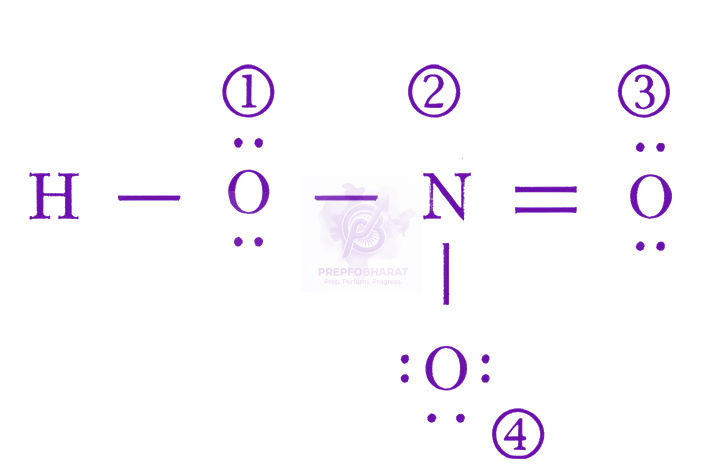
Given below are statements about some molecules/ions. Identify the CORRECT statements. A. The dipole moment value of $\mathrm{NF}_{3}$ is higher than that of $\mathrm{NH}_{3}$. B. The dipole moment value of $\mathrm{BeH}_{2}$ is zero. C. The bond order of $\mathrm{O}_{2}{ }^{2-}$ and $\mathrm{F}_{2}$ is same. D. The formal charge on the central oxygen atom of ozone is -1. E. In $\mathrm{NO}_{2}$, all the three atoms satisfy the octet rule, hence it is very stable. Choose the correct answer from the options given below: