Inorganic Chemistry PYQ — Page 15
JEE Main Chemistry — Inorganic Chemistry previous year questions with solutions.
All Inorganic Chemistry Questions (1476)
Consider the following reaction \(\mathrm{MnO}_2+\mathrm{KOH}+\mathrm{O}_2 \rightarrow \mathrm{A}+\mathrm{H}_2 \mathrm{O}\). Product ' \(\mathrm{A}\) ' in neutral or acidic medium disproportionate to give products ' \(\mathrm{B}\) ' and ' \(\mathrm{C}\) ' along with water. The sum of spin-only magnetic moment values of \(\mathrm{B}\) and \(\mathrm{C}\) is \(\qquad\) BM. (nearest integer) (Given atomic number of \(\mathrm{Mn}\) is 25)
The compound that is white in color is
Match List I with List II \(\begin{array}{|l|l|l|l|} \hline & \text{List - I} & & \text{List - II} \\ & \text{(Precipitating reagent and conditions)} & & \text{(Cation)} \\ \hline \text { A. } & \mathrm{NH}_4 \mathrm{Cl}+\mathrm{NH}_4 \mathrm{OH} / \mathrm{ARKS} & \text { I. } & \mathrm{Mn}^{2+} \\ \hline \text { B. } & \mathrm{NH}_4 \mathrm{OH}+\mathrm{Na}_2 \mathrm{CO}_3 & \text { II. } & \mathrm{Pb}^{2+} \\ \hline \text { C. } & \mathrm{NH}_4 \mathrm{OH}+\mathrm{NH}_4 \mathrm{Cl}+\mathrm{H}_2 \mathrm{~S} \text { gas } & \text { III. } & \mathrm{Al}^{3+} \\ \hline \text { D. } & \text { dilute } \mathrm{HCl} & \text { IV. } & \mathrm{Sr}^{2+} \\ \hline \end{array}\) Choose the correct answer from the options given below:
Match List I with List II \(\begin{array}{|l|l|l|l|} \hline & \text{ List - I } & & \text{List - II} \\ \hline \text { A. } & \mathrm{K}_2\left[\mathrm{Ni}(\mathrm{CN})_4\right] & \text { I. } & \mathrm{sp}^3 \\ \hline \text { B. } & {\left[\mathrm{Ni}(\mathrm{CO})_4\right]} & \text { II. } & \mathrm{sp}^3 \mathrm{~d}^2 \\ \hline \text { C. } & {\left[\mathrm{Co}\left(\mathrm{NH}_3\right)_6\right] \mathrm{Cl}_3} & \text { III. } & \mathrm{dsp}^2 \\ \hline \text { D. } & \mathrm{Na}_3\left[\mathrm{CoF}_6\right] & \text { IV. } & \mathrm{d}^2 \mathrm{sp}^3 \\ \hline \end{array}\) Choose the correct answer from the options given below:
Match List I with List II \(\begin{array}{|l|l|l|l|} \hline & \text{List-I} & & \text{List-II} \\ \hline & \text{(Molecule)} & & \text{(Shape)} \\ \hline \text { A. } & \mathrm{Fe}_4\left[\mathrm{Fe}(\mathrm{CN})_6\right]_3 \cdot \mathrm{xH}_2 \mathrm{O} & \text { I. } & \text { Violet } \\ \hline \text { B. } & {\left[\mathrm{Fe}(\mathrm{CN})_5 \mathrm{NOS}^{4-}\right.} & \text { II. } & \text { Blood Red } A \\ \hline \text { C. } & {[\mathrm{Fe}(\mathrm{SCN})]^{2+}} & \text { III. } & \text { Prussian Blue } \\ \hline \text { D. } & \left(\mathrm{NH}_4\right)_3 \mathrm{PO}_4 \cdot 12 \mathrm{MoO}_3 & \text { IV. } & \text { Yellow } \\ \hline \end{array}\) Choose the correct answer from the options given below:
Given below are two statements : one is labelled as Assertion (A) and the other is labelled as Reason (R). Assertion (A) : Both rhombic and monoclinic sulphur exist as \(\mathrm{S}_8\) while oxygen exists as \(\mathrm{O}_2\). Reason (R) : Oxygen forms \(\mathrm{p} \pi-\mathrm{p} \pi\) multiple bonds with itself and other elements having small size and high electronegativity like \(\mathrm{C}, \mathrm{N}\), which is not possible for sulphur. In the light of the above statements, choose the most appropriate answer from the options given below :
The total number of molecular orbitals formed from $2s$ and $2p$ atomic orbitals of a diatomic molecule
Match List I with List II \(\begin{array}{|l|l|c|l|} \hline & \text{ List - I } & & \text{List - II} \\ \hline \text { A. } & \text { Melting Point }[\mathrm{K}] & \text { I. } & \mathrm{T} 1>\mathrm{In}>\mathrm{Ga}>\mathrm{A} 1>\mathrm{B} \\ \hline \text { B. } & \text { Ionic Radius }\left[\mathrm{M}^{+3} / \mathrm{pm}\right] & \text { II. } & \mathrm{B}>\mathrm{T} 1>\mathrm{A} 1 \approx \mathrm{Ga}>\mathrm{In} \\ \hline \text { C. } & \Delta_{\mathrm{i}} \mathrm{H}_1\left[\mathrm{~kJ} \mathrm{~mol}^{-1}\right] & \text { III. } & \mathrm{T} 1>\mathrm{In}>\mathrm{A} 1>\mathrm{Ga}>\mathrm{B} \\ \hline \text { D. } & \text { Atomic Radius }[\mathrm{pm}] & \text { IV. } & \mathrm{B}>\mathrm{A} 1>\mathrm{T} 1>\mathrm{In}>\mathrm{Ga} \\ \hline \end{array}\) Choose the correct answer from the options given below:
When \(\mathrm{MnO}_2\) and \(\mathrm{H}_2 \mathrm{SO}_4\) is added to a salt (A), the greenish yellow gas liberated as salt (A) is :
Give below are two statements: Statement I : The higher oxidation states are more stable down the group among transition elements unlike p-block elements. Statement II : Copper can not liberate hydrogen from weak acids. In the light of the above statements, choose the correct answer from the options given below :
Given below are two statements: Statement I: \(\mathrm{N}\left(\mathrm{CH}_3\right)_3\) and \(\mathrm{P}\left(\mathrm{CH}_3\right)_3\) can act as ligands to form transition metal complexes. Statement II: As N and P are from same group, the nature of bonding of \(\mathrm{N}\left(\mathrm{CH}_3\right)_3\) and \(\mathrm{P}\left(\mathrm{CH}_3\right)_3\) is always same with transition metals. In the light of the above statements, choose the most appropriate answer from the options given below:
Molar mass of the salt from $\mathrm{NaBr},{\mathrm{NaNO}}_{3},\mathrm{KI}$ and ${\mathrm{CaF}}_{2}$ which does not evolve coloured vapours on heating with concentrated ${H}_{2}{\mathrm{SO}}_{4}$ is ____ $g{\mathrm{mol}}^{–1}$, (Molar mass in $g{\mathrm{mol}}^{–1}:\mathrm{Na}:23,N:14,K:39,O:16,\mathrm{Br}:80,I:127,F:19,\mathrm{Ca}:40$)
Number of complexes from the following with even number of unpaired " \(\mathrm{d}\) " electrons is \(\qquad\) \(\left[\mathrm{V}\left(\mathrm{H}_2 \mathrm{O}\right)_6\right]^{3+},\left[\mathrm{Cr}\left(\mathrm{H}_2 \mathrm{O}\right)_6\right]^{2+},\left[\mathrm{Fe}\left(\mathrm{H}_2 \mathrm{O}\right)_6\right]^{3+},\left[\mathrm{Ni}\left(\mathrm{H}_2 \mathrm{O}\right)_6\right]^{3+},\left[\mathrm{Cu}\left(\mathrm{H}_2 \mathrm{O}\right)_6\right]^{2+}\) [Given atomic numbers : \(\mathrm{V}=23, \mathrm{Cr}=24, \mathrm{Fe}=26, \mathrm{Ni}=28 \mathrm{Cu}=29\)]
In the reaction of potassium dichromate, potassium chloride and sulfuric acid (conc.), the oxidation state of the chromium in the product is $(+)$ _______.
\(0.05 \mathrm{M} \mathrm{CuSO}_4\) when treated with \(0.01 \mathrm{M} \mathrm{K}_2 \mathrm{Cr}_2 \mathrm{O}_7\) gives green colour solution of \(\mathrm{Cu}_2 \mathrm{Cr}_2 \mathrm{O}_7\). The two solutions are separated as shown below : [SPM : Semi Permeable Membrane] 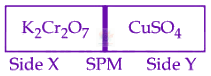 Due to osmosis :
The 'Spin only’ Magnetic moment for $[\mathrm{Ni}({\mathrm{NH}}_{3}{)}_{6}]{}^{2+}$ is______$\times {10}^{–1}$ BM. (given = Atomic number of $\mathrm{Ni}:28$) Round off your answer to the nearest integer.
The electron affinity value are negative for A. \(\mathrm{Be} \rightarrow \mathrm{Be}^{-}\) B. \(\mathrm{N} \rightarrow \mathrm{N}^{-}\) C. \(\mathrm{O} \rightarrow \mathrm{O}^{2-}\) D. \(\mathrm{Na} \rightarrow \mathrm{Na}^{-}\) E. \(\mathrm{Al} \rightarrow \mathrm{Al}^{-}\) Choose the most appropriate answer from the options given below :
Number of complexes which show optical isomerism among the following is _________. $cis-{[\mathrm{Cr}(\mathrm{ox}{)}_{2}{\mathrm{Cl}}_{2}]}^{3-},{[\mathrm{Co}(\mathrm{en}{)}_{3}]}^{3+}$$\text{, cis }-{[\mathrm{Pt}(\mathrm{en}{)}_{2}{\mathrm{Cl}}_{2}]}^{2+}\text{, cis }-{[\mathrm{Co}(\mathrm{en}{)}_{2}{\mathrm{Cl}}_{2}]}^{+}$ $,trans-{[\mathrm{Pt}(\mathrm{en}{)}_{2}{\mathrm{Cl}}_{2}]}^{2+},\text{ trans }-{[\mathrm{Cr}(\mathrm{ox}{)}_{2}{\mathrm{Cl}}_{2}]}^{3-}$
Given below are two statements : Statement I : In group 13, the stability of +1 oxidation state increases down the group. Statement II : The atomic size of gallium is greater than that of aluminium. In the light of the above statements, choose the most appropriate answer from the options given below :
Choose the polar molecule from the following :
The Lassiagne's extract is boiled with dil ${\mathrm{HNO}}_{3}$ before testing for halogens because,
Given below are the two statements: one is labeled as Assertion (A) and the other is labeled as Reason (R). Assertion (A): There is a considerable increase in covalent radius from $N$ to $P$. However from $As$ to $Bi$ only a small increase in covalent radius is observed. Reason (R): covalent and ionic radii in a particular oxidation state increases down the group. In the light of the above statement, choose the most appropriate answer from the options given below:
Given below are two statements: Statement-I: The gas liberated on warming a salt with dil ${H}_{2}{\mathrm{SO}}_{4}$, turns a piece of paper dipped in lead acetate into black, it is a confirmatory test for sulphide ion. Statement-II: In statement-I the colour of paper turns black because of formation of lead sulphite. In the light of the above statements, choose the most appropriate answer from the options given below:
The correct order of the first ionization enthalpy is