Inorganic Chemistry PYQ — Page 16
JEE Main Chemistry — Inorganic Chemistry previous year questions with solutions.
All Inorganic Chemistry Questions (1476)
Number of compounds with one lone pair of electrons on central atom amongst following is _ ${O}_{3},{H}_{2}O,{\mathrm{SF}}_{4},{\mathrm{ClF}}_{3},{\mathrm{NH}}_{3},{\mathrm{BrF}}_{5},{\mathrm{XeF}}_{4}$
The number of ions from the following that have the ability to liberate hydrogen from a dilute acid is _____. \(\mathrm{Ti}^{2+}, \mathrm{Cr}^{2+}\) and \(\mathrm{V}^{2+}\)
The spin-only magnetic moment value of the ion among \(\mathrm{Ti}^{2+}, \mathrm{V}^{2+}, \mathrm{Co}^{3+}\) and \(\mathrm{Cr}^{2+}\), that acts as strong oxidising agent in aqueous solution is _______ BM (Near integer). (Given atomic numbers : \(\mathrm{Ti}: 22, \mathrm{~V}: 23, \mathrm{Cr}: 24, \mathrm{Co}: 27\))
Which of the following statements are correct about $\mathrm{Zn},\mathrm{Cd}$ and $\mathrm{Hg}$ ? A. They exhibit high enthalpy of atomization as the d-subshell is full. B. $\mathrm{Zn}$ and $\mathrm{Cd}$ do not show variable oxidation state while $\mathrm{Hg}$ shows $+I$ and $+\mathrm{II}$. C. Compounds of $\mathrm{Zn},\mathrm{Cd}$ and $\mathrm{Hg}$ are paramagnetic in nature. D. $\mathrm{Zn},\mathrm{Cd}$ and $\mathrm{Hg}$ are called soft metals. Choose the most appropriate from the options given below:
Match List - I with List - II. \(\begin{array}{lll} \begin{array}{l} \text { List - I } \\ \text { (Complex ion) } \end{array} & \begin{array}{l} \text { List - II } \\ \text { (Spin only magnetic moment in B.M.) } \end{array} \\ \text { (A) }\left[\mathrm{Cr}\left(\mathrm{NH}_3\right)_6\right]^{3+} & \text { (I) } 4.90 \\ \text { (B) }\left[\mathrm{NiCl}_4\right]^{2-} & \text { (II) } 3.87 \\ \text { (C) }\left[\mathrm{CoF}_6\right]^{3-} & \text { (III) } 0.0 \\ \text { (D) }\left[\mathrm{Ni}(\mathrm{CN})_4\right]^{2-} & \text { (IV) } 2.83 \end{array}\) Choose the correct answer from the options given below :
Number of molecules/species from the following having one unpaired electron is \(\qquad\) \(\mathrm{O}_2, \mathrm{O}_2^{-1}, \mathrm{NO}, \mathrm{CN}^{-1}, \mathrm{O}_2^{2-}\)
Given below are two statements : one is labelled as Assertion (A) and the other is labelled as Reason (R). Assertion (A) : \(\mathrm{NH}_3\) and \(\mathrm{NF}_3\) molecule have pyramidal shape with a lone pair of electrons on nitrogen atom. The resultant dipole moment of \(\mathrm{NH}_3\) is greater than that of \(\mathrm{NF}_3\). Reason (R) : In \(\mathrm{NH}_3\), the orbital dipole due to lone pair is in the same direction as the resultant dipole moment of the \(\mathrm{N}-\mathrm{H}\) bonds. \(\mathrm{F}\) is the most electronegative element. In the light of the above statements, choose the correct answer from the options given below :
From the given list, the number of compounds with $+4$oxidation state of Sulphur ${\mathrm{SO}}_{3},{H}_{2}{\mathrm{SO}}_{3},{\mathrm{SOCl}}_{2},{\mathrm{SF}}_{4},{\mathrm{BaSO}}_{4},{H}_{2}{S}_{2}{O}_{7}$
Match List I with List II \(\begin{array}{|l|l|l|l|} \hline & \text{List-I} & & \text{List-II} \\ \hline & \text{(Name of the test)} & & \text{(Reaction sequence involved) [M is metal]} \\ \hline \text { A. } & \text { Borax bead test } & \text { I. } & \mathrm{MCO}_3 \rightarrow \mathrm{MO} \xrightarrow{\mathrm{Co}\left(\mathrm{NO}_3\right)_2} \mathrm{CoO} \cdot \mathrm{MO} \\ \hline \text { B. } & \begin{array}{l} \text { Charcoal } \\ \text { cavity test } \end{array} & \text { II. } & \mathrm{MCO}_3 \rightarrow \mathrm{MCl}_2 \rightarrow \mathrm{M}^{2+} \\ \hline \text { C } & \begin{array}{l} \text { Cobalt nitrate } \\ \text { test } \end{array} & \text { III } & \mathrm{MSO}_4 \xrightarrow[\Delta]{\mathrm{Na}_2 \mathrm{~B}_4 \mathrm{O}_7} \mathrm{M}\left(\mathrm{BO}_2\right)_2 \rightarrow \mathrm{MBO}_2 \rightarrow \mathrm{M} \\ \hline \text { D. } & \text { Flame test } & \text { IV } & \mathrm{MSO}_4 \xrightarrow[\Delta]{\mathrm{Na}_2 \mathrm{CO}_3} \mathrm{MCO}_3 \rightarrow \mathrm{MO} \rightarrow \mathrm{M} \\ \hline \end{array}\) Choose the correct answer from the options given below:
Diamagnetic Lanthanoid ions are:
lectronic configuration of \(\mathrm{Cu}(\mathrm{II})\) is \(3 \mathrm{~d}^9\) whereas that of \(\mathrm{Cu}(\mathrm{I})\) is \(3 \mathrm{~d}^{10}\). Which of the following is correct?
Given below are two statements : Statement (I) : The oxidation state of an element in a particular compound is the charge acquired by its atom on the basis of electron gain enthalpy consideration from other atoms in the molecule. Statement (II) : \(\mathrm{p} \pi-\mathrm{p} \pi\) bond formation is more prevalent in second period elements over other periods. In the light of the above statements, choose the most appropriate answer from the options given below :
Which of the following compounds show colour due to $d-d$ transition?
he following complexes \(\underset{\large \text{(A)}}{\left[\mathrm{CoCl}\left(\mathrm{NH}_3\right)_5\right]^{2+}},\underset{\large \text{(B)}}{\left[\mathrm{Co}(\mathrm{CN})_6\right]^{3-}},\underset{\large \text{(C)}}{\left[\mathrm{Co}\left(\mathrm{NH}_3\right)_5\left(\mathrm{H}_2 \mathrm{O}\right)\right]^{3+}},\underset{\large \text{(D)}}{\left[\mathrm{Cu}\left(\mathrm{H}_2 \mathrm{O}\right)_4\right]^{2+}}\) The correct order of A, B, C and D in terms of wavenumber of light absorbed is :
Select the option with correct property:
Aluminium chloride in acidified aqueous solution forms an ion having geometry
The correct order of ligands arranged in increasing field strength.
Consider the following elements. 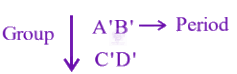 Which of the following is/are true about ${A}^{'},{B}^{'},{C}^{'}$ and ${D}^{'}$ ? A. Order of atomic radii: ${B}^{'}<{A}^{'}<{D}^{'}<{C}^{'}$ B. Order of metallic character : ${B}^{'}<{A}^{'}<{D}^{'}<{C}^{'}$ C. Size of the element : ${D}^{'}<{C}^{'}<{B}^{'}<{A}^{'}$ D. Order of ionic radii : ${{B}^{'}}^{+}<{{A}^{'}}^{+}<{{D}^{'}}^{+}<{{C}^{'}}^{+}$ Choose the correct answer from the options given below:
The shape of carbocation is :
Choose the correct Statements from the following: (A) $\mathrm{Ethane}-1,2-\mathrm{diamine}$ is a chelating ligand. (B) Metallic aluminium is produced by electrolysis of aluminium oxide in presence of cryolite. (C) Cyanide ion is used as ligand for leaching of silver. (D) Phosphine act as a ligand in Wilkinson catalyst. (E) The stability constants of ${\mathrm{Ca}}^{2+}$ and ${\mathrm{Mg}}^{2+}$ are similar with EDTA complexes. Choose the correct answer from the options given below:
The total number of molccules with zero dipole moment among ${\mathrm{CH}}_{4},{\mathrm{BF}}_{3},{H}_{2}O,\mathrm{HF},{\mathrm{NH}}_{3},{\mathrm{CO}}_{2}$ and ${\mathrm{SO}}_{2}$ is ______.
During the detection of acidic radical present in a salt, a student gets a pale yellow precipitate soluble with difficulty in \(\mathrm{NH}_4 \mathrm{OH}\) solution when sodium carbonate extract was first acidified with dil. \(\mathrm{HNO}_3\) and then \(\mathrm{AgNO}_3\) solution was added. This indicates presence of :
Match List - I with List - II. \(\begin{array}{ll} \text{List - I} & \text{List - II} \\ \text{Reaction} & \text{Type of redox reaction} \\ \text{(A) } \mathrm{Li} & \text{(I) } 589.2 \\ \text{(B) } \mathrm{Na} & \text{(II) } 455.5 \\ \text{(C) } \mathrm{Rb} & \text{(III) } 670.8 \\ \text{(D) } \mathrm{Cs} & \text{(IV) } 780.0 \\ \end{array}\) Choose the correct answer from the options given below :
In the precipitation of the iron group (III) in qualitative analysis, ammonium chloride is added before adding ammonium hydroxide to :