Correct Option :
3) Reproductive cloning of animals
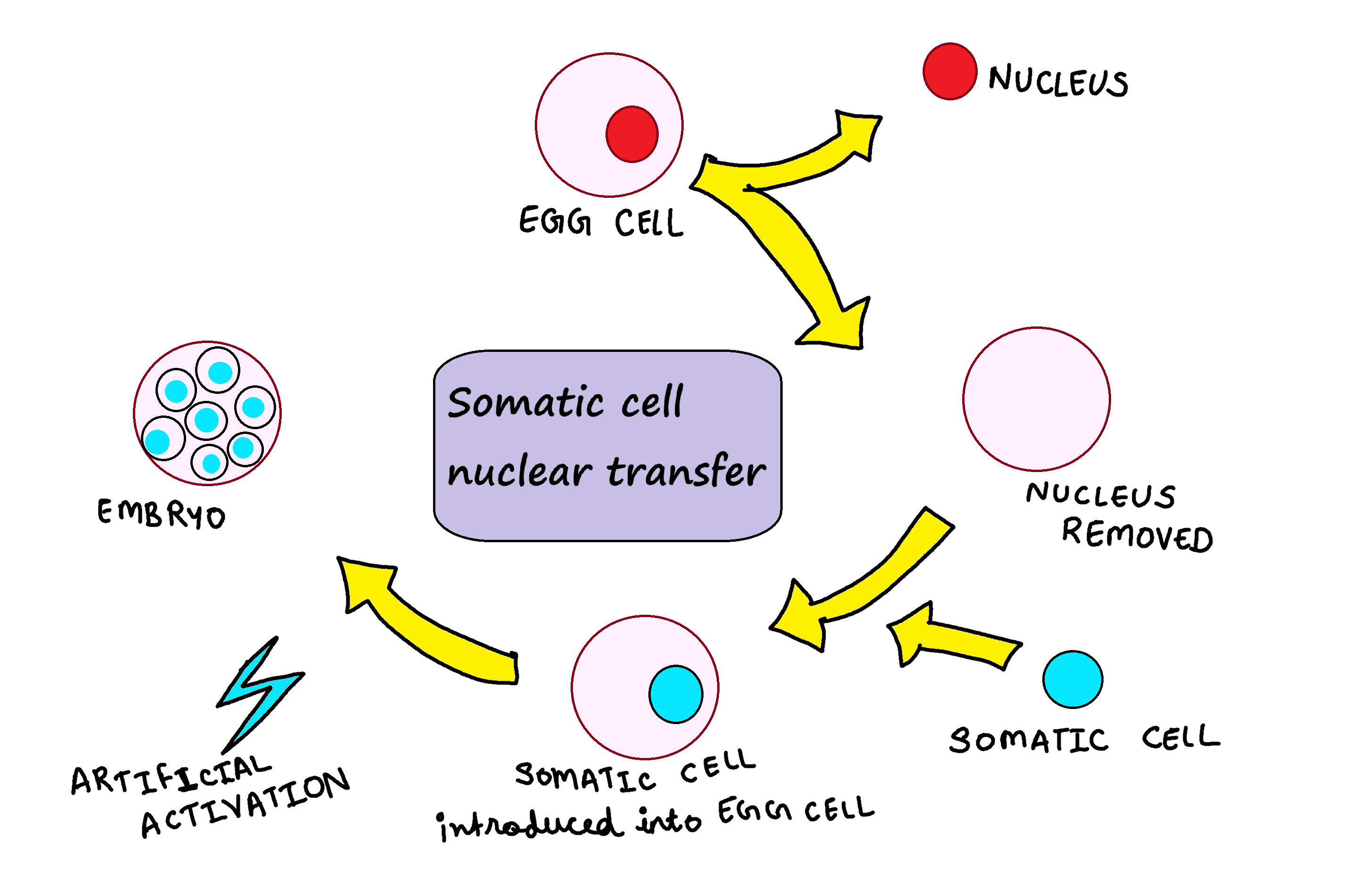
Somatic Cell Nuclear Transfer (SCNT) is a laboratory technique for creating an ovum with a donor nucleus. This process involves removing the nucleus from a somatic cell (a body cell other than a sperm or egg cell) and transferring it into an enucleated egg cell (an egg cell from which the nucleus has been removed). The reconstructed egg is then stimulated to develop into an embryo. If this embryo is implanted into a surrogate mother and brought to term, it results in a genetically identical copy of the donor organism, a process known as reproductive cloning.
Incorrect Options:
1) Production of biolarvicides
Biolarvicides are biological agents, often bacteria or their toxins (e.g., Bacillus thuringiensis israelensis), used to control insect larvae. Their production does not involve Somatic Cell Nuclear Transfer (SCNT).
2) Manufacture of biodegradable plastics
Biodegradable plastics are polymers that can be decomposed by microorganisms. Their manufacture typically involves chemical synthesis or biotechnological processes utilizing microorganisms, not SCNT.
4) Production of organisms free of diseases
While SCNT can be used in therapeutic cloning for disease research or potentially to generate disease-resistant organisms through genetic modification, its direct application is not the general production of disease-free organisms. Techniques like embryo transfer or specific genetic engineering methods are more directly associated with producing disease-free offspring or modifying disease susceptibility.