CUET UG Mathematics — Algebra previous year questions with solutions.
The feasible region for a LPP is shown in the given figure. The maximum value of $z = 2x + 5y$ is :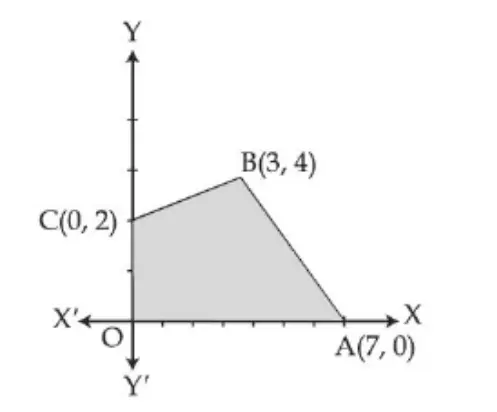
If order of matrix A is $m \times p$ and order of matrix B is $p \times n$, then what is the order of matrix AB ?
Let $A = [a_{ij}]$ be a $2 \times 2$ matrix such that $a_{ij} = \frac{|-3i+j|}{2}$ then $a_{21}$ is :
The value of the determinant $\begin{vmatrix} a\cos\theta & b\sin\theta & 0 \\ -b\sin\theta & a\cos\theta & 0 \\ 0 & 0 & c \end{vmatrix}$ is :
If $A = \begin{bmatrix} 1 & 2 \\ 4 & 2 \end{bmatrix}$, then the value of K for which $|2A| = K|A|$ is :
The inverse of the matrix $A = \begin{bmatrix} 2 & 3 \\ 1 & 2 \end{bmatrix}$ is:
If $A = \begin{bmatrix} 3 & 1 \\ -1 & 2 \end{bmatrix}$, then $A^2 - 5A + 7I =$
If $P = \begin{bmatrix} 1 & x & 3 \\ 1 & 3 & 3 \\ 2 & 4 & 4 \end{bmatrix}$ is the adjoint of 3x3 matrix A and $|A|$ is 4, then $x$ is equal to :
Match List - I with List - II. If $A = \begin{vmatrix} 3 & -2 & 3 \\ 2 & 1 & -1 \\ 4 & -3 & 2 \end{vmatrix}$ | List - I | List - II | |----------|-----------| | (A) $M_{23}$ | (I) $-17$ | | (B) $A_{32} + a_{13}$ | (II) $-1$ | | (C) A | (III) 0 | | (D) $a_{13}A_{12} + a_{23}A_{22} + a_{33}A_{32}$ | (IV) 12 | Choose the correct answer from the options given below :
The matrix $\begin{bmatrix} 2 & 0 & 0 \\ 0 & 1 & 0 \\ 0 & 0 & 1 \end{bmatrix}$ is a
The set of values of K for which the system of equations $\begin{bmatrix} 2 & 3 & 1 \\ 4 & 5 & 0 \\ 1 & K & 3 \end{bmatrix} \begin{bmatrix} x \\ y \\ z \end{bmatrix} = \begin{bmatrix} 5 \\ 6 \\ 7 \end{bmatrix}$ gives a unique solution is :
If corner points of a feasible region are (0, 0), (2, 0), $\left(\frac{20}{19}, \frac{45}{19}\right)$ and (0, 3), then (A) Maximum value of $z = 5x + 3y$ is 10 (B) Minimum value of $z = 5x + 3y$ is 0 (C) Maximum value of $z = 5x + 3y$ is $\frac{235}{19}$ and minimum value is 0 (D) Maximum value of $z = 5x + 3y$ is 10 and minimum value is 0 Choose the correct answer from the options given below :
Let $\begin{vmatrix} 3x & -7 \\ 1 & 4 \end{vmatrix} = \begin{vmatrix} 3 & 2 \\ 4 & x \end{vmatrix}$, then value of $x$ is :
### Match List–I with List–II 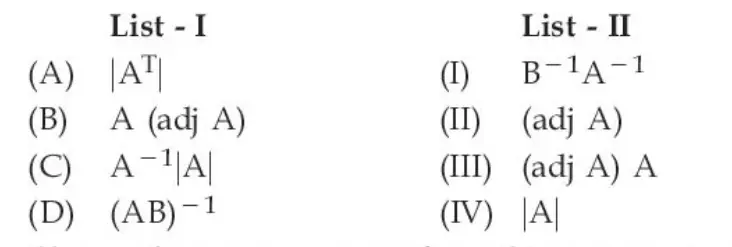 Choose the correct answer from the options given below
Let the vectors $\vec{a} = \hat{i} - 3\hat{j} + 2\hat{k}, \vec{b} = 2\hat{i} + \hat{j} - \hat{k}$ and $\vec{c} = 3\hat{i} + 5\hat{j} - 2\lambda\hat{k}$ be coplanar. Then $\lambda$ is equal to
If $\begin{vmatrix} 2 & 3-x \\ x & 1 \end{vmatrix} = 0$, then the values of $x$ are:
Let $\vec{a}$ and $\vec{b}$ be two unit vectors. If the vectors $\vec{c} = 5\vec{a} - 4\vec{b}$ and $\vec{d} = \vec{a} + 2\vec{b}$ are perpendicular to each other, then the angle between $\vec{a}$ and $\vec{b}$ is :
If $A = \begin{pmatrix} \cos 2\theta & \sin 2\theta \\ -\sin 2\theta & \cos 2\theta \end{pmatrix}$, then $A^2 =$
If a, b and c are all different from zero and $\begin{vmatrix} 1+a & 1 & 1 \\ 1 & 1+b & 1 \\ 1 & 1 & 1+c \end{vmatrix} = 0$, then the value of $\frac{1}{a} + \frac{1}{b} + \frac{1}{c}$ is :
If the matrix $A = \begin{bmatrix} x & -2 & -5y \\ 2 & 0 & -9 \\ 10 & 3z & 0 \end{bmatrix}$ is skew-symmetric, then the value of $(2x - 3y + 4z)$ is :
If $x, y$ & $z$ are non zero real numbers, the inverse of matrix $A = \begin{bmatrix} x & 0 & 0 \\ 0 & y & 0 \\ 0 & 0 & z \end{bmatrix}$ is :
The value of the determinant $\Delta = \begin{vmatrix} 1! & 2! & 3! \\ 2! & 3! & 4! \\ 3! & 4! & 5! \end{vmatrix}$ is :
If the matrix $A = \begin{bmatrix} 0 & x+y & 1 \\ 3 & z & 2 \\ x-y & -2 & 0 \end{bmatrix}$ is skew-symmetric, then :
If $\begin{vmatrix} 2x & 2 \\ 4 & x \end{vmatrix} = 10$, then $x$ is: