CUET UG Mathematics — Algebra previous year questions with solutions.
If the function $f: \mathbb{N} \rightarrow \mathbb{N}$ is defined as $f(n)=\left\{\begin{array}{ll}n-1, & \text { if } n \text { is even } \\ n+1, & \text { if } n \text { is odd }\end{array}\right.$, then (A) f is injective (B) f is into (C) f is surjective (D) f is invertible
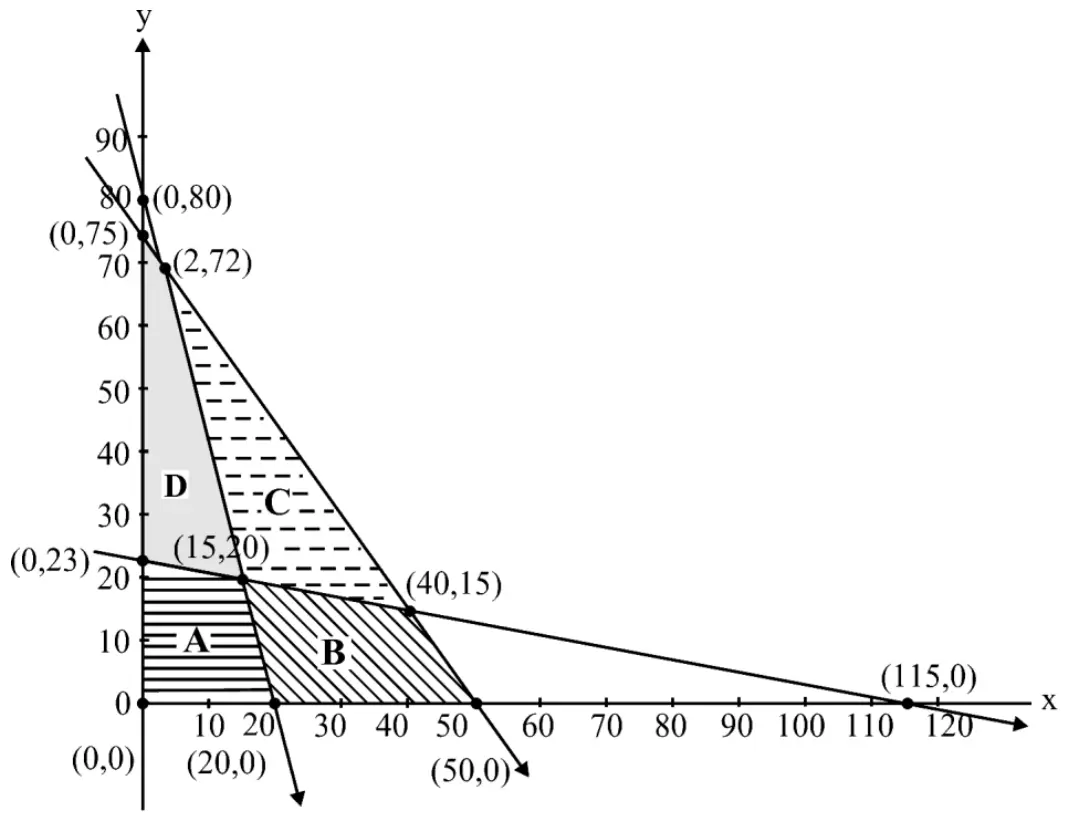 The feasible region represented by the constraints $4 x+y \geq 80, x+5 y \geq 115,3 x+2 y \leq 150, x, y \geq 0$ of an LPP is
The matrix $\left[\begin{array}{lll}1 & 0 & 0 \\ 0 & 1 & 0 \\ 0 & 0 & 1\end{array}\right]$ is a : (A) scalar matrix (B) diagonal matrix (C) skew-symmetric matix (D) symmetric matrix Choose the correct answer from the options given below :
$\Delta=\left|\begin{array}{ccc}1 & \cos x & 1 \\ -\cos x & 1 & \cos x \\ -1 & -\cos x & 1\end{array}\right|$ (A) $\Delta=2\left(1-\cos ^{2} x\right)$ (B) $\Delta=2\left(2-\sin ^{2} x\right)$ (C) Minimum value of $\Delta$ is $2$ (D) Maximum value of $\Delta$ is $4$ Choose the correct answer from the options given below :
Let $X$ denote the number of hours you play during a randomly selected day. The probability that $X$ can take values $x$ has the following form, where $c$ is some constant. $\mathrm{P}(\mathrm{X}=\mathrm{x})=\left\{\begin{array}{lll} 0.1, & \text { if } \mathrm{x}=0 \\ \mathrm{cx}, & \text { if } \mathrm{x}=1 \text { or } \mathrm{x}=2 \\ \mathrm{c}(5-\mathrm{x}), & \text { if } \mathrm{x}=3 \text { or } \mathrm{x}=4 \\ 0, & \text { otherwise } \end{array}\right.$ Match List-I with List-II : | List-I | List-II | | --- | --- | | (A) $ c $ | (I) 0.75 | | (B) $ P(X \leq 2) $ | (II) 0.3 | | (C) $ P(X = 2) $ | (III) 0.55 | | (D) $ P(X \geq 2) $ | (IV) 0.15 |
There are two bags. Bag-1 contains $4$ white and $6$ black balls and Bag-2 contains $5$ white and $5$ black balls. A die is rolled, if it shows a number divisible by 3, a ball is drawn from Bag-1, else a ball is drawn from Bag-2. If the ball drawn is not black in colour, the probability that it was not drawn from Bag-2 is :
Which of the following cannot be the direction ratios of the straight line $\frac{x-3}{2}=\frac{2-y}{3}=\frac{z+4}{-1}$ ?
Which one of the following represents the correct feasible region determined by the following constraints of an LPP? $x+y \geq 10,2 x+2 y \leq 25, x \geq 0, y \geq 0$
The probability of not getting $53$ Tuesdays in a leap year is :
The angle between two lines whose direction ratios are propotional to $1,1,-2$ and $(\sqrt{3}-1),(-\sqrt{3}-1),-4$ is :
If $(\vec{a}-\vec{b}) \cdot(\vec{a}+\vec{b})=27$ and $|\vec{a}|=2|\vec{b}|$, then $|\vec{b}|$ is :
The unit vector perpendicular to each of the vectors $\vec{a}+\vec{b}$ and $\vec{a}-\vec{b}$, where $\vec{a}=\hat{i}+\hat{j}+\hat{k}$ and $\vec{b}=\hat{i}+2 \hat{j}+3 \hat{k}$, is :
A coin is tossed K times. If the probability of getting $3$ heads is equal to the probability of getting $7$ heads, then the probability of getting $8$ tails is :
If $A, B$ and $C$ are three singular matrices given by $A=\left[\begin{array}{ll}1 & 4 \\ 3 & 2 a\end{array}\right], B=\left[\begin{array}{ll}3 b & 5 \\ a & 2\end{array}\right]$ and $C=\left[\begin{array}{cc}a+b+c & c+1 \\ a+c & c\end{array}\right]$, then the value of $a b c$ is :
An objective function $Z=a x+b y$ is maximum at points $(8,2)$ and $(4,6)$. If $a \geq 0$ and $b \geq 0$ and $a b=25$, then the maximum value of the function is equal to :
If the random variable $ X $ has the following distribution: | $X$ | 0 | 1 | 2 | otherwise | | --- | --- | --- | --- | --- | | $P(X)$ | $ k $ | $ 2k $ | $ 3k $ | $ 0 $ | Match List-I with List-II: | List-I | List-II | | --- | --- | | (A) $ k $ | (I) $ \frac{5}{6} $ | | (B) $ P(X < 2) $ | (II) $ \frac{4}{3} $ | | (C) $ E(X) $ | (III) $ \frac{1}{2} $ | | (D) $ P(1 \leq X \leq 2) $ | (IV) $ \frac{1}{6} $ |
If $A = \begin{bmatrix} \cos\theta & \sin\theta & 0 \\ -\sin\theta & \cos\theta & 0 \\ 0 & 0 & 1 \end{bmatrix}$ and B is a square matrix of order 3, then |AB| is equal to:
Two cards are drawn simultaneously from a well shuffled pack of 52 cards. Then variance of the number of kings is
In a meeting, 70% of the members favour and 30% oppose a certain proposal. A member is selected at random and we take X = 0 if he opposed, and X = 1 if he is in favour. Then, E (X) is :
In a LPP, let R be the feasible region. A. If R is unbounded then a max./min. value of objective function may not exist. B. If R is bounded then a max. and min. value of objective function will always exist. C. If a solution exists, it must occur at a corner point. D. If R is bounded then max. will exist but min. may or may not exist for an objective function. Choose the correct answer from the options given below:
If A is a square matrix of order 3, then |adj A| is equal to:
Let R be a relation on the set of natural numbers N defined by nRm if n divides m. Then R is : (A) Reflexive Relation (B) Symmetric Relation (C) Transitive Relation (D) Identity Relation Choose the **correct** answer from the options given below :
The region represented by the system of inequalities $x, y \geq 0$ ; $2x + 3y \geq 4$ ; $x \geq 1$ is :
The number of ways to arrange the letters of the word "COMMITTEE" is: