Algebra PYQ — Page 35
CUET UG Mathematics — Algebra previous year questions with solutions.
All Algebra Questions (1106)
Let $A = [a_{ij}]$ be a $2 \times 2$ matrix such that $a_{ij} = \frac{|-3i+j|}{2}$ then $a_{21}$ is :
All points lying inside the triangle formed by the points (5, 0), (-1, 2) and (1, 3) satisfy : (A) $3x + 2y - 18 > 0$ (B) $3x + 2y > 0$ (C) $2x + y + 13 < 0$ (D) $2x - 3y - 12 < 0$ (E) $2x - 3y + 12 > 0$ Choose the **correct** answer from the options given below :
Let A be a square matrix of order 3 then |3A| is equal to
In a Linear Programming problem, the objective function is always :
The black and red die are rolled. The conditional probability of obtaining a sum greater than 9 given that the black die resulted in a 5 is :
If a fair coin is tossed 10 times, then the probability of obtaining at least one head is :
Relation R on Real Numbers is defined as $R = \{(a, b) : a \leq b\}$. The relation is :
The inverse of the function $f : R \to R$ given by $f(x) = 2x + 7$ is :
The position vector of a point R which divides the line joining two points P and Q whose position vectors are $\hat{i} + 2\hat{j} - \hat{k}$ and $-\hat{i} + \hat{j} + \hat{k}$ respectively in the ratio 2 : 1 externally is :
The random variable X has a probability distribution P(X) of the following form, where k is some number. $P(X=x) = \begin{cases} k, & \text{if } x=0 \\ 2k, & \text{if } x=1 \\ 3k, & \text{if } x=2 \\ 0, & \text{otherwise} \end{cases}$ Then $P(x \leq 2)$ is :
The matrix $A = \begin{bmatrix} 0 & 1 & -3 \\ -1 & 0 & 0 \\ 3 & 0 & 0 \end{bmatrix}$ is a
The linear constraints, for which the shaded area in the figure is the feasible region of an LPP, are :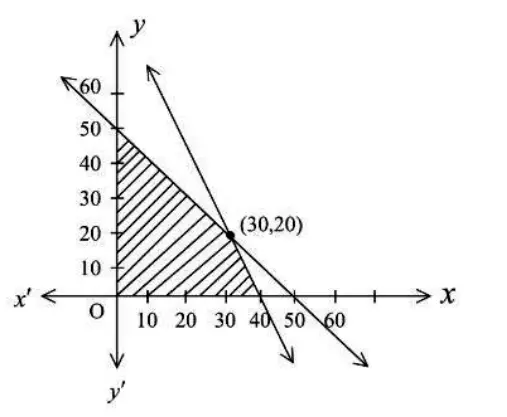
Let A = {1,2,3}. Consider the relation R = {(1,1),(2,2),(3,3),(1,2),(2,3),(1,3)}. Then R is
Match List I with List II | LIST I | LIST II | |---|---| | A. The area of parallelogram determined by vectors $2\hat{i}$ and $3\hat{j}$ | I. 2 | | B. The value of $(\hat{i} \times \hat{j}) \cdot \hat{k} + (\hat{j} \times \hat{k}) \cdot \hat{i}$ | II. 4 | | C. The value of a for which the vectors $2\hat{i} - 3\hat{j} + 4\hat{k}$ and $a\hat{i} - 6\hat{j} + 8\hat{k}$ are collinear. | III. 0 | | D. The value of $\lambda$ for which the vectors $2\hat{i} + \hat{j} + \hat{k}$ and $2\hat{i} - 4\hat{j} + \lambda\hat{k}$ are perpendicular | IV. 6 | Choose the correct answer from the options given below:
If three points $A(a_1, b_1), B(a_2, b_2)$ and $C(a_3, b_3)$ are collinear and $D = \begin{vmatrix} a_1 & b_1 & 1 \\ a_2 & b_2 & 1 \\ a_3 & b_3 & 1 \end{vmatrix}$, then:
Which of the following statements is NOT CORRECT.
The corner points of the feasible region determined by the system of linear constraints are (0, 0), (0, 40), (20, 40), (60, 20), (60, 0). The objective function is $z = 4x + 3y$. Compare the quantity in Column - A and Column - B. | Column - A | Column - B | |---|---| | Maximum value of z | 350 |
In a box containing 100 bulbs, 10 are defective. Then the probability, that out of a sample of 5 bulbs none is defective, is:
Two dice are thrown simultaneously. If X denotes the number of sixes, then the variance of X is:
The range of the function $f(x) = \frac{1}{3 - \sin 4x}$ is:
If $A = \begin{bmatrix} -2 & 6 \\ -5 & -1 \end{bmatrix}$ then $A^{-1}$ is :
If A is a square matrix of order 3 such that $|A|=2$, then the value of $|adj(adj A)|$ is :
Owner of a whole sale computers shop plans to sell 2 types of computers. A desktop and portable model. If $x$ is the number of desktops and $y$ is the number of portable model and the shop's capacity cannot exceed 250 units. Which of the following is correct ?
If $A = \begin{bmatrix} 1 & 2 \\ 4 & 2 \end{bmatrix}$, then the value of K for which $|2A| = K|A|$ is :