CUET UG Mathematics — Algebra previous year questions with solutions.
Let $A = \begin{bmatrix} \cos\theta & -\sin\theta \\ \sin\theta & \cos\theta \end{bmatrix}$, then $(A^{-1})^T$ equals
If $\vec{a}$ is a unit vector and $(\vec{x} - \vec{a}) \cdot (\vec{x} + \vec{a}) = 15$, then the value of $|\vec{x}|$ is:
'A' speaks the truth in 80% of the cases while 'B' in 90% of the cases. The probability that they contradict each other in stating the same statement is
A person can sell a maximum of 20 units of shirts and pants on which a profit of ₹40 is made on each shirt and a profit of ₹30 on each pant. A minimum of 2 shirts are being sold, while pants are sold at least 4 times as many as shirts. Then the maximum profit is:
Which one of the following set of constraints represents the shaded region given below? 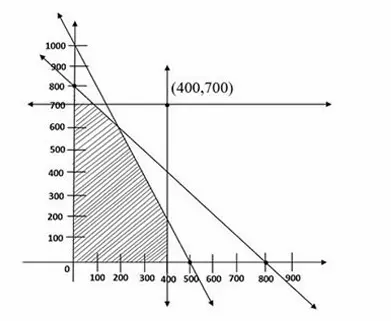
Match List-I with List-II Let $A$ and $B$ be two events such that $P(A) = 0.2$, $P(B) = 0.4$, $P(B|A) = 0.5$ | List-I | List-II | | --- | --- | | (A) $P(A \cap B)$ | (I) $0.5$ | | (B) $P(A\vert B)$ | (II) $0.8$ | | (C) $P(A \cup B)$ | (III) $0.25$ | | (D) $P(A')$ | (IV) $0.1$ | Choose the correct answer from the options given below:
If $\hat{i}$, $\hat{j}$ and $\hat{k}$ are unit vectors along the co-ordinate axes OX, OY and OZ respectively, then (A) $\hat{i} \times \hat{j} = \hat{k}$ (B) $\hat{k} \times \hat{i} = -\hat{j}$ (C) $\hat{j} \cdot \hat{j} = 1$ (D) $\hat{j} \cdot \hat{k} = 0$ Choose the correct answer from the options given below:
For a random variable x, probability distribution P(x) is given by $P(x) = \frac{k}{6}(3-x), x = 0, 1, 2$, then Match List-I with List-II | List-I | List-II | |---|---| | (A) k is equal to | (i) $\frac{1}{2}$ | | (B) P(x = 0) | (ii) 1 | | (C) P(x < 2) | (iii) $\frac{1}{6}$ | | (D) P(1 < x ≤ 2) | (iv) $\frac{5}{6}$ | Choose the correct answer from the options given below:
Given a matrix A of order 3x3. If |A|=3 then the value of |A(adj A)| is:
If $\begin{bmatrix}2x+1 & 5x \\ 0 & y^2+1\end{bmatrix} = \begin{bmatrix}x+3 & 10 \\ 0 & 26\end{bmatrix}$ then the possible values of x + y are:
For a linear programming problem, the feasible region is shown in the figure by shaded portion, then linear constraints are 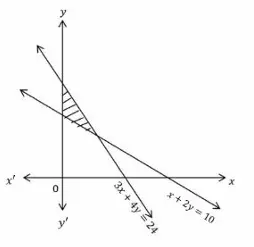
For the L.P.P. Maximize z = 10x + 6y subjected to 3x + y ≤ 12, 2x + 5y ≤ 34, x, y ≥ 0. Then the feasible region represented by system of inequalities is
The probability of a shooter of hitting the target is $\frac{1}{4}$. The minimum number of fire needed so that the probability of hitting the target atleast once is greater than $\frac{7}{16}$ is:
Probability distribution of random variable X is | X | -2 | -1 | 0 | 1 | 2 | |---|---|---|---|---|---| | P(X) | 2/11 | 1/11 | 4/11 | 3/11 | 1/11 | Then the value of E(X) is
Which of the following statement('s) is/are TRUE? (A) Skew symmetric matrix of even order is always symmetric (B) Skew symmetric matrix of odd order is non-singular (C) Skew symmetric matrix of odd order is singular (D) Skew symmetric matrix is always square matrix Choose the correct answer from the options given below:
A random variable X has the following probability distribution: | X | 0 | 1 | 2 | 3 | |---|---|---|---|---| | P(X) | 0.2 | 0.1 | 0.3 | 0.4 | The variance of X will be
If $ \theta$ is the angle between two unit vectors $\hat{a}$ and $\hat{b}$ then $|\hat{a}-\hat{b}| =$
If $A = [a_{ij}]_{3 \times 2}$ where $a_{ij} = i + j$, then (A) A is a square matrix (B) $a_{21} + a_{32} = 8$ (C) Number of elements in A is 6 (D) Transpose of $A = \begin{bmatrix}2 & 3 \\ 3 & 4 \\ 4 & 5\end{bmatrix}$ Choose the correct answer from the options given below:
The linear inequalities satisfying the shaded feasible region given in the figure are 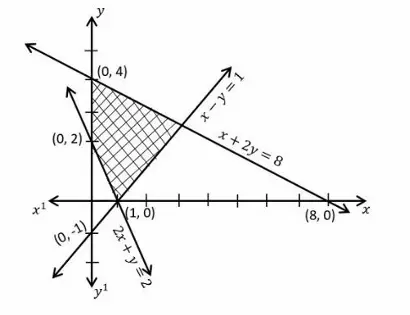 (A) $x \geq 0$, $y \geq 0$, $2x + y \geq 2$ (B) $x \geq 0$, $y \geq 0$, $2x + y \leq 2$ (C) $x \geq 0$, $y \geq 0$, $2x + y \geq 2$, $x + 2y \leq 8$, $x - y \leq 1$ (D) $x + 2y \geq 8$, $x - y \geq 1$ Choose the correct answer from the options given below:
If A is a singular matrix, then A{adj A} is equal to
If A and B are two events such that $P(A) = \frac{1}{2}$, $P(B) = \frac{1}{3}$ and $P(A \cap B) = \frac{1}{4}$, then which of the following statements are true? (A) A and B are independent events (B) $P(A | B) = \frac{3}{4}$ (C) $P(A' | B') = \frac{5}{8}$ (D) $P(A' | B) = \frac{1}{4}$ Choose the correct answer from the options given below:
If $\vec{a} + \vec{b} + \vec{c} = \vec{0}$ and $|\vec{a}| = 3, |\vec{b}| = 5, |\vec{c}| = 7$, then the angle between $\vec{a}$ and $\vec{b}$ is
The probability distribution of a random variable $x$ is, $P(x) = \frac{k}{2^x}, x = 0, 1, 2, 3$. Then Match List-I with List-II | List-I | List-II | |---|---| | (A) $k$ | (I) $\frac{2}{15}$ | | (B) $P(x = 1)$ | (II) $\frac{1}{5}$ | | (C) $P(1 < x < 3)$ | (III) $\frac{8}{15}$ | | (D) $P(x \geq 2)$ | (IV) $\frac{4}{15}$ | Choose the correct answer from the options given below:
Consider an LPP: Maximise $Z = 50x + 15y$ subjected to constraints $x + y \leq 60$, $5x + y \leq 100$, $x, y \geq 0$. If the maximum value of $Z$ occurs at $x = \alpha$ and $y = \beta$, then the value of $\alpha + \beta$ is