CUET UG Mathematics — Algebra previous year questions with solutions.
Linear inequalities corresponding to the shaded feasible region OABCO in the given figure are 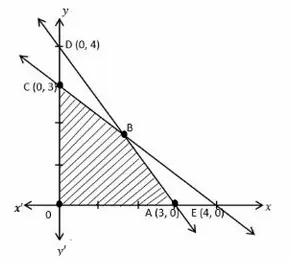
For the linear programing problem, $Minimize(Z) = 60x + 30y$ subject to: $2x - y \geq -5; 3x + y \geq 3; 2x - 3y \leq 12; x, y \geq 0$ the optimal value of $z$ is
The maximum value of $z$ for the linear programing problem maximize $z = x + y$ subject to the constraints $x + 4y \leq 8, 2x + 3y \leq 12, 3x + y \leq 9, x \geq 0, y \geq 0$ is:
Solution of the inequality $\frac{2x+3}{4x-5} \geq 0$ is
If $a_{ij}=i+3j$, then the matrix of order 2 with elements as $a_{ij}$ is
The domain of $y = \cos^{-1}(x^2 - 4)$ is
Relation R on the set $A = \{1, 2, ..., 15\}$ defined as $R = \{(x, y): y - 4x = 0\}$ is
In a college, 30% students fail in physics, 25% fail in Mathematics and 10% fail in both. One student is chosen at random. The probability that she fails in physics if she has failed in mathematics is
The value of $\lambda$, for which the two vectors $2\hat{i} - \hat{j} + 2\hat{k}$ and $3\vec{i} + \lambda\vec{j} + \hat{k}$ are perpendicular, is:
If $A$ is an invertible matrix of order 3, then Match List-I with List-II | List-I | List-II | | --- | --- | | (A) $\vert \text{adj} A\vert $ | (I) $8\vert A\vert $ | | (B) $\vert A(\text{adj} A)\vert $ | (II) $\vert A\vert ^2$ | | (C) $\vert 2A\vert $ | (III) $\frac{1}{\vert A\vert }$ | | (D) $\vert A^{-1}\vert $ | (IV) $\vert A\vert ^3$ | Choose the correct answer from the options given below:
A random variable y has the following probability distribution | y | 1 | 2 | 3 | 4 | 5 | |---|---|---|---|---|---| | P(y) | 2k | 3k | k | 4k | 5k | Match List-I with List-II | List-I | List-II | |---|---| | (A) $P(y > 2)$ | (I) $2/5$ | | (B) k | (II) $2/3$ | | (C) $P(y \leq 3)$ | (III) $8/15$ | | (D) $P(2 \leq y \leq 4)$ | (IV) $1/15$ | Choose the correct answer from the options given below:
Which of the following statements are true? (A) If $\vec{r} = x\hat{i} + y\hat{j} + z\hat{k}$, then $x, y, z$ are called direction ratios of $\vec{r}$. (B) For any two vectors $\vec{a}$ and $\vec{b}$, $\vec{a} + \vec{b} = \vec{b} + \vec{a}$ (C) $\vec{a} \perp \vec{b}$ if and only if $\vec{a} \times \vec{b} = \vec{0}$ (D) Projection of $\vec{b}$ on $\vec{a}$ is $\frac{\vec{a} \cdot \vec{b}}{|\vec{a}|^2}$ Choose the correct answer from the options given below:
Let $\vec{a}$ and $\vec{b}$ are unit vectors. If $\sqrt{3}\vec{a} - \vec{b}$ is a unit vector, then the angle between $\vec{a}$ and $\vec{b}$ is
If the binomial distribution $X\sim B(n, p)$ of mean 3 and variance $\frac{3}{2}$, $(p + q) = 1$, then which of the following is/are TRUE? (A) $q = \frac{1}{2}$, $n = 6$ (B) $P(X \leq 5) = \frac{63}{64}$, $p = \frac{1}{2}$ (C) $q = \frac{1}{3}$, $p = \frac{2}{3}$ (D) $P(X = 4) = \frac{15}{64}$, $n = 6$ Choose the correct answer from the options given below:
A random variable X has the following probability distribution: | X | 2 | 3 | 4 | 5 | |---|---|---|---|---| | P(X) | 5/k | 7/k | 9/k | 11/k | Then the value of $\frac{k}{4}$ is:
If $A = [a_{ij}]$ is skew symmetric matrix of order 'n', then
A random variable X has the following probability distribution | X | 0 | 1 | 2 | 3 | 4 | 5 | 6 | 7 | 8 | |---|---|---|---|---|---|---|---|---|---| | P(X) | a | 3a | 5a | 7a | 9a | 11a | 13a | 15a | 17a | Then the values of 'a' and P(0 < X < 5) respectively are
Match List-I with List-II | List-I | List-II | |---|---| | (Matrix A) | (Determinant of adj A) | | (A) $\begin{bmatrix} 2 & 1 \\ -1 & 2 \end{bmatrix}$ | (I) 3 | | (B) $\begin{bmatrix} 3 & 4 \\ 3 & 6 \end{bmatrix}$ | (II) 6 | | (C) $\begin{bmatrix} 3 & 7 \\ -2 & -4 \end{bmatrix}$ | (III) 5 | | (D) $\begin{bmatrix} 4 & 3 \\ 3 & 3 \end{bmatrix}$ | (IV) 2 | Choose the correct answer from the options given below:
The corner points of the bounded feasible region associated with the LPP: Maximize $Z=px+qy$, $p,q>0$ are $(0, 0)$, $(3.5, 0)$, $\left(\frac{112}{59}, \frac{135}{59}\right)$ and $(0, 3)$. If the optimum value of Z occurs at both $\left(\frac{112}{59}, \frac{135}{59}\right)$ and $(0, 3)$, then
Let $A = [a_{ij}]_{3×2}$ and $B = [b_{ij}]_{3×4}$ be two matrices. Then the order of the matrix $(A^T . B)^T$ is:
If $A = \begin{bmatrix} 2 & -1 & -2 \\ 0 & 2 & -1 \\ 3 & -5 & 0 \end{bmatrix}$, then the value of det (adj (2A)) is:
The probabilities of occurrance of two events A and B are 0.45 and 0.20 respectively. The probability of their simultaneous occurrence is 0.06. The probability that neither A nor B occurs is
The area of triangle with vertices P, Q, R is given by (where $\vec{AB}$ = position vector of point B – position vector of point A)
A random variable X has the following probability distribution: | X | 0 | 1 | 2 | 3 | |---|---|---|---|---| | P(X) | 0.1 | 0.2 | 0.3 | 0.4 | The variance of the X will be: