Algebra PYQ — Page 11
CUET UG Mathematics — Algebra previous year questions with solutions.
All Algebra Questions (1106)
The system of linear equations $kx + 5y = 5$, $2x + 3y = 5$ will be consistent if
If A is a square matrix such that $A^2 = A$ and I is the identity matrix of the same order as A, then $(I+A)^2-3A$ is equal to
Let X be random variable which assumes $x_1$, $x_2$, $x_3$, $x_4$ such that 2P(X=$x_1$)= 3P(X=$x_2$)=P(X=$x_3$)=5P(X=$x_4$) , then the probability distribution of X is
If corner points of the bounded feasible region are (0, 0), (3, 0) and (0, 3) and objective function is $z = 4x + 7y$, then the maximum value of $z$ is
If R and S are two equivalence relations on a set A, then
If a matrix has 8 elements then the possible order(s) it may have (A) $8 \times 1$ (B) $5 \times 3$ (C) $6 \times 2$ (D) $2 \times 4$ Choose the correct answer from the options given below:
If $A = \begin{bmatrix} 1 & 0 \\ 0 & -1 \end{bmatrix}$ and $B = \begin{bmatrix} 0 & 2 \\ 2 & 0 \end{bmatrix}$, then the matrix AB is equal to
Match List-I with List-II | List-I | List-II | | --- | --- | | (A) If $A$ is a non-singular matrix of order $n$, then $\vert A(\text{adj} A)\vert $ is equal to | (I) $\vert A\vert ^{n-1}$ | | (B) If $A$ is a non-singular matrix of order $n$, then $\vert \text{adj}(\text{adj} A)\vert $ is equal to | (II) $\vert A\vert ^{n-2} A$ | | (C) If $A$ is a non-singular matrix of order $n$, then $\text{adj}(\text{adj} A)$ is equal to | (III) $\vert A\vert ^n$ | | (D) If $A$ is a non-singular matrix of order $n$, then $\vert (\text{adj} A)\vert $ is equal to | (IV) $\vert A\vert ^{(n-1)^2}$ | Choose the correct answer from the options given below:
Which of the following are correct? (A) If a ≡ b(mod n), then -a ≡ -b (mod n) (B) If a + b = c, then a(mod n) + b(mod n) ≡ (a + b + c)(mod n). (C) If a ≡ b (mod n), then ka ≡ kb(mod n), ∀ k ∈ I. (D) If a ≡ b (mod n), then (a + k) ≡ (b + k)(mod n), ∀ k ∈ I. Choose the correct answer from the options given below:
The maximum value of the objective function $Z = 2x + y$ of an LPP, subject to the constraints $x \leq 6, y \leq 2, x - y \leq 0$, $x \geq 0, y \geq 0$ is
Let $M_{ij}$ and $A_{ij}$ denote respectively minors and co-factors of the element in the $i^{th}$ row and $j^{th}$ column of the matrix $A = \begin{bmatrix} 1 & 2 & -1 \\ 3 & 2 & 3 \\ 4 & -1 & 0 \end{bmatrix}$. Then: (A) $M_{32} = 6$ (B) $M_{23} = 9$ (C) $A_{32} = -6$ (D) $A_{23} = -9$ Choose the correct answer from the options given below:
There are 50 telephone lines in an exchange. The probability that any one of them will be busy is 0.1, then the probability that all the lines are busy?
The probabilities of occurrence of two events E and F are 0.25 and 0.50 respectively. The probability of their simultaneous occurrence is 0.14. The probability that neither E nor F occurs is
Let $\vec{a} = 3\hat{i} + \hat{j} - 4\hat{k}$ and $\vec{b} = 6\hat{i} + 5\hat{j} - 2\hat{k}$ be two vectors. Then a vector perpendicular to $\vec{a}$ and $\vec{b}$ with magnitude 3 units is
If $\hat{a}, \hat{b}$ and $\hat{c}$ are three unit vectors and $\hat{a} + \hat{b} + \hat{c} = \vec{0}$, then the angle between $\hat{a}$ and $(-\hat{b})$ is
Let $\vec{a} = \hat{i} + 2\hat{j} + 3\hat{k}$ and $\vec{b} = -2\hat{i} + 3\hat{j} - 4\hat{k}$, then which of the following statements are correct? (A) $|\vec{a}| = \sqrt{14}$ (B) $|\vec{b}| = 29$ (C) $\vec{a} \cdot \vec{b} = 8$ (D) Angle between $\vec{a}$ and $\vec{b}$ is $\cos^{-1}\left(\frac{-8}{\sqrt{406}}\right)$ Choose the correct answer from the options given below:
An urn contains 5 red and 5 black balls. A ball is drawn at random, its color is noted and is returned to the urn. Moreover, 2 additional balls of the same color are put in the urn and then a ball is drawn at random. The probability that the second drawn ball is red, is:
Which of the following are correct about the linear programming problem(LPP)? (A) The objective function is always linear. (B) A corner point of a feasible region is a point in the region which is the intersection of two boundary lines. (C) The common region determined by all the linear constraints of a LPP is called the feasible region. (D) If an LPP admits optimal solution at two points then its optimal values occurs at an infinite number of points. Choose the correct answer from the options given below:
If the matrix $\begin{bmatrix} -1 & x-y & 4 \\ 2 & 0 & 5 \\ x+y & z & 6 \end{bmatrix}$ is symmetric, then $x + 3y + 2z$ is equal to
The feasible region for an LPP is shown by shaded region in the figure. Then the minimum value of Z = 11x + 7y is 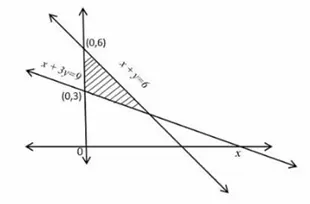
The function $f: [0, \infty) \rightarrow \mathbb{R}$ defined by, $f(x) = 2x^2 + 3$, is
The linear inequalities satisfying the shaded feasible region given in the figure are 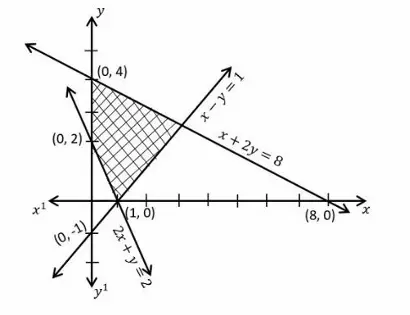 (A) $x \geq 0$, $y \geq 0$, $2x + y \geq 2$ (B) $x \geq 0$, $y \geq 0$, $2x + y \leq 2$ (C) $x \geq 0$, $y \geq 0$, $2x + y \geq 2$, $x + 2y \leq 8$, $x - y \leq 1$ (D) $x + 2y \geq 8$, $x - y \geq 1$ Choose the correct answer from the options given below:
Let x denotes the number of heads in a simultaneous toss of three coins, then $P(0 < x \leq 3)$
If $\vec{a} = 3\hat{i} - 6\vec{j} + \hat{k}$ and $\vec{b} = 2\hat{i} - 4\vec{j} + \lambda\hat{k}$ are such that $\vec{a} \parallel \vec{b}$, then $3\lambda + 2 =$