Algebra PYQ — Page 12
CUET UG Mathematics — Algebra previous year questions with solutions.
All Algebra Questions (1106)
Let $A = \begin{bmatrix} 1 & 2 & 1 \\ -1 & 3 & 2 \\ 2&4&1\end{bmatrix}$ and $M_{ij}$, $A_{ij}$ respectively denote the minor, co-factor of an element $a_{ij}$ of matrix A, then which of the following are true? (A) $M_{22} = -1$ (B) $A_{23} = 0$ (C) $A_{32} = 3$ (D) $M_{23} = 1$ (E) $M_{32} = -3$ Choose the correct answer from the options given below:
The corner points of the feasible region of the LPP: Minimize $Z = -50x + 20y$ subject to $2x - y \geq -5$, $3x + y \geq 3$, $2x - 3y \leq 12$ and $x, y \geq 0$ are
If A and B are skew-symmetric matrices, then which one of the following is NOT true?
Which one of the following set of constraints does the given shaded region represent? 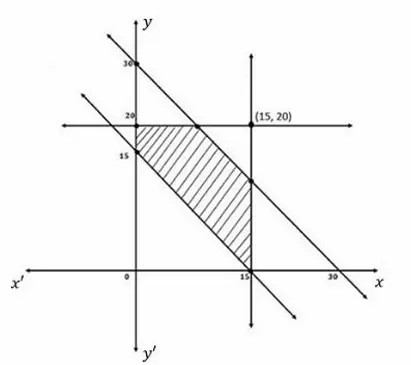
Let A be a non-singular matrix of order 3 and $|A| = 15$, then $|adj A|$ is equal to
Which of the following statements are correct in reference to the linear programming problem(LPP): Maximize ${Z} = 5x + 2y$ subject to the following constraints $3x + 5y \leq 15$, $5x + 2y \leq 10$, $x \geq 0, y \geq 0$. (A) The LPP has a unique optimal solution at $(2, 0)$ only. (B) The feasible region is bounded with corner points $(0, 0)$, $(2, 0)$, $(20/19, 45/19)$ and $(0, 3)$. (C) The optimal value is unique, but there are an infinite number of optimal solutions. (D) The feasible region is unbounded. Choose the correct answer from the options given below:
Let $F(z)$ be the cumulative density function of the standard normal variate $z$, then which of the following are correct? (A) $F(z) = \frac{1}{\sqrt{2\pi}} \int_{-\infty}^z e^{-\frac{z^2}{2}} dz$, $-\infty < z < \infty$ (B) $F(-z) = 1 - F(z)$ (C) $F(0) = 0$ (D) $F(\infty) = 1$ Choose the correct answer from the options given below:
Bag A contains 2 unbiased and 3 biased coins whereas Bag B contains 3 unbiased and 2 biased coins. A bag is selected at random and 2 coins are taken out simultaneously. The probability, that both coins are unbiased is:
The probability that in a year of the 22nd century choosen at random, there will be 53 Sundays is:
If $\begin{vmatrix} p-a & 0 & c-r \\ 0 & q-b & c-r \\ a & b & r \end{vmatrix} = 0$, then the value of $\dfrac{p}{p-a} + \dfrac{q}{q-b} + \dfrac{r}{r-c}$ is
If $A = \begin{bmatrix} -2 \\ -1 \\ -4 \end{bmatrix}$, $B = [-1 \quad 2 \quad 3]$, then the value of $A'B'$ is
The probability distribution of a random variable X is given by | X | 0 | 1 | 2 | |---|---|---|---| | P(X) | k | 2k | 3k | If k > 0, then $P(0 < X \leq 2)$ is equal to
If A is a square matrix such that $A^2 = A$ then which of the following statements are TRUE ? (Where I is an identity matrix of same order as A) (A) $(I+A)^4 = I + 15A$ (B) $(I+A)^2 = I + 3A$ (C) $(I+A)^6 = I + 30A$ (D) $(I+A)^3 = I + 7A$ Choose the correct answer from the options given below:
Match List-I with List-II | List-I | List-II | |---|---| | Matrix/equations | Values | | (A) $\begin{bmatrix} 2x+1 & 3y \\ 0 & y^2-5y \end{bmatrix} = \begin{bmatrix} x+3 & y^2+2 \\ 0 & -6 \end{bmatrix}$ | (I) $x = 2, y = -1$ | | (B) $\begin{bmatrix} 1 & 2 & -1 \\ x & 0 & 3 \\ y & 3 & 4 \end{bmatrix}$ is symmetric | (II) $x = 2, y = 2$ | | (C) $[x \ \ 1]\begin{bmatrix} 1 & 0 \\ -2 & -3 \end{bmatrix}\begin{bmatrix} 5 & 2 \\ 0 & y \end{bmatrix} = O$ | (III) $x = -2, y = 2$ | | (D) $\begin{bmatrix} x & 0 \\ 1 & 1 \end{bmatrix}\begin{bmatrix} x & 0 \\ 1 & 1 \end{bmatrix} = \begin{bmatrix} 4 & 0 \\ -1 & y/2 \end{bmatrix}$ | (IV) $x = 2, y = 0$ | Choose the correct answer from the options given below:
If $\vec{a}$ and $\vec{b}$ are two non-zero orthogonal vectors, then $|\vec{a} + \vec{b}|$ is equal to
If the points (a, b), (c, d) and (a + c, b + d) are collinear, then
The corner points of the feasible region with the constraints $x + y \leq 30$, $x + y \geq 15$, $y \leq 20$, $x \leq 15$ and $x$, $y \geq 0$ are
Which of the following statement are correct? (A) $A = [a_{ij}]_{n \times n}$ is a diagonal matrix if $a_{ij} = 0$ when $i = j$ (B) A square matrix $A = [a_{ij}]$ is called a symmetric matrix if $a_{ij} = a_{ji}$ for all $i, j$ (C) A square matrix $A = [a_{ij}]$ is called a skew-symmetric matrix if $a_{ij} = -a_{ji}$ for all $i, j$ (D) For every square matrix $A$, there exist an identity matrix of the same order such that $IA = AI = I$ Choose the correct answer from the options given below:
If the corner points of the bounded feasible region of an LPP are (0,2), (3,0), (6,0), (6,8) and (0,5), then the minimum value of objective function F = 4x + 6y occurs at
Let $A = \begin{bmatrix} \cos\theta & -\sin\theta \\ \sin\theta & \cos\theta \end{bmatrix}$, then $(A^{-1})^T$ equals
Which one of the following set of constraints represents the shaded region given below? 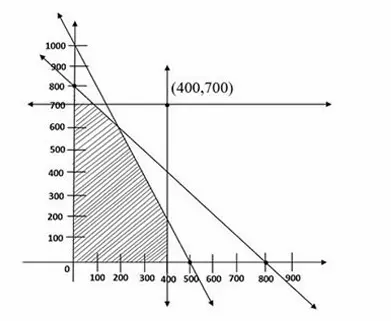
Match List-I with List-II Let $A$ and $B$ be two events such that $P(A) = 0.2$, $P(B) = 0.4$, $P(B|A) = 0.5$ | List-I | List-II | | --- | --- | | (A) $P(A \cap B)$ | (I) $0.5$ | | (B) $P(A\vert B)$ | (II) $0.8$ | | (C) $P(A \cup B)$ | (III) $0.25$ | | (D) $P(A')$ | (IV) $0.1$ | Choose the correct answer from the options given below:
If $\hat{i}$, $\hat{j}$ and $\hat{k}$ are unit vectors along the co-ordinate axes OX, OY and OZ respectively, then (A) $\hat{i} \times \hat{j} = \hat{k}$ (B) $\hat{k} \times \hat{i} = -\hat{j}$ (C) $\hat{j} \cdot \hat{j} = 1$ (D) $\hat{j} \cdot \hat{k} = 0$ Choose the correct answer from the options given below:
For a random variable x, probability distribution P(x) is given by $P(x) = \frac{k}{6}(3-x), x = 0, 1, 2$, then Match List-I with List-II | List-I | List-II | |---|---| | (A) k is equal to | (i) $\frac{1}{2}$ | | (B) P(x = 0) | (ii) 1 | | (C) P(x < 2) | (iii) $\frac{1}{6}$ | | (D) P(1 < x ≤ 2) | (iv) $\frac{5}{6}$ | Choose the correct answer from the options given below: