Algebra PYQ — Page 10
CUET UG Mathematics — Algebra previous year questions with solutions.
All Algebra Questions (1106)
If the points P, Q, R with position vectors $5\hat{i} + \lambda\hat{j}$, $20\hat{i} - \hat{j}$ and $15\hat{i} - 6\hat{j}$ respectively are collinear, then the value of $\lambda$ is
What is the mean of the numbers obtained on throwing a die having written 1 on three faces, 2 on two faces and 5 on 1 face?
For the objective function $Z = 3x + 5y$ subject to constraints $x + 3y \geq 3$, $x + y \geq 2$, $x \geq 0$, $y \geq 0$:
If $\theta$ is an acute angle and the vector $\vec{a} = (\sin \theta)\vec{i} + (\cos\theta)\vec{j}$ is perpendicular to the vector $\vec{b} = i - \sqrt{3}j$ then $\theta$ is equal to
If the system of equation $x - y + z = 4$ $x - 2y - 2z = 9$ $2x + y + \lambda z = 1$ has a unique solution, then
It is given that 3% of items manufactured by an industry are defective. The probability that a packet of 250 items contains one defective item is: [Given: $e^{-7.5} \approx 0.000553$]
Let the corner points of the bounded feasible region of the linear programming problem (LPP) $Z = ax+by$ be: (0, 0), (2, 0), (20/19, 45/19) and (0, 3). If the optimal value of Z occurs at both points (2, 0) and (20/19, 45/19), then the relation between a and b is:
If A is a square matrix such that $A^2=A$ and I is the identify matrix of the same order as A then $(I + 2A)^3$-6A is equal to
If A and B are two non-singular matrices of order n, then which of the following statement/statements is/are not correct? (A) AB is non-singular. (B) AB is singular. (C) $(AB)^{-1} = A^{-1}B^{-1}$ (D) $(AB)^{-1}$ does not exist. Choose the correct answer from the options given below:
If $z = 5x + 8y$ is the objective function of a LPP and (0, 0), (3, 1), (2, 4), (0, 3), (5, 0) are corner points of the bounded feasible region, then the maximum value of the objective function is
If $\vec{a} = 2\hat{i} + m\hat{j} - n\hat{k}$ and $\vec{b} = l\hat{i} - 3\hat{j} + 4\hat{k}$ such that $\vec{a} = 2\vec{b}$ then the value of $14{l} + m + n$ is:
If the points $A, B, C$ with position vectors $20\hat{i} + \lambda\hat{j}$, $5\hat{i} - \hat{j}$ and $10\hat{i} - 13\hat{j}$ respectively are collinear, then the value of $\lambda$ is
If the objective function $Z = px + qy, p > 0, q > 0$ of a linear programming problem attains its optimal value at the points (4, 7) and (5, 5) and $pq = 50$ then
In a game, a man wins ₹ 8 for getting a number greater than 3 and loses ₹ 3 otherwise, when a fair die is thrown. The man decided to throw a die 4 times but to quit as and when he gets a number greater than 3. If X denotes the amount which the man wins or loses, then which of the following are correct? (A) All the possible values of X are 8, 5, 2 and -1. (B) The probability distribution of X is: | X | 8 | 5 | 2 | -1 | -12 | |---|---|---|---|---|---| | P(X) | 1/2 | 1/4 | 1/8 | 1/16 | 1/16 | (C) The mean value of X is 75/16. (D) The variance of X is 6615/256. Choose the correct answer from the options given below:
The curve $y = f(x)$ is normal probability curve, then which of the following statements are correct? (A) mean, median and mode of the distribution coincide. (B) the area bounded by the curve $y = f(x)$ and $x$-axis is one unit. (C) The curve is symmetrical about the line $x = \mu$, where $\mu$ is the mean. (D) $y$-axis is an asymptote to the curve. Choose the correct answer from the options given below:
Let A= {1, 2, 3}, then the possible equivalence relations on A are: (A) {(1, 1), (2, 2) , (3, 3)} (B) {(1, 1), (2, 2), (3, 3), (1, 2), (2, 1)} (C) {(1, 1), (2, 2), (3, 3), (1, 2), (2, 1), (1, 3)} (D) {(1, 1), (2, 2), (3, 3), (1, 3), (3, 1)} Choose the correct answer from the options given below:
In a box containing 100 bulbs, 10 are defective. The probability that out of a sample of 5 bulbs, none is defective is
With respect to the following shaded feasible region (ABCDEFA), the maximum value of the objective function z = 3x + 4y – 2 is at point(s): 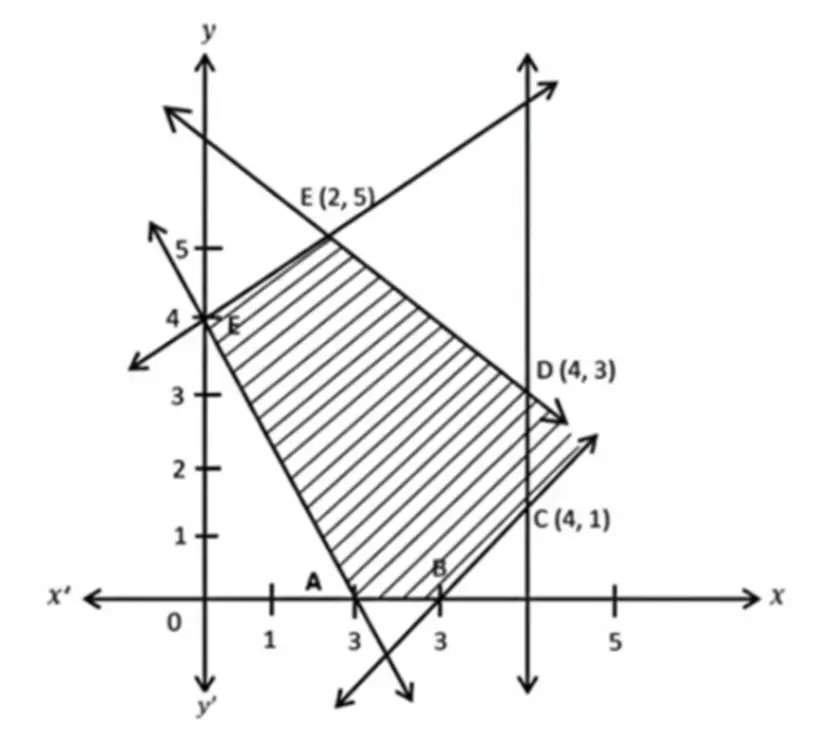
If $ \theta$ is the angle between two unit vectors $\hat{a}$ and $\hat{b}$ then $|\hat{a}-\hat{b}| =$
If $\begin{bmatrix} 2a + b & a - 2b \\ 5c - d & 4c + 3d \end{bmatrix} = \begin{bmatrix} 4 & -3 \\ 11 & 24 \end{bmatrix}$, then the value of $a + 2b - 3c + 4d$ is equal to
The corner points of the bounded feasible region determined by the system of linear constraints are (0, 10), (5, 5), (15, 15), (0, 20). Let z = px + qy where p, q > 0. Then the condition on p and q so that the maximum value of z occurs at (15, 15) and (0, 20) is
If the system of equations $2x + 3y = 10$, $x + ky = 4$ has a unique solution, then
If $\frac{3x - 5}{6} + 8 \geq 4 + \frac{2x}{3}$, then
If $\frac{1}{|x| - 3} \leq \frac{1}{2}$, then value of $x$: