Modern Physics PYQ — Page 6
NEET UG Physics — Modern Physics previous year questions with solutions.
All Modern Physics Questions (300)
In the spectrum of hydrogen, the ratio of the longest wavelength in the Lyman series to the longest wavelength in the Balmer series is:
In the given figure, a diode $D$ is connected to an external resistance $R=100\Omega$ and an $emf$ of $3.5V$ If the barrier potential developed across the diode is $0.5V$, the current in the circuit will be 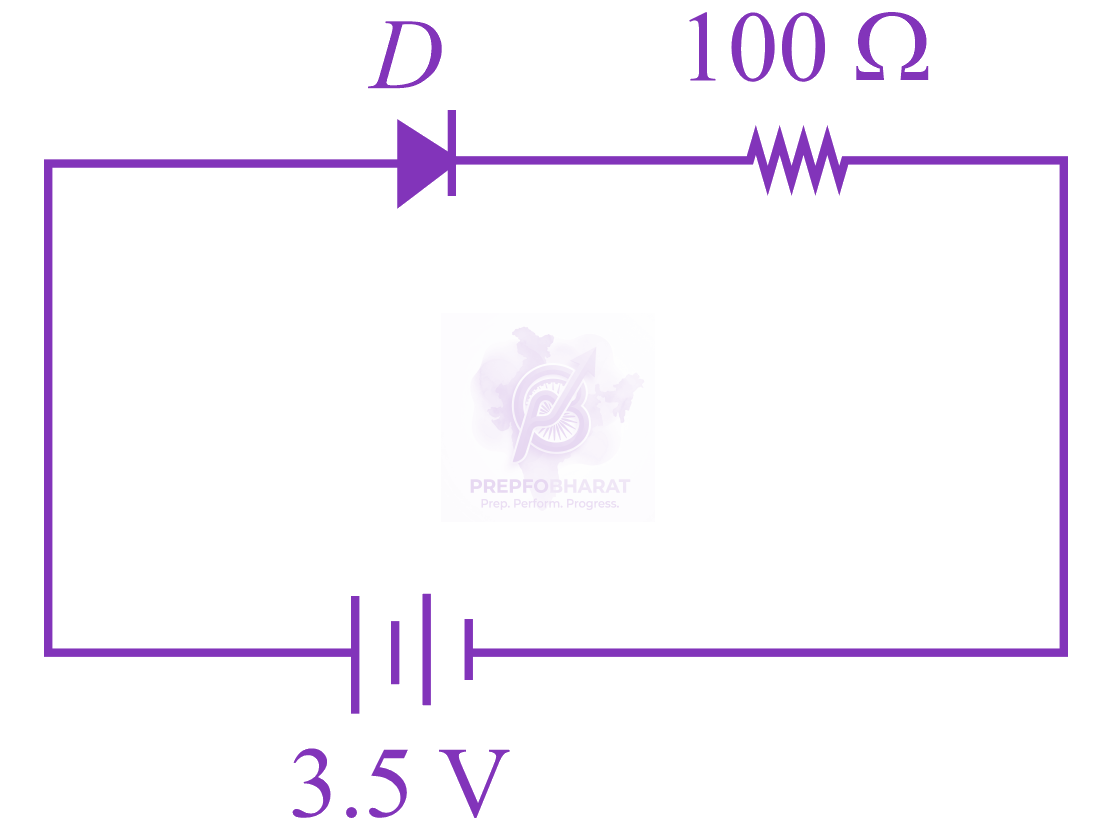
If radius of the $A1327l$ nucleus is taken to be ${R}_{Al}$ then the radius of $Te53125$ nucleus is nearly
If in a p-n junction, a square input signal of $10V$ is applied as shown, then the output across ${R}_{L}$ will be 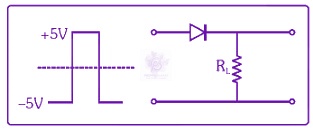
Consider third orbit of ${\mathrm{He}}^{+}$ (helium), using non-relativistic approach, the speed of electron in this orbit will be given constant $K{\text{=9×10}}^{\text{9}}$, $Z=2$ and $h$ (Planck's Constant)$\text{= 6}\text{.6 }\times {\text{ 10}}^{-34}\text{ J s}$
A photoelectric surface is illuminated successively by monochromatic light of wavelength $\lambda$ and $\frac{\lambda }{2}$. If the maximum kinetic energy of the emitted photoelectrons in the second case is 3 times that in the first case, the work function of the surface of the material is: ($h$ = Planck's constant, $c$ = speed of light)
A nucleus of uranium decays at rest into nuclei of thorium and helium. Then:
When the energy of the incident radiation is increased by $20%,$ the kinetic energy of the photoelectrons emitted from a metal surface increased from emitted $0.5 eV$ to $0.8 eV.$ The work function of the metal is:
The given graph represents $V$ - $I$ characteristic for a semiconductor device. 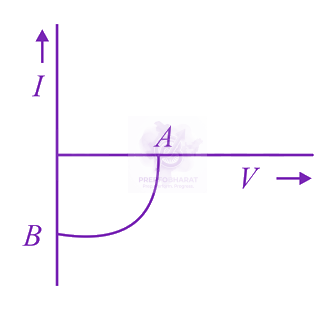 Which of the following statement is correct?
The Binding energy per nucleon of $Li37$ and $He24$ nucleon are $5.60 MeV$ and $7.06 M\mathrm{eV}$, respectively. In the nuclear reaction ${ }_{3}^{7}Li+{ }_{1}^{1}H\rightarrow { }_{2}^{4}He+{ }_{2}^{4}He+Q$, the value of energy $Q$ released is
The barrier potential of a p-n junction depends on: $(a)$ type of semi-conductor material $(b)$ amount of doping $(c)$ temperature Which one of the following is correct?
If the kinetic energy of the particle is increased to 16 times its previous value, the percentage change in the de-Broglie wavelength of the particle is:
Hydrogen atom in ground state is excited by a monochromatic radiation of $\lambda =975 Å.$ Number of spectral lines in the resulting spectrum emitted will be:
A radio isotope ‘$X$’ with a half life $1.4\times {10}^{9}$ years decays to ‘$Y$’ which is stable. A sample of the rock from a cave was found to contain ‘$X$’ and ‘$Y$’ in the ratio $1:7$. The age of the rock is
The wavelength $\lambda_e$ of an electron and $\lambda_p$ of a photon of same energy $E$ are related by
The output $(X)$ of the logic circuit shown in figure will be 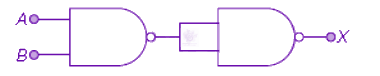
The output from a NAND gate is divided into two in parallel and fed to another NAND gate. The resulting gate is a: 
The half-life of a radioactive isotope $X$ is $20 \mathrm{yr}$. It decays to another element $Y$ which is stable. The two elements $X$ and $Y$ were found to be in the ratio $1: 7$ in a sample of a given rock. The age of the rock is estimated to be
The de-Broglie wavelength of neutrons in thermal equilibrium at temperature $T$ is:
Ratio of longest wavelengths corresponding to Lyman and Balmer series in hydrogen spectrum is
In an unbiased $p-n$ junction holes from the p-region to $n$-region because of:
In a $n$-type semiconductor, which of the following statement is true?
How does the Binding Energy per nucleon vary with the increase in the number of nucleons?
For photoelectric emission from certain metal the cut-off frequency is $v$. If radiation of frequency $2 \mathrm{v}$ impinges on the metal plate, the maximum possible velocity of the emitted electron will be ( $m$ is the electron mass)