Electromagnetism PYQ — Page 3
NEET UG Physics — Electromagnetism previous year questions with solutions.
All Electromagnetism Questions (503)
The incorrect relation for a diamagnetic material (all the symbols carry their usual meaning and $\varepsilon$ is a small positive number) is
A step up transformer is connected to an ac mains supply of 220 V to operate at $11000 \mathrm{~V}, 88$ watt. The current in the secondary circuit, ignoring the power loss in the transformer, is
The value of electric potential at a distance of 9 cm from the point charge $4 \times 10^{-7} \mathrm{C}$ is $\left[\right.$ Given $\left.\frac{1}{4 \pi \varepsilon_0}=9 \times 10^9 \mathrm{~N} \mathrm{~m}^2 \mathrm{C}^{-2}\right]$ :
A uniform metal wire of length / has $10 \Omega$ resistance. Now this wire is stretched to a length $2 /$ and then bent to form a perfect circle. The equivalent resistance across any arbitrary diameter of that circle is
The property which is not of an electromagnetic wave travelling in free space is that:
If $Z_1$ and $Z_2$ are the impedances of the given circuits (a) and (b) as shown in figures, then choose the correct option. 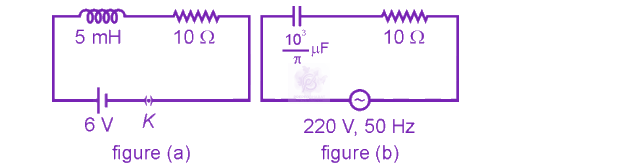
The magnetic energy stored in an inductor of inductance $4\mu H$ carrying a current of $2A$ is:
In a series$LCR$ circuit, the inductance$L$ is $10\mathrm{mH}$, capacitance $C$ is $1\mu F$ and resistance $R$ is $100\Omega$. The frequency at which resonance occurs is:
The resistance of platinum wire at $0^{\circ}C$ is $2\Omega$ and $6.8\Omega$ at $80^{\circ}C$. The temperature coefficient of resistance of the wire is:
A very long conducting wire is bent in a semi- circular shape from $A$ to $B$ as shown in figure. The magnetic field at point$P$ for steady current configuration is given by: 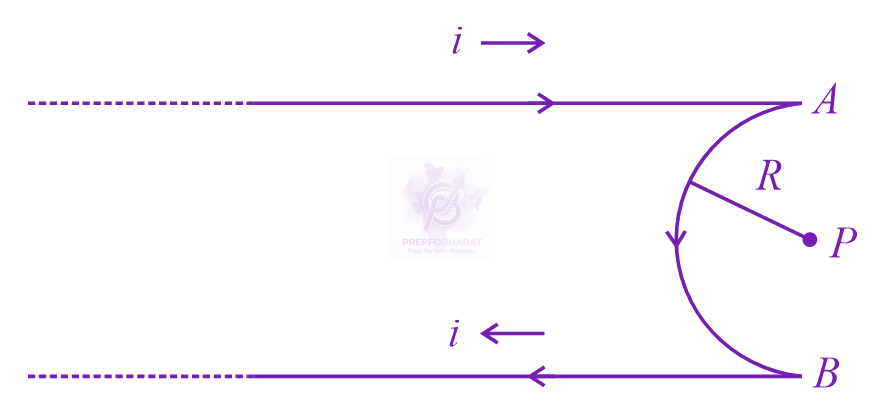
The net impedance of circuit (as shown in figure) will be: 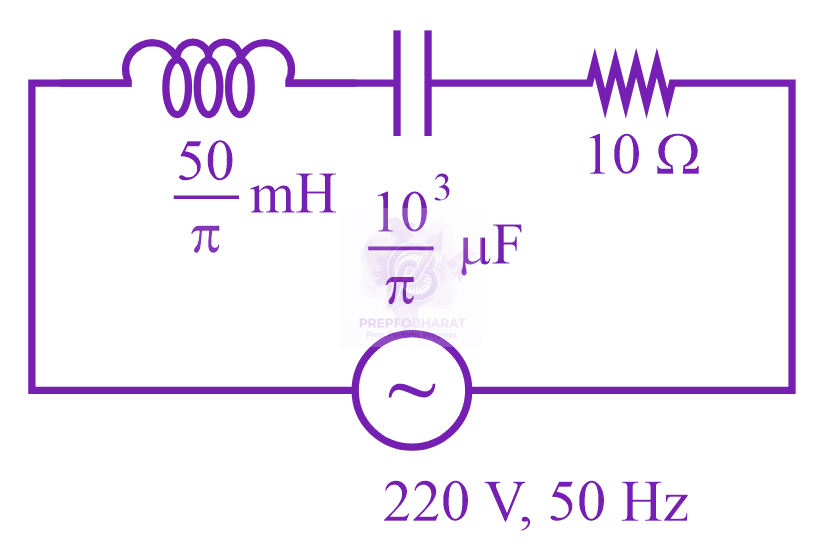
For very high frequencies, the effective impedance of the circuit (shown in the figure) will be 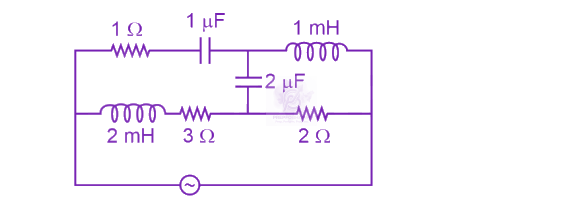
The net magnetic flux through any closed surface is:
An ac source is connected in the given circuit. The value of $\phi$ will be 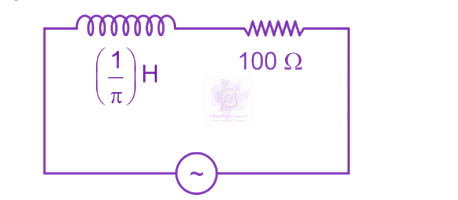
On the basis of electrical conductivity, which one of the following material has the smallest resistivity?
To produce an instantaneous displacement current of $2 \mathrm{~mA}$ in the space between the parallel plates of a capacitor of capacitance $4 \mu \mathrm{F}$, the rate of change of applied variable potential difference $\left(\frac{d V}{d t}\right)$ must be
$10$ resistors, each of resistance $R$ are connected in series to a battery of emf $E$ and negligible internal resistance. Then those are connected in parallel to the same battery, the current is increased $n$ times. The value of $n$ is:
If a conducting sphere of radius $R$ is charged. Then the electric field at a distance $r(r>R)$ from the centre of the sphere would be, $(V=$ potential on the surface of the sphere $)$
A $12V,60W$ lamp is connected to the secondary of a step down transformer, whose primary is connected to ac mains of $220V$. Assuming the transformer to be ideal, what is the current in the primary winding?
A uniform electric field and a uniform magnetic field are acting along the same direction in a certain region. If an electron is projected in the region such that its velocity is pointed along the direction of fields, then the electron
A copper wire of radius $1 \mathrm{~mm}$ contains $10^{22}$ free electrons per cubic metre. The drift velocity for free electrons when $10 \mathrm{~A}$ current flows through the wire will be (Given, charge on electron $=1.6 \times 10^{-19} \mathrm{C}$ )
An emf is generated by an ac generator having 100 turn coil, of loop area $1 \mathrm{~m}^2$. The coil rotates at a speed of one revolution per second and placed in a uniform magnetic field of $0.05 \mathrm{~T}$ perpendicular to the axis of rotation of the coil. The maximum value of emf is
An ac source is connected to a capacitor $C$. Due to decrease in its operating frequency:
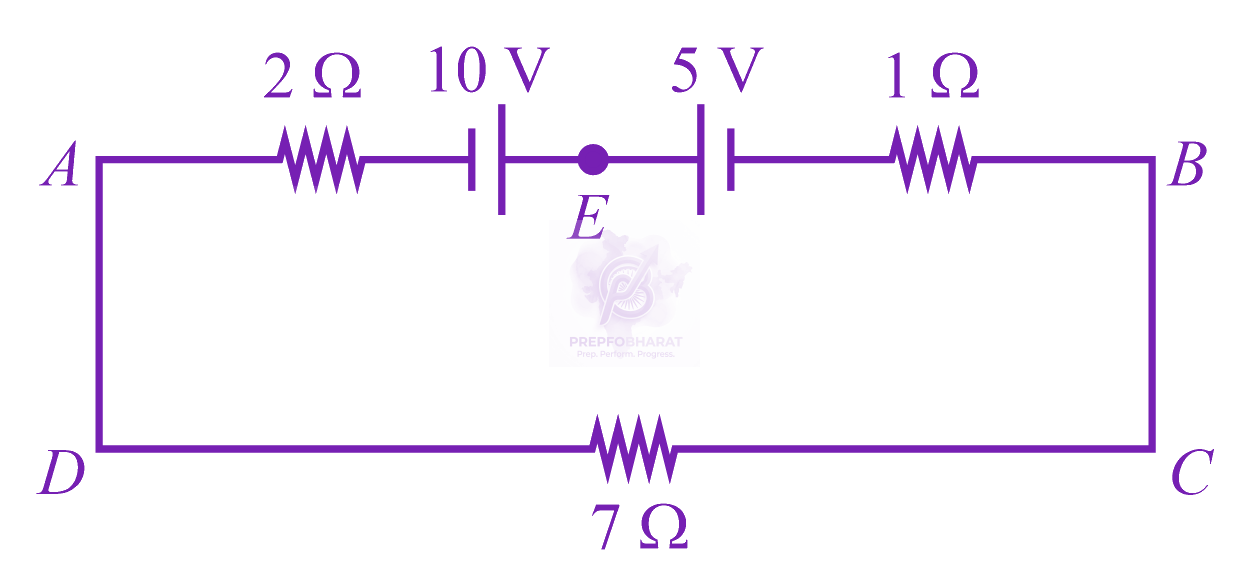
The magnitude and direction of the current in the following circuit is