Electromagnetism PYQ — Page 14
NEET UG Physics — Electromagnetism previous year questions with solutions.
All Electromagnetism Questions (503)
The electric field associated with an electro magnetic wave in vacuum is given by $\mathbf{E}=\mathbf{i}$ $40 \cos \left(k z-6 \times 10^8 t\right)$, where $E$, $z$ and $t$ are in volt/m, metre and second respectively. The value of wave vector $k$ is
A millivoltmeter of $25 \mathrm{mV}$ range is to be converted into an ammeter of 25 A range. The value (in ohm) of necessary shunt will be
Four point charges $-Q,-q, 2 q$ and $2 Q$ are placed, one at each corner of the square. The relation between $Q$ and $q$ for which the potential at the centre of the square is zero, is
The rms value of potential difference $V$ shown in the figure is 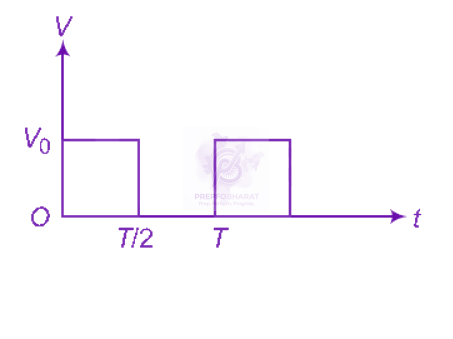
A charge $Q$ is enclosed by a Gaussian spherical surface of radius $R$. If the radius is doubled, then the outward electric flux will
Charge $q$ is uniformly spread on a thin ring of radius $R$. The ring rotates about its axis with a uniform frequency $f \mathrm{~Hz}$. The magnitude of magnetic induction at the centre of the ring is
A coil has resistance $30 \Omega$ and inductive reactance $20 \Omega$ at $50 \mathrm{~Hz}$ frequency. If an $\mathrm{AC}$ source of $200 \mathrm{~V}, 100 \mathrm{~Hz}$, is connected across the coil, the current in the coil will be
A thermocouple of negligible resistance produces an emf of $40 \mu \mathrm{V} /{ }^{\circ} \mathrm{C}$ in the linear range of temperature. A galvanometer of resistance $10 \Omega$ whose sensitivity is $1 \mu \mathrm{A} /$ div, is employed with the termocouple. The smallest value of temperature difference that can be detected by the system will be
The current $i$ in a coil varies with time as shown in the figure. The variation of induced emf with time would be 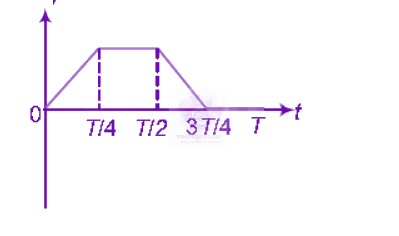
A parallel plate condenser has a uniform electric field $E(\mathrm{~V} / \mathrm{m})$ in the space between the plates. If the distance between the plates is $d(\mathrm{~m})$ and area of each plate is $A\left(\mathrm{~m}^2\right)$ the energy (joule) stored in the condenser is
The rate of increase of thermo-emf with temperature at the neutral temperature of a thermocouple
A square loop, carrying a steady current $I$, is placed in a horizontal plane near a long straight conductor carrying a steady current $I_1$ at a distance $d$ from the conductor as shown in figure. The loop will experience 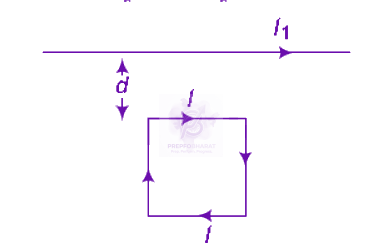
A galvanometer of resistance, $G$ is shunted by a resistance $S \mathrm{~ohm}$. To keep the main current in the circuit unchanged, the resistance to be put in series with the galvanometer is
The electric potential $V$ at any point $(x, y, z)$, all in metres in space is given by $V=4 x^2$ volt. The electric field at the point $(1,0,2)$ in volt/metre is
In the circuit shown in the figure, if potential at point $A$ is taken to be zero, the potential at point $B$ is 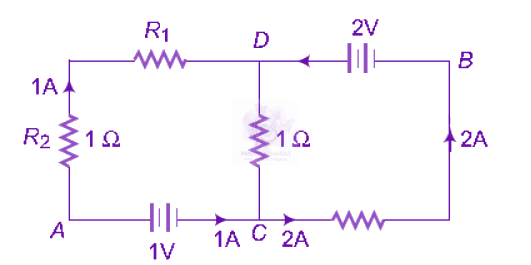
In an $\mathrm{AC}$ circuit an alternating voltage $e=200 \sqrt{2} \sin 100 t$ volt is connected to a capacitor of capacity $1 \mu \mathrm{F}$. The rms value of the current in the circuit is
A short bar magnet of magnetic moment $0.4 \mathrm{~J} \mathrm{~T}^{-1}$ is place in a uniform magnetic field of $0.16 \mathrm{~T}$. The magnet is stable equilibrium when the potential energy is
If power dissipated in the $9 \Omega$ resistor in the circuit shown is $36 \mathrm{~W}$, the potential difference across the $2 \Omega$ resistor is 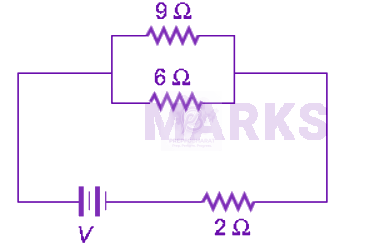
Three charges, each $+q$, are placed at the corners of an isosceles triangle $A B C$ of sides $B C$ and $A C, 2 a . D$ and $E$ are the mid points of $B C$ and $C A$. The work done in taking a charge $Q$ from $D$ to $E$ is 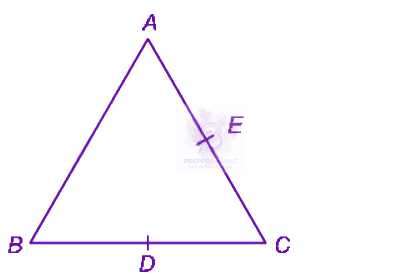
The electric and the magnetic field, associated with an electromagnetic wave, propagating along the $+z$-axis, can be represented by
A uniform electric field and a uniform magnetic field are acting along the same direction in a certain region. If an electron is projected in the region such that its velocity is pointed along the direction of fields, then the electron
A current carrying closed loop in the form of a right angle isosceles triangle $A B C$ is placed in a uniform magnetic field acting along $A B$. If the magnetic force on the $\operatorname{arm} B C$ is $\mathbf{F}$, the force on the arm $A C$ is 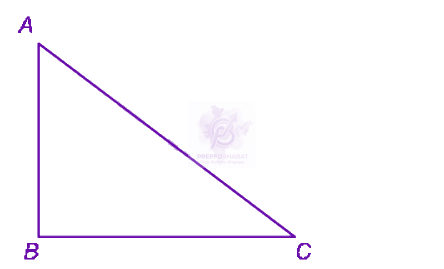
There are four light-weight-rod samples $A, B, C$, $D$ separately suspended by threads. A bar magnet is slowly brought near each sample and the following observations are noted (i) $A$ is feebly repelled (ii) $B$ is feebly attracted (iii) $C$ is strongly attracted (iv) $D$ remains unaffected Which one of the following is true?
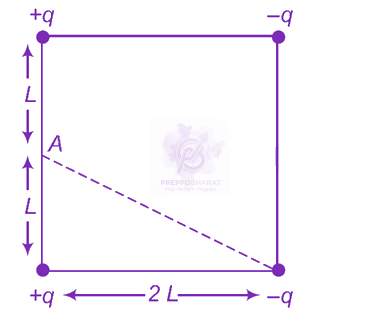
Four electric charges $+q,+q,-q$ and $-q$ are placed at the corners of a square of side $2 \mathrm{~L}$ (see figure). The electric potential at point $A$, mid-way between the two charges $+q$ and $+q$, is