Organic Chemistry PYQ — Page 4
NEET UG Chemistry — Organic Chemistry previous year questions with solutions.
All Organic Chemistry Questions (474)
Choose the correct sequence of reagents in the conversion of 4-nitrotoluene to 2 -bromotoluene.
Which amongst the following will be most readily dehydrated under acidic conditions?
Identify ' $X$ ' in the following reaction. 
Identify the final product [D] obtained in the following sequence of reactions. ${\mathrm{CH}}_{3}\mathrm{CHO}\rightarrow _{{H}_{3}{O}^{+}}^{i){\mathrm{LiAlH}}_{4}}[A]\rightarrow _{\Delta }^{{H}_{2}{\mathrm{SO}}_{4}}[B]\overset{\mathrm{HBr}}{\rightarrow }[C]\rightarrow _{\mathrm{Na}/\mathrm{Dry}\mathrm{ether}}^{{C}_{6}{H}_{5}\mathrm{Br}}[D]$
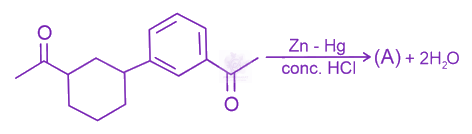
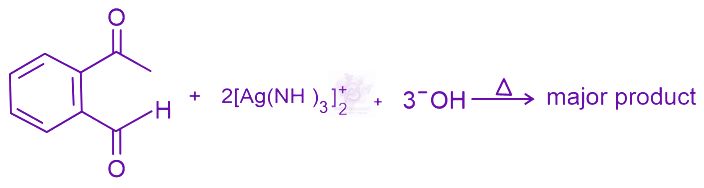
Which amongst the following reaction of alkyl halides produces isonitrile as a major products? (A) $\mathrm{R}-\mathrm{X}+\mathrm{HCN} \rightarrow$ (B) $\mathrm{R}-\mathrm{X}+\mathrm{AgCN} \rightarrow$ (C) $\mathrm{R}-\mathrm{X}+\mathrm{KCN} \rightarrow$ (D) $\mathrm{R}-\mathrm{X}+\mathrm{NaCN} \underset{\mathrm{H}_2 \mathrm{O}}{\mathrm{C}_2 \mathrm{H}_5 \mathrm{OH}}$ Choose the most appropriate answer from the options given below
$\mathrm{R}-\mathrm{COOH} \frac{\text { (i) "X" }}{\text { (ii) } \mathrm{H}_2 \mathrm{O} / \mathrm{HCl}} \mathrm{R}-\mathrm{CH}_2 \mathrm{OH}$ $\mathrm{R}-\mathrm{CH}=\mathrm{CH}_2 \frac{\text { (i) " X" }}{\text { (ii) } \mathrm{H}_2 \mathrm{O}, \mathrm{NaOH}, \mathrm{H}_2 \mathrm{O}_2} \mathrm{R}-\mathrm{CH}_2-\mathrm{CH}_2-\mathrm{OH}$ Identify ' $X$ ' in above reactions.
Which amongst the following compounds/species is least basic?
The major product formed in the following conversion is 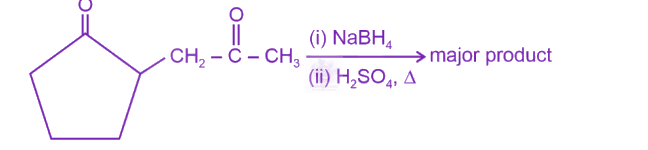
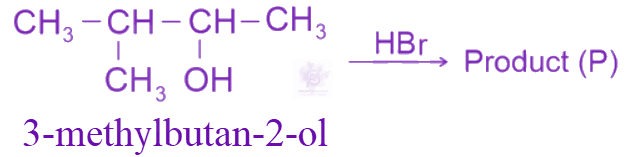
The product formed from the following reaction sequence is 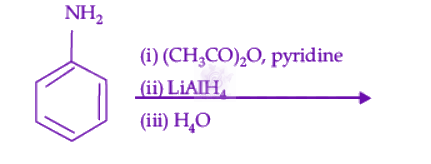
DNA contains which sugar?
IUPAC name of CH₃COCH₃ is
The product formed from the following reaction sequence is: 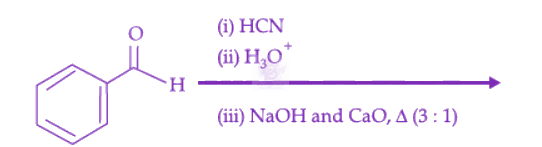
Which compound amongst the following is not an aromatic compound?
The incorrect method for the synthesis of alkenes is:
The incorrect method to synthesize benzaldehyde is:
Match List - I with List - II. <table class="pyq-table"><tbody><tr><td colspan="2" rowspan="1">List - I (Products formed)</td><td colspan="2" rowspan="1">List - II (Reaction of carbonyl compound with)</td></tr><tr><td>(a)</td><td>Cyanohydrin</td><td>(i)</td><td>${\mathrm{NH}}_{2}\mathrm{OH}$</td></tr><tr><td>(b)</td><td>Acetal</td><td>(ii)</td><td>${\mathrm{RNH}}_{2}$</td></tr><tr><td>(c)</td><td>Schiff's base</td><td>(iii)</td><td>alcohol</td></tr><tr><td>(d)</td><td>Oxime</td><td>(iv)</td><td>$\mathrm{HCN}$</td></tr></tbody></table>Choose the correct answer from the options given below:
The Kjeldahl's method for the estimation of nitrogen can be used to estimate the amount of nitrogen in which one of the following compounds?
Given below are two statements: Statement I: In Lucas test, primary, secondary and tertiary alcohols are distinguished on the basis of their reactivity with conc. $\mathrm{HCl}+{\mathrm{ZnCl}}_{2}$, known as Lucas Reagent. Statement II: Primary alcohols are most reactive and immediately produce turbidity at room temperature on reaction with Lucas Reagent. In the light of the above statements, choose the most appropriate answer from the options given below:
The product formed from the following reaction sequence is 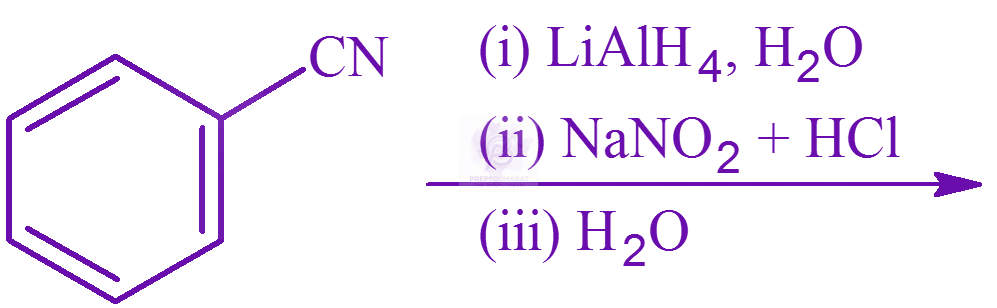
The products $A$ and $B$ in the following reaction sequence are: 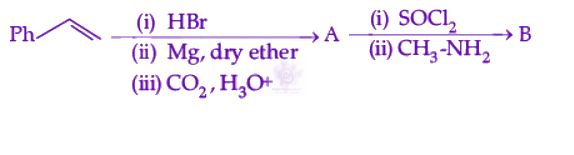
$\mathrm{RMgX}+{\mathrm{CO}}_{2}\rightarrow _{\mathrm{ether}}^{\mathrm{dry}}Y\overset{{H}_{3}{O}^{+}}{\longrightarrow }\mathrm{RCOOH}$ What is $Y$ in the above reaction?