Organic Chemistry PYQ — Page 3
NEET UG Chemistry — Organic Chemistry previous year questions with solutions.
All Organic Chemistry Questions (474)
Major products A and B formed in the following reaction sequence, are 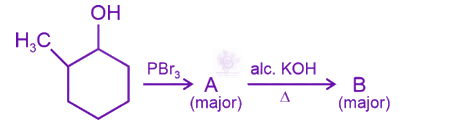
The alkane that can be oxidized to the corresponding alcohol by $\mathrm{KMnO}_4$ as per the equation 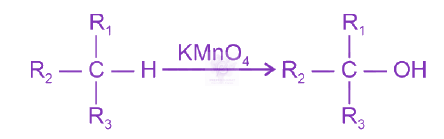 is, when:
Methyl group attached to a positively charged carbon atom stabilizes the carbocation due to
Which one of the following alcohols reacts instantaneously with Lucas reagent?
The reagents with which glucose does not react to give the corresponding tests/products are A. Tollen's reagent B. Schiff's reagent C. HCN D. $\mathrm{NH}_2 \mathrm{OH}$ E. $\mathrm{NaHSO}_3$ Choose the correct options from the given below:
Which is not a protein?
Weight (g) of two moles of the organic compound, which is obtained by heating sodium ethanoate with sodium hydroxide in presence of calcium oxide is :
Reagents which can be used to convert alcohols to carboxylic acids, are (A) $\mathrm{CrO}_3-\mathrm{H}_2 \mathrm{SO}_4$ (B) $\mathrm{K}_2 \mathrm{Cr}_2 \mathrm{O}_7+\mathrm{H}_2 \mathrm{SO}_4$ (C) $\mathrm{KMnO}_4+\mathrm{KOH} / \mathrm{H}_3 \mathrm{O}^{+}$ (D) $\mathrm{Cu}, 573 \mathrm{~K}$ (E) $\mathrm{CrO}_3,\left(\mathrm{CH}_3 \mathrm{CO}\right)_2 \mathrm{O}$ Choose the most appropriate answer from the options given below.
Cheilosis occurs due to deficiency of
The correct order for the rate of $\alpha, \beta$-dehydrohalogenation for the following compounds is 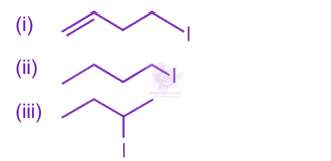
Consider the given reaction: $\mathrm{CH}_3 \mathrm{COCH}_3 \stackrel{\text { dil Ba}(\mathrm{OH})_2}{\longrightarrow}$ "X" The functional groups present in compound " $\mathrm{X}$ " are
In Lassaigne's extract of organic compound both nitrogen and sulphur are present, which gives blood-red colour with ${\mathrm{Fe}}^{3+}$ due to the formation of
Which of the following reactions will NOT give primary amine as the product?
(i) 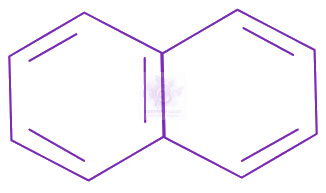 (ii) 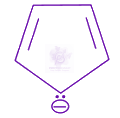 (iii) 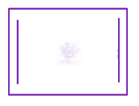 (iv) 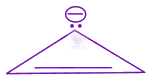 (v) 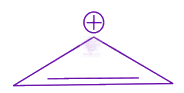 (vi) 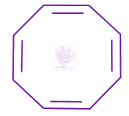 (vii) 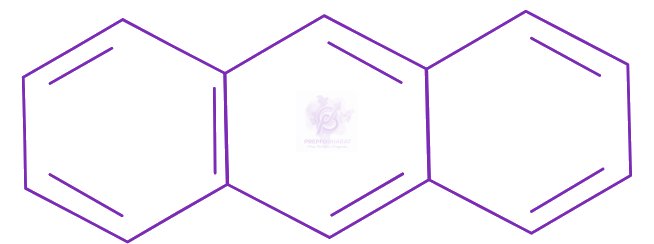 The number of compounds/species which obey Huckel's rule is _____
Identify the product in the following reaction. 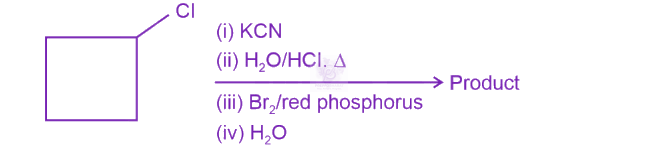
Match List-I with List-II. \(\begin{array}{|c|l|c|l|} \hline & \text { List-I } & & \text { List-II } \\ \hline & \text { (Mixtures/Sample) } & & \text { (Technique used for purification) } \\ \hline(A) & \text { Glycerol from spent lye } & \text { (I) } & \text { Steam distillation } \\ \hline(B) & \text { Chloroform + Aniline } & \text { (II) } & \text { Fractional distillation } \\ \hline \text { (C) } & \text { Fractions of crude oil } & \text { (III) } & \text { Distillation under reduced pressure } \\ \hline \text { (D) } & \text { Aniline + Water } & \text { (IV) } & \text { Distillation } \\ \hline \end{array}\) Choose the correct answer from the options given below:
The given compound 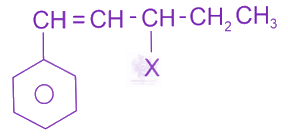 is an example of
The following conversion is known as 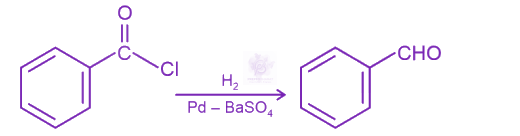
Complete the following reaction : 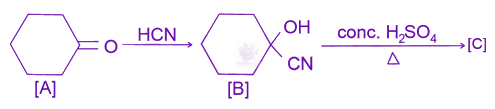
Given below are two statements: Statement I: In an organic compound, when inductive and electromeric effects operate in opposite directions, the inductive effect predominates. Statement II: Hyperconjugation is observed in o-xylene. In the light of the above statements, choose the correct answer from the options given below
Given below are two statements : Statement I: A unit formed by the attachment of a base to ${1}^{'}$ position of sugar is known as nucleoside Statement II: When nucleoside is linked to phosphorous acid at ${5}^{'}$-position of sugar moiety, we get nucleotide. In the light of the above statements, choose the correct answer from the options given below:
Identify the product in the following reaction 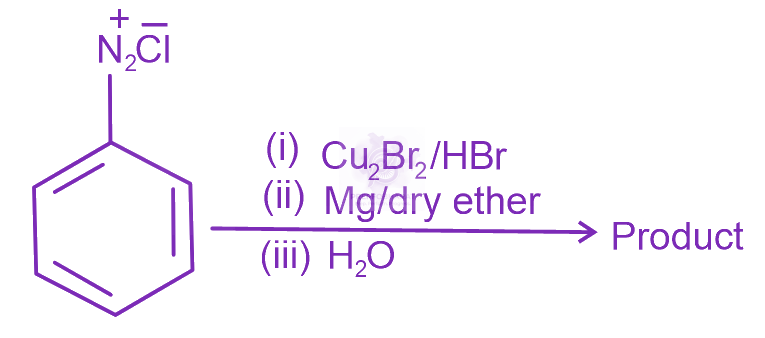
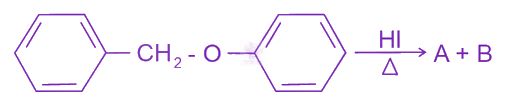 Identify A and B
Which is not an electrophile?