Respiration in Plants PYQ — Page 2
NEET UG Botany — Respiration in Plants previous year questions with solutions.
All Respiration in Plants Questions (52)
Select the option which is not correct with respect to enzyme action:
In which one of the following processes CO$_{2}$ is not released?
The three boxes in this diagram represent the three major biosynthetic pathways in aerobic respiration. Arrows represent net reactants or products 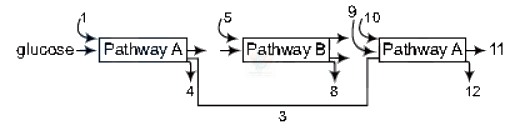 Arrows numbered 4,8 and 12 can all be
Which one of the following is not a parasitic adaptation?
Which of the metabolites is common to respiration mediated breakdown of fats, carbohydrates and proteins?
The energy-releasing metabolic process in which substrate is oxidised without an external electron acceptor is called
PGA as the first $\mathrm{CO}_2$ fixation product was discovered in photosynthesis of
Study the pathway given below 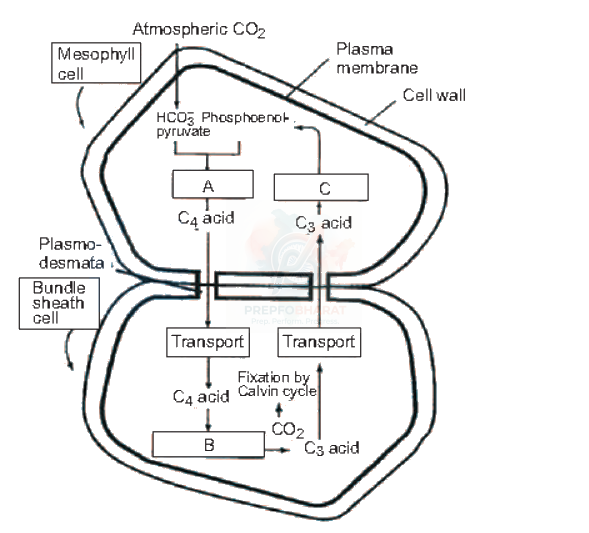 In which of the following options, correct words for all the three blanks A, B and C are indicated?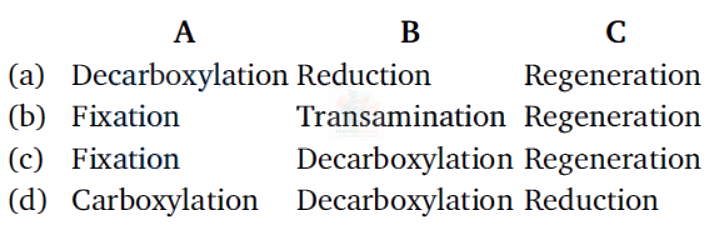
Cyclic photophosphorylation results in the formation of :
Aerobic respiratory pathway is appropriately termed :-
Aerobic respiratory pathway is appropriately termed
Cyclic-photophosphorylation results in the formation of
The chemiosmotic coupling hypothesis of oxidative phosphorylation proposes that Adenosine Triphosphate (ATP) is formed because
The energy-releasing process in which the substrate is oxidized without an external electron acceptor is called
The energy releasing process in which the substrate is oxidised without an external electron acceptor is called
All enzymes of TCA cycle are located in the mitochondrial matrix except one which is located in inner mitochondrial membranes in eukaryotes and in cytosol in prokaryotes. This enzyme is:
The overall goal of glycolysis, Krebs cycle and the electron transport system is the formation of:
How many ATP molecules could maximally be generated from one molecule of glucose, if the complete oxidation of one mole of glucose to $\mathrm{CO}_2$ and $\mathrm{H}_2 \mathrm{O}$ yields $686 \mathrm{kcal}$ and the useful chemical energy available in the high energy phosphate bond of one mole of ATP is $12 \mathrm{kcal}$ ?
During which stage in the complete oxidation of glucose arc the greatest number of ATP molecules formed from ADP?
Chemiosmotic theory of ATP synthesis in the chloroplasts and mitochondria is based on:
ATPase enzyme needed for muscle contraction is located in:
Dough kept overnight in warm weather becomes son and spongy because of
In glycolysis, during oxidation electrons are removed by:
During anaerobic digestion of organic waste, such as in producing biogas, which one of the following is left undegraded ?