Proton motive force develop between perimitochondrial space and matrix across inner mitochondrial membrane.
The chemiosmotic coupling hypothesis of oxidative phosphorylation proposes that adenosine triphosphate (ATP) is formed because
NEET UG 2008 — Botany Photosynthesis in Higher Plants
2008mcqeasy
The chemiosmotic coupling hypothesis of oxidative phosphorylation proposes that adenosine triphosphate (ATP) is formed because
Official previous-year question
Held on 30 Apr 2008 · Verified 9 Jul 2026.
Options
- A
There is a change in the permeability of the inner mitochondiral membrane toward adenosine diphosphate (ADP)
- B
High energy bonds are formed in mitochondrial proteins
- C
ADP is pumped out of the matrix into the intermembrane space
- D
A proton gradient forms across the inner membrane
Did you get this right?
Sign in to track your attempts and accuracy.
Your note
Sign in to keep a private note on this question. Nothing you write is ever public.
NEET UG Photosynthesis in Higher Plants in other years
Photosynthesis in Higher Plants 2025Photosynthesis in Higher Plants 2024Photosynthesis in Higher Plants 2023Photosynthesis in Higher Plants 2022Photosynthesis in Higher Plants 2021Photosynthesis in Higher Plants 2020Photosynthesis in Higher Plants 2019Photosynthesis in Higher Plants 2018Photosynthesis in Higher Plants 2017Photosynthesis in Higher Plants 2016Photosynthesis in Higher Plants 2015Photosynthesis in Higher Plants 2013
More NEET UG Photosynthesis in Higher Plants questions
Match List I with List II: $\begin{array}{|l|l|l|l|}\hline & \text{List - I} & & \text{List - II} \\\hline \text{A}. & \text{Chlorophyll a} & \text{(i)} & \text{Yellow-green} \\\hline \text{B.} & \text{Chlorophyll b} & \text{(ii)} & \text{Yellow} \\\hline \text{C.} & \text{Xanthophylls} & \text{(iii)} & \text{Blue-green} \\\hline \text{D.} & \text{Carotenoids} & \text{(iv)} & \text{Yellow to Yellow-orange} \\\hline\end{array}$ Choose the option with all correct matches.
2025easy
Which of the following statements about RuBisCO is true?
2025easy
Observe the given figure. Identify the different stages labelled with alphabets by selecting the correct option. 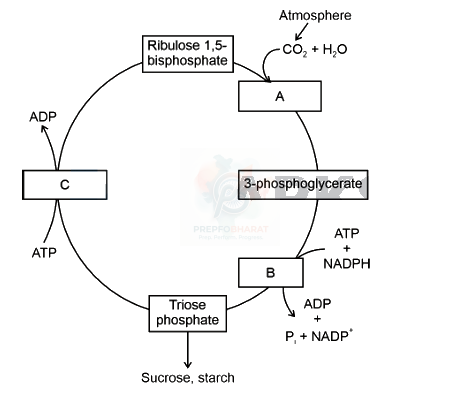
2024medium
How many molecules of ATP and NADPH are required for every molecule of $\mathrm{CO}_2$ fixed in the Calvin cycle?
2024medium
Given below are two statements: Statement I: In $\mathrm{C}_3$ plants, some $\mathrm{O}_2$ binds to RuBisCO, hence $\mathrm{CO}_2$ fixation is decreased. Statement II: In $\mathrm{C}_4$ plants, mesophyll cells show very little photorespiration while bundle sheath cells do not show photorespiration. In the light of the above statements, choose the correct answer from the options given below:
2024medium
Other Botany topics for NEET UG
Keep practicing Photosynthesis in Higher Plants
Work through every NEET UG Photosynthesis in Higher Plants PYQ, year by year.