Photosynthesis in Higher Plants PYQ
NEET UG Botany — Photosynthesis in Higher Plants previous year questions with solutions.
Browse by Year
Photosynthesis in Higher Plants at a glance
Questions per year
73 across 23 yearsDifficulty mix
73 total- easy44 · 60%
- medium22 · 30%
- hard7 · 10%
All Photosynthesis in Higher Plants Questions (73)
Which of the following statements about RuBisCO is true?
Match List I with List II: $\begin{array}{|l|l|l|l|}\hline & \text{List - I} & & \text{List - II} \\\hline \text{A}. & \text{Chlorophyll a} & \text{(i)} & \text{Yellow-green} \\\hline \text{B.} & \text{Chlorophyll b} & \text{(ii)} & \text{Yellow} \\\hline \text{C.} & \text{Xanthophylls} & \text{(iii)} & \text{Blue-green} \\\hline \text{D.} & \text{Carotenoids} & \text{(iv)} & \text{Yellow to Yellow-orange} \\\hline\end{array}$ Choose the option with all correct matches.
Observe the given figure. Identify the different stages labelled with alphabets by selecting the correct option. 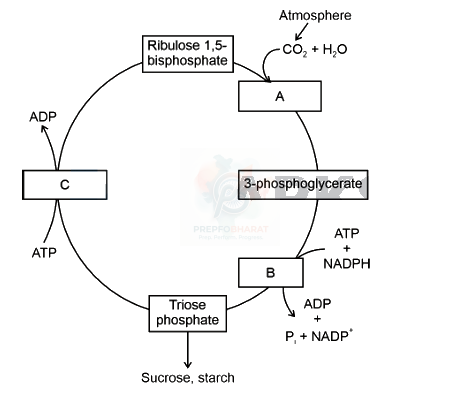
How many molecules of ATP and NADPH are required for every molecule of $\mathrm{CO}_2$ fixed in the Calvin cycle?
Given below are two statements: Statement I: In $\mathrm{C}_3$ plants, some $\mathrm{O}_2$ binds to RuBisCO, hence $\mathrm{CO}_2$ fixation is decreased. Statement II: In $\mathrm{C}_4$ plants, mesophyll cells show very little photorespiration while bundle sheath cells do not show photorespiration. In the light of the above statements, choose the correct answer from the options given below:
Which of the following are required for the dark reaction of photosynthesis? A. Light B. Chlorophyll C. $\mathrm{CO}_2$ D. ATP E. NADPH Choose the correct answer from the options given below:
Which of the following are required for the light reaction of Photosynthesis? A. $\mathrm{CO}_2$ B. $\mathrm{O}_2$ C. $\mathrm{H}_2 \mathrm{O}$ D. Chlorophyll E. Light Choose the correct answer from the options given below:
Which one of the following products diffuses out of the chloroplast during photosynthesis?
How many ATP and NADPH$_{2}$, are required for the synthesis of one molecule of Glucose during Calvin cycle?
The reaction centre in PS II has an absorption maxima at
How many times decarboxylation occurs during each TCA cycle?
Which of the following combinations is required for chemiosmosis?
Which out of the following statements is incorrect?
Match List-I with List-II 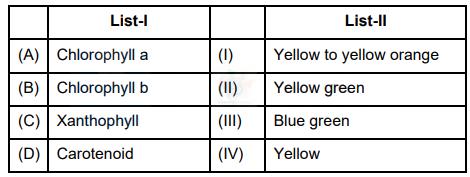 Choose the correct answer from the options given below :
Given below are two statements : Statement I : RuBisCO is the most abundant enzyme in the world. Statement II : Photorespiration does not occur in $\mathrm{C}_4$ plants. In the light of the above statements, choose the most appropriate answer from the options given below :
What is the role of large bundle shealth cells found around the vascular bundles in ${C}_{4}$ plants?
When one $\mathrm{CO}_2$ molecule is fixed as one molecule of triose phosphate, which of the following photochemically made, high energy chemical intermediates are used in the reduction phase?
Identify the correct statements regarding chemiosmotic hypothesis : (a) Splitting of the water molecule takes place on the inner side of the membrane. (b) Protons accumulate within the lumen of the thylakoids. (c) Primary acceptor of electron transfers the electrons to an electron carrier. (d) NADP reductase enzyme is located on the stroma side of the membrane. (e) Protons increase in number in stroma. Choose the correct answer from the options given below:
Which one of the following is not true regarding the release of energy during ATP synthesis through chemiosmosis? It involves :
Given below are two statements: Statement I: The primary ${\mathrm{CO}}_{2}$ acceptor in ${C}_{4}$ plants is phosphoenolpyruvate and is found in the mesophyll cells. Statement II : Mesophyll cells of ${C}_{4}$ plants lack RuBisCo enzyme. In the light of the above statements, choose the correct answer from the options given below :
Which of the following statements is incorrect?
The first stable product of ${\mathrm{CO}}_{2}$ fixation in Sorghum is:
Which of the following statements is incorrect?
During non-cyclic photophosphorylation, when electrons are lost from the reaction centre at $\mathrm{PSII}$, what is the source which replaces these electrons?