The pigments of the chloroplasts are broadly classified into two types - Chlorophylls and carotenoids. As these pigments are involved in the process of photosynthesis, they are also known as photosynthetic pigments. The action spectrum shows that the maximum photosynthesis occurs in the blucviolet and red parts of the light. (Ref. to Fig.) 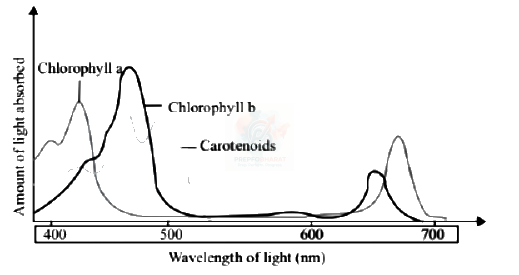
Related Theory The absorption spectra of chlorophyll a and b show that maximum light is absorbed by chlorophyll pigments in the blue-violet and red wavelengths. The absorption spectra of chlorophyll a and b are different. Chlorophyll b has an absorption spectrum shifted toward the green wavelengths. Therefore, chlorophyll b can absorb photons that chlorophyll a cannot, greatly increasing the proportion of the photons that plants can harvest, during photosynthesis.