Major intracellular cation is K+. Major extracellular cation is Na+. Ca+play major role in signal transduction pathways. H+is found in aqueous solution of all acids.
The most abundant intracellular cation is
NEET UG 2013 — Botany Biomolecules
2013mcqeasy
The most abundant intracellular cation is
Official previous-year question
Held on 30 Apr 2013 · Verified 9 Jul 2026.
Options
- A
Na+
- B
Ca2+
- C
H+
- D
K+
Did you get this right?
Sign in to track your attempts and accuracy.
Your note
Sign in to keep a private note on this question. Nothing you write is ever public.
NEET UG Biomolecules in other years
More NEET UG Biomolecules questions
Lecithin, a small molecular weight organic compound found in living tissues, is an example of:
2024medium
Ligases is a class of enzymes responsible for catalysing the linking together of two compounds. Which of the following bonds is not catalysed by it?
2024easy
Match List-I with List-II. \begin{array}{|l|l|l|l|}\hline & List-I & & List-II \\\hline A. & Primary structure of protein & I. & Human haemoglobin \\\hline B. & Secondary structure of protein & II. & Disulphide bonds \\\hline C. & Tertiary structure of protein & III. & Polypeptide chain \\\hline D. & Quaternary structure of protein & IV. & Alpha helix and \beta sheet \\\hline\end{array} Choose the correct answer from the options given below :
2024medium
The cofactor of the enzyme carboxypeptidase is:
2024medium
Match List-I with List-II 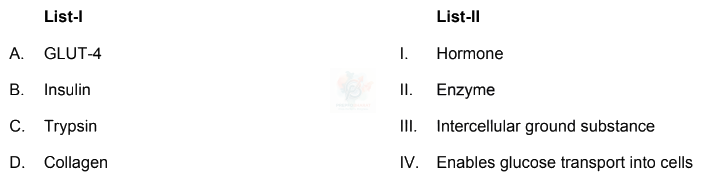 Choose the correct answer from the options given below.
2024medium
Other Botany topics for NEET UG
Keep practicing Biomolecules
Work through every NEET UG Biomolecules PYQ, year by year.