NEET UG 2024 — Biomolecules
Botany Biomolecules questions from NEET UG 2024.
Other Years
11 Biomolecules Questions from 2024
The cofactor of the enzyme carboxypeptidase is:
Ligases is a class of enzymes responsible for catalysing the linking together of two compounds. Which of the following bonds is not catalysed by it?
Match List-I with List-II. \begin{array}{|l|l|l|l|}\hline & List-I & & List-II \\\hline A. & Primary structure of protein & I. & Human haemoglobin \\\hline B. & Secondary structure of protein & II. & Disulphide bonds \\\hline C. & Tertiary structure of protein & III. & Polypeptide chain \\\hline D. & Quaternary structure of protein & IV. & Alpha helix and \beta sheet \\\hline\end{array} Choose the correct answer from the options given below :
Lecithin, a small molecular weight organic compound found in living tissues, is an example of:
Match List-I with List-II 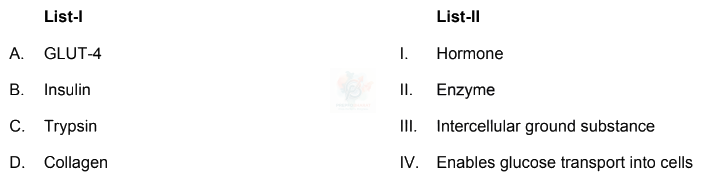 Choose the correct answer from the options given below.
Inhibition of Succinic dehydrogenase enzyme by malonate is a classical example of:
Which of the following is a nucleotide?
Regarding catalytic cycle of an enzyme action, select the correct sequential steps : A. Substrate enzyme complex formation. B. Free enzyme ready to bind with another substrate. C. Release of products. D. Chemical bonds of the substrate broken. E. Substrate binding to active site. Choose the correct answer from the options given below :
Which of the following graphs depicts the effect of substrate concentration on velocity of enzyme catalysed reaction?
Which of the following are not fatty acids? A. Glutamic acid B. Arachidonic acid C. Palmitic acid D. Lecithin E. Aspartic acid Choose the correct answer from the options given below :
Enzymes that catalyse the removal of groups from substrates by mechanisms other than hydrolysis leaving double bonds, are known as :