The amount of energy required to raise the energy of molecules at which chemical reaction can occur is called activation energy. Thus, activation energy is actually the energy required to form the transition state. Enzymes dramatically reduce the activation energy of a reaction, so that most molecules can easily get over the activation energy barrier and quickly turn into product. Simply we can say that activation energy of an enzyme catalysed reaction is lower than that of an uncatalysed reaction.
The figure given below shows the conversion of a substrate into product by an enzyme. In which one of the four options (a-d), the components of…
NEET UG 2010 — Botany Biomolecules
2010mcqeasy
The figure given below shows the conversion of a substrate into product by an enzyme. In which one of the four options (a-d), the components of reaction labelled as A,B,C and D are identified correctly? 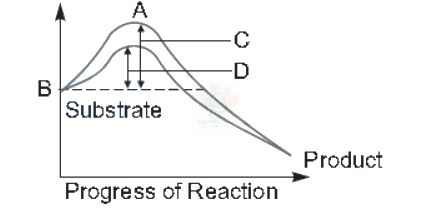 (a)(b)(c)(d)APotential energyTransition energyPotential energyActivation energy with enzymeBTransition statePotential energyTransition stateTransition stateCActivation energy with enzymeActivation energy without enzymeActivation energy with enzymeActivation energy without enzymeDActivation energy without enzymeActivation energy with enzymeActivation energy without enzymePotential energy
Official previous-year question
Held on 30 Apr 2010 · Verified 9 Jul 2026.
Options
- A
(a)
- B
(b)
- C
(c)
- D
(d)
Did you get this right?
Sign in to track your attempts and accuracy.
Your note
Sign in to keep a private note on this question. Nothing you write is ever public.
NEET UG Biomolecules in other years
More NEET UG Biomolecules questions
Lecithin, a small molecular weight organic compound found in living tissues, is an example of:
2024medium
Ligases is a class of enzymes responsible for catalysing the linking together of two compounds. Which of the following bonds is not catalysed by it?
2024easy
Match List-I with List-II. \begin{array}{|l|l|l|l|}\hline & List-I & & List-II \\\hline A. & Primary structure of protein & I. & Human haemoglobin \\\hline B. & Secondary structure of protein & II. & Disulphide bonds \\\hline C. & Tertiary structure of protein & III. & Polypeptide chain \\\hline D. & Quaternary structure of protein & IV. & Alpha helix and \beta sheet \\\hline\end{array} Choose the correct answer from the options given below :
2024medium
The cofactor of the enzyme carboxypeptidase is:
2024medium
Match List-I with List-II 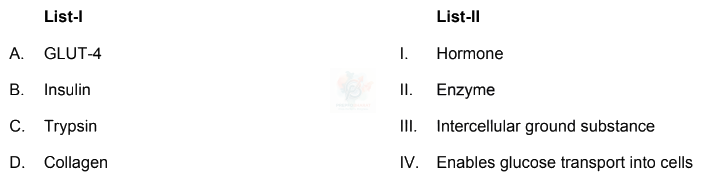 Choose the correct answer from the options given below.
2024medium
Other Botany topics for NEET UG
Keep practicing Biomolecules
Work through every NEET UG Biomolecules PYQ, year by year.