Optics PYQ — Page 5
JEE Main Physics — Optics previous year questions with solutions.
All Optics Questions (489)
Given below are two statements : one is labelled as Assertion (A) and the other is labelled as Reason (R). Assertion-(A) : If Young's double slit experiment is performed in an optically denser medium than air, then the consecutive fringes come closer. Reason-(R) : The speed of light reduces in an optically denser medium than air while its frequency does not change. In the light of the above statements, choose the most appropriate answer from the options given below :
Two thin convex lenses of focal length 30 cm and 10 cm are placed coaxially, 10 cm apart. The power of this combination is :
A mirror is used to produce an image with magnification of $\frac{1}{4}$. If the distance between object and its image is 40 cm , then the focal length of the mirror is ________
The width of one of the two slits in Young's double slit experiment is d while that of the other slit is $x \mathrm{~d}$. If the ratio of the maximum to the minimum intensity in the interference pattern on the screen is $9: 4$ then what is the value of $x$ ? (Assume that the field strength varies according to the slit width.)
A concave mirror produces an image of an object such that the distance between the object and image is 20 cm . If the magnification of the image is ' -3 ', then the magnitude of the radius of curvature of the mirror is :
Given below are two statements. One is labelled as Assertion (A) and the other is labelled as Reason (R). Assertion (A) : In Young's double slit experiment, the fringes produced by red light are closer as compared to those produced by blue light. Reason (R): The fringe width is directly proportional to the wavelength of light. In the light of the above statements, choose the correct answer from the options given below :
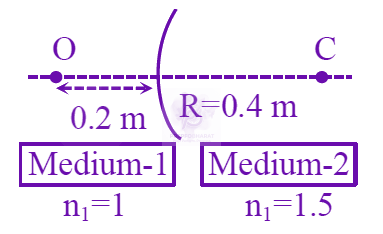 A spherical surface separates two media of refractive indices 1 and 1.5 as shown in figure. Distance of the image of an object ' O ', is : ( C is the center of curvature of the spherical surface and $R$ is the radius of curvature)
Let u and \(v\) be the distances of the object and the image from a lens of focal length \(f\). The correct graphical representation of \(\mathbf{u}\) and \(v\) for a convex lens when \(|\mathbf{u}|\gt f\), is
What is the relative decrease in focal length of a lens for an increase in optical power by 0.1 D from 2.5D ? ['D' stands for dioptre]
A symmetric thin biconvex lens is cut into four equal parts by two planes $A B$ and $C D$ as shown in figure. If the power of original lens is 4 D then the power of a part of the divided lens is 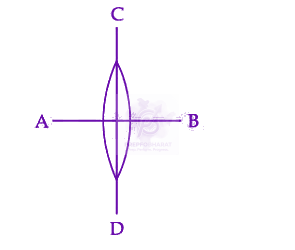
The driver sitting inside a parked car is watching vehicles approaching from behind with the help of his side view mirror, which is a convex mirror with radius of curvature $\mathrm{R}=2 \mathrm{~m}$. Another car approaches him from behind with a uniform speed of $90 \mathrm{~km} / \mathrm{hr}$. When the car is at a distance of 24 m from him, the magnitude of the acceleration of the image of the car in the side view mirror is ' a '. The value of 100 a is _______ $\mathrm{m} / \mathrm{s}^2$.
At the interface between two materials having refractive indices \(n_1\) and \(n_2\), the critical angle for reflection of an em wave is \(\theta_{1 C}\). The \(n_2\) material is replaced by another material having refractive index \(n_3\) such that the critical angle at the interface between \(n_1\) and \(n_3\) materials is \(\theta_{2 \mathrm{C}}\). If \(\mathrm{n}_3\gt\mathrm{n}_2\gt\mathrm{n}_1 ; \frac{\mathrm{n}_2}{\mathrm{n}_3}=\frac{2}{5}\) and \(\sin \theta_{2 \mathrm{C}}-\sin \theta_{1 \mathrm{C}}=\frac{1}{2}\), then \(\theta_{1 \mathrm{C}}\) is
When an object is placed 40 cm away from a spherical mirror an image of magnification $\frac{1}{2}$ is produced. To obtain an image with magnification of $\frac{1}{3}$, the object is to be moved :
Two monochromatic light beams have intensities in the ratio 1:9. An interference pattern is obtained by these beams. The ratio of the intensities of maximum to minimum is
The radii of curvature for a thin convex lens are 10 cm and 15 cm respectively. The focal length of the lens is 12 cm. The refractive index of the lens material is
A plano-convex lens having radius of curvature of first surface 2 cm exhibits focal length of $f_1$ in air. Another plano-convex lens with first surface radius of curvature 3 cm has focal length of $\mathrm{f}_2$ when it is immersed in a liquid of refractive index 1.2 . If both the lenses are made of same glass of refractive index 1.5 , the ratio of $f_1$ and $f_2$ will be
A slanted object $A B$ is placed on one side of convex lens as shown in the diagram. The image is formed on the opposite side. Angle made by the image with principal axis is: 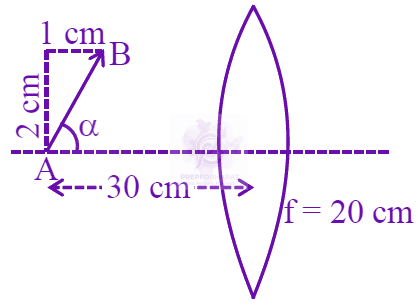
A convex lens made of glass (refractive index $=1.5$ ) has focal length 24 cm in air. When it is totally immersed in water (refractive index $=1.33$ ), its focal length changes to
The Young's double slit interference experiment is performed using light consisting of 480 nm and 600 nm wavelengths to form interference patterns. The least number of the bright fringes of 480 nm light that are required for the first coincidence with the bright fringes formed by 600 nm light is
In a Young's double slit experiment, three polarizers are kept as shown in the figure. The transmission axes of $P_1$ and $P_2$ are orthogonal to each other. The polarizer $P_3$ covers both the slits with its transmission axis at $45^{\circ}$ to those of $P_1$ and $P_2$. An unpolarized light of wavelength $\lambda$ and intensity $I_0$ is incident on $P_1$ and $P_2$. The intensity at a point after $P_3$ where the path difference between the light waves from $s_1$ and $s_2$ is $\frac{\lambda}{3}$, is 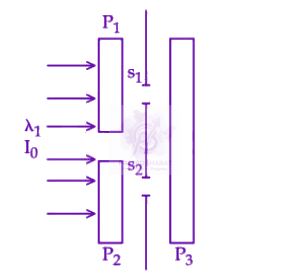
Two light beams fall on a transparent material block at point 1 and 2 with angle \(\theta_1\) and \(\theta_{2^{\prime}}\) respectively, as shown in figure. After refraction, the beams intersect at point 3 which is exactly on the interface at other end of the block. Given : the distance between 1 and 2, \(\mathrm{d}=4 \sqrt{3} \mathrm{~cm}\) and \(\theta_1=\theta_2=\cos ^{-1}\left(\frac{\mathrm{n}_2}{2 \mathrm{n}_1}\right)\), where refractive index of the block \(\mathrm{n}_2\gt\) refractive index of the outside medium \(\mathrm{n}_1\), then the thickness of the block is ________ cm. 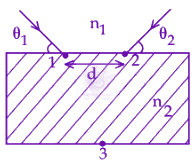
Given below are two statements : one is labelled as Assertion (A) and the other is labelled as Reason (R) Assertion (A) : Refractive index of glass is higher than that of air. Reason ( $\mathrm{R}$) : Optical density of a medium is directly proportionate to its mass density which results in a proportionate refractive index. In the light of the above statements, choose the most appropriate answer from the options given below :
A transparent film of refractive index, 2.0 is coated on a glass slab of refractive index, 1.45. What is the minimum thickness of transparent film to be coated for the maximum transmission of Green light of wavelength 550 nm . [Assume that the light is incident nearly perpendicular to the glass surface.]
Consider following statements for refraction of light through prism, when angle of deviation is minimum. (A) The refracted ray inside prism becomes parallel to the base. (B) Larger angle prisms provide smaller angle of minimum deviation. (C) Angle of incidence and angle of emergence becomes equal. (D) There are always two sets of angle of incidence for which deviation will be same except at minimum deviation setting. (E) Angle of refraction becomes double of prism angle. Choose the correct answer from the options given below.