JEE Main Physics — Modern Physics previous year questions with solutions.
Which of the following gives a reversible operation?
When the wavelength of radiation falling on a metal is changed from $500\mathrm{nm}\mathrm{to}200\mathrm{nm}$, the maximum kinetic energy of the photoelectrons becomes three times larger. The work function of the metal is close to:
When radiation of wavelength $A$ is used to illuminate a metallic surface, the stopping potential is $V$. When the same surface is illuminated with radiation of wavelength $3A$, the stopping potential is $\frac{V}{4}$. If the threshold wavelength for the metallic surface is $n\lambda$ then value of $n$ will be :
When photon of energy $4.0eV$ strikes the surface of a metal $A,$ the ejected photoelectrons have maximum kinetic energy ${T}_{A}eV$ and de-Broglie wavelength ${\lambda }_{A}.$ The maximum kinetic energy of photoelectrons liberated from another metal $B$ by photon of energy $4.50eV$ is ${T}_{B}=({T}_{A}-1.5)eV.$ If the de-Broglie wavelength of these photoelectrons ${\lambda }_{B}=2{\lambda }_{A},$ then the work function of metal $B$ is:
When a diode is forward biased, it has a voltage drop of $0.5V$ . the safe limit of current through the diode is $10\mathrm{mA}$. If a battery of emf $1.5V$ is used in the circuit, the value of minimum resistance to be connected in series with the diode so that the current does not exceed the safe limit is :
Two Zener diodes ($A$ and $B$) having breakdown voltages of $6V$ and $4V$ respectively, are connected as shown in the circuit below. The output voltage ${V}_{0}$ variation with input voltage linearly increasing with time, is given by (${V}_{input}=0Vatt=0$)
The time period of revolution of electron in its ground state orbit in a hydrogen atom is $1.6\times {10}^{-16}s.$ The frequency of revolution of the electron in its first excited state (in ${s}^{-1}$ ) is:
The surface of a metal is illuminated alternately with photons of energies ${E}_{1}=4\mathrm{eV}$ and ${E}_{2}=2.5\mathrm{eV}$ respectively. The ratio of maximum speeds of the photoelectrons emitted in the two cases is $2.$ The work function of the metal in $(\mathrm{eV})$ is..........
The radius $R$ of a nucleus of mass number $A$ can be estimated by the formula $R=(1.3\times {10}^{-15}){A}^{1/3}m$. It follows that the mass density of n nucleus is of the order of: $({M}_{prot}\cong {M}_{\text{neut }}\simeq 1.67\times {10}^{-27}\mathrm{kg})$
The first member of the Balmer series of hydrogen atom has a wavelength of $6561\overset{\circ }{A}$. The wavelength of the second member of the Balmer series (in nm) is_____________
The energy required to ionise a hydrogen like ion in its ground state is $9$ Rydbergs. What is the wavelength of the radiation emitted when the electron in this ion jumps from the second excited stale to the ground state?
The current $i$ in the network is 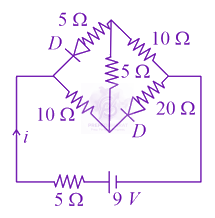
Take the breakdown voltage of the zener diode used in the given circuit as $6\text{V}$. For the input voltage shown in the figure below, the time variation of the output voltage is: (Graphs drawn are schematic and not to the scale) 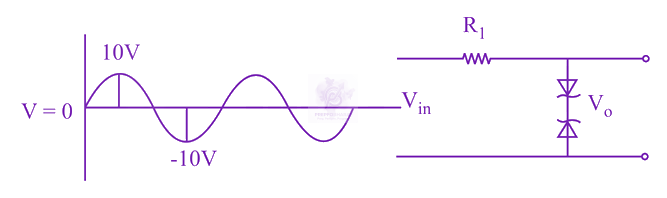
Particle $A$ of mass ${\text{m}}_{\text{A}}=\frac{\text{m}}{2}$ moving along the $\text{x}$ -axis with velocity ${\text{v}}_{0}$ collides elastically with another particle $\text{B}$ at rest having mass ${\text{m}}_{\text{B}}=\frac{\text{m}}{3}$. If both the particles move along the $\text{x}$ -axis after the collision, the change $\Delta \lambda$ in the wavelength of the particle $\text{A}$, in terms of its de-Broglie wavelength $({\lambda }_{0})$ before the collision is:
The de Broglie wavelength of an electron accelerated through a potential difference of 100 V is approximately:
In the line spectra of hydrogen atom, difference between the largest and the shortest wavelengths of the Lyman series is $305\overset{\circ }{A}$. The corresponding difference for the Paschan series in $\overset{\circ }{A}$ is:________
In the given circuit, value of $Y$ is: 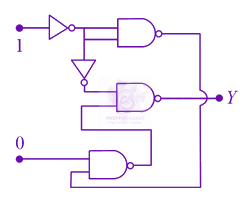
In the following, digital circuit, what will be the output a '$Z$', when the input $(A,B)$ are $(1,0),(0,0),(1,1),(0,1)$ 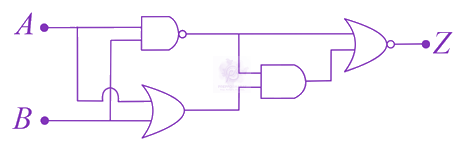
In the circuit shown below, is working as a $8Vdc$ regulated voltage source. When $12V$ is used as an input, the power dissipated (in $mW$ ) in each diode is (Considering both zener diodes are identical) 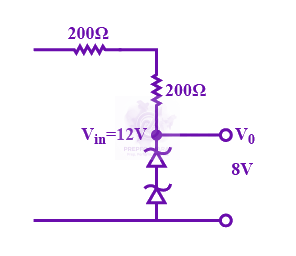
In a photoelectric effect experiment, the graph of stopping potential $V$ versus reciprocal of wavelength obtained is shown in the figure. As the intensity of incident radiation is increased : 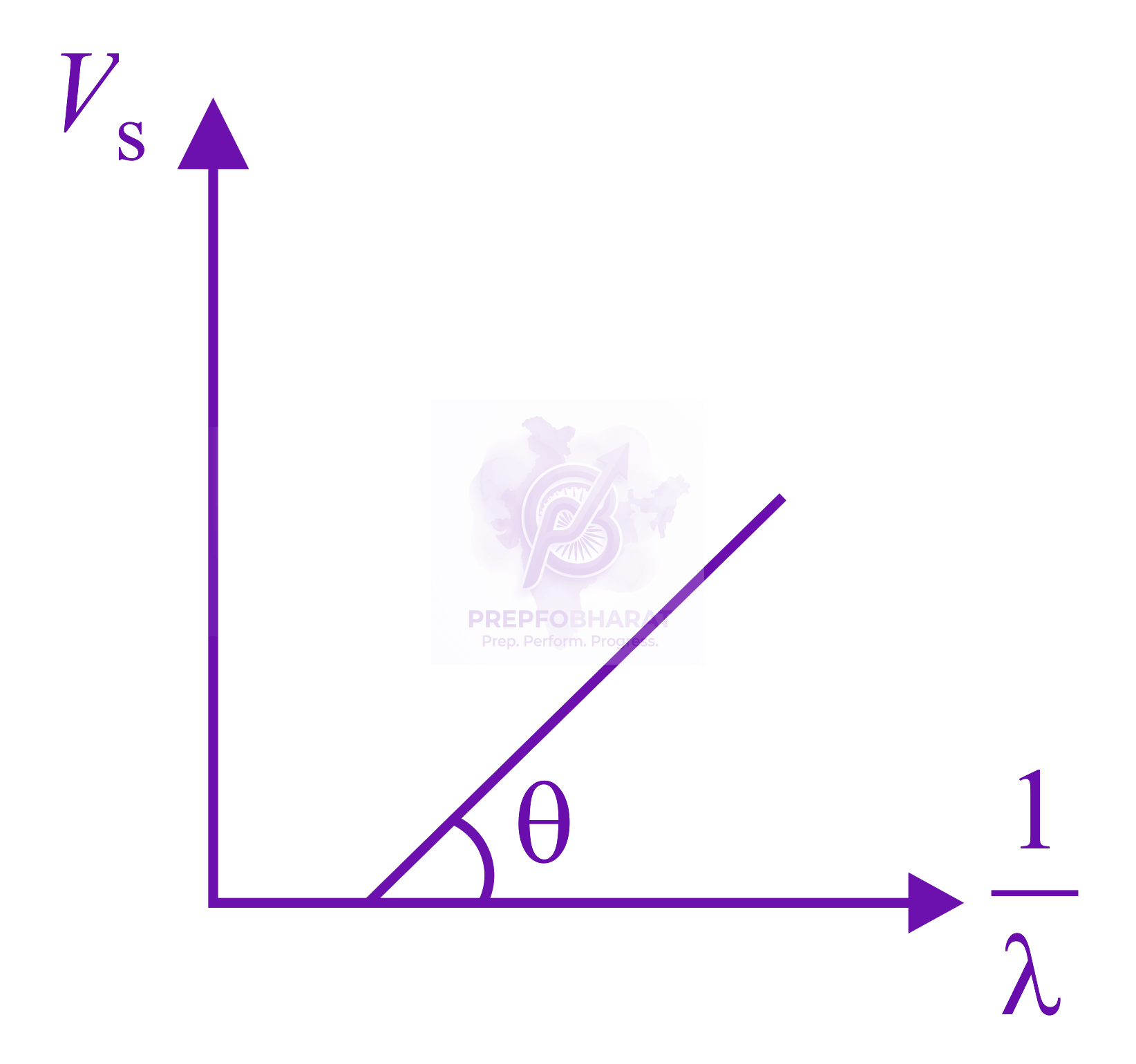
In a hydrogen atom the electron makes a transition from ${(n+1)}^{\mathrm{th}}$ level to the ${n}^{\mathrm{th}}$ level. If $n>>1$, the frequency of radiation emitted is proportional to :
If a semiconductor photo diode can detect a photon with a maximum wavelength of $400\mathrm{nm}$, then its band gap energy is: Planck's constant $h=6.63\times {10}^{-34}J.s$ Speed of light $c=3\times {10}^{8}m{s}^{-1}$
Identify the operation performed by the circuit given below : 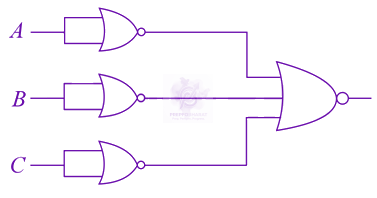
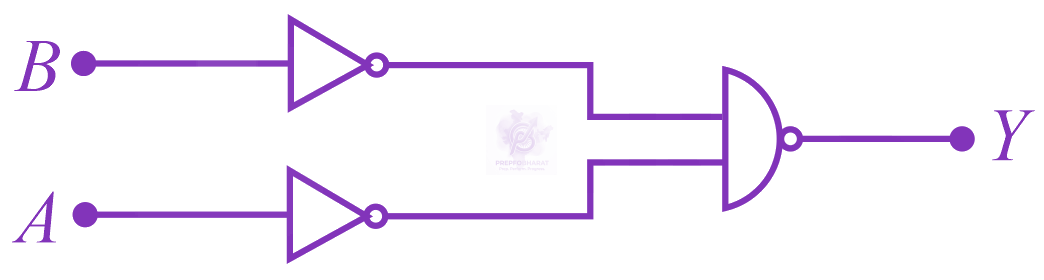
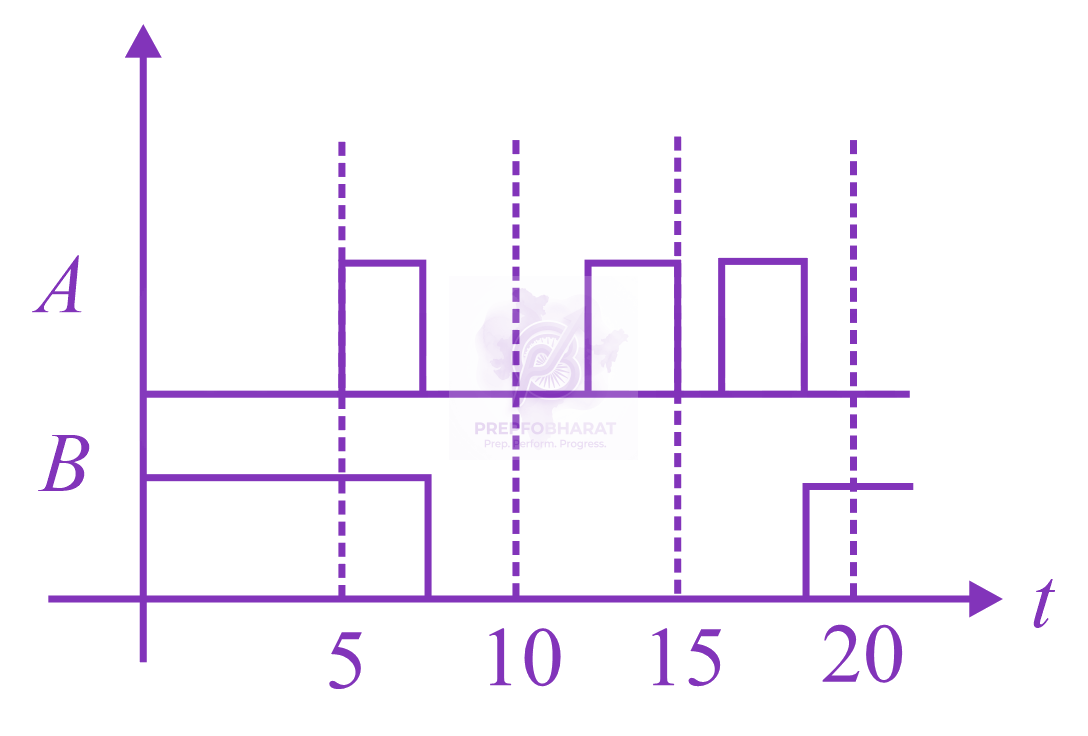
Identify the correct output signal $Y$ in the given combination of gates (as shown $n$) for the given inputs $AandB$