JEE Main Physics — Modern Physics previous year questions with solutions.
A particle is moving $5$ times as fast as an electron. The ratio of the de-Broglie wavelength of the particle to that of the electron is $1.878\times {10}^{–4}$. The mass of the particle is close to :
The energy required to ionise a hydrogen like ion in its ground state is $9$ Rydbergs. What is the wavelength of the radiation emitted when the electron in this ion jumps from the second excited stale to the ground state?
An electron (mass $m$ ) with initial velocity $\vec{v}={v}_{0}\hat{i}+{v}_{0}\hat{j}$ is in an electric filed $\vec{E}=-{E}_{0}\hat{k}.$ If ${\lambda }_{0}$ is initial de-Broglie wavelength of electron, its de-Broglie wave length at time $t$ is given by:
The surface of a metal is illuminated alternately with photons of energies ${E}_{1}=4\mathrm{eV}$ and ${E}_{2}=2.5\mathrm{eV}$ respectively. The ratio of maximum speeds of the photoelectrons emitted in the two cases is $2.$ The work function of the metal in $(\mathrm{eV})$ is..........
Two Zener diodes ($A$ and $B$) having breakdown voltages of $6V$ and $4V$ respectively, are connected as shown in the circuit below. The output voltage ${V}_{0}$ variation with input voltage linearly increasing with time, is given by (${V}_{input}=0Vatt=0$)
An electron, a doubly ionized helium ion ($He^{++}$) and proton are having the same kinetic energy. The relation between their respective de-Broglie wavelength ${\lambda }_{{e}^{*}}{\lambda }_{{\mathrm{He}}^{++}}$ and ${\lambda }_{p}$ is :
Identify the correct output signal $Y$ in the given combination of gates (as shown $n$) for the given inputs $AandB$ 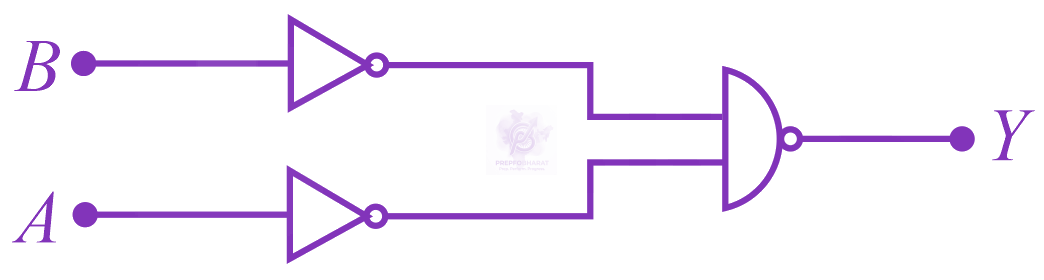 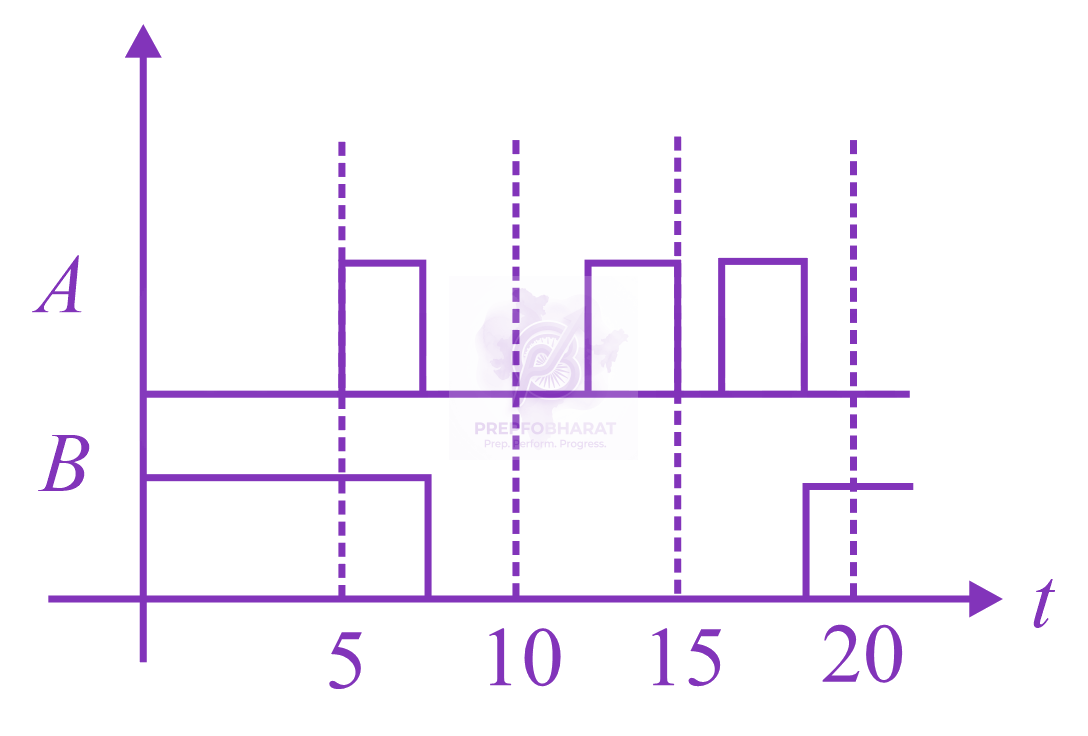
In the circuit shown below, is working as a $8Vdc$ regulated voltage source. When $12V$ is used as an input, the power dissipated (in $mW$ ) in each diode is (Considering both zener diodes are identical) 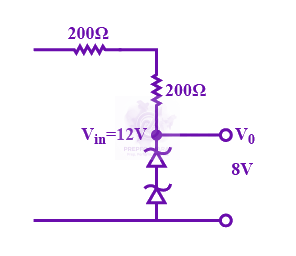
The de Broglie wavelength of an electron accelerated through a potential difference of 100 V is approximately:
An electron (of mass $m$ ) and a photon have the same energy $E$ in the range of a few $eV$. The ratio of the de-Broglie wavelength associated with the electron and the wavelength of the photon is ( $c=$ speed of light in vacuum)
In a hydrogen atom the electron makes a transition from ${(n+1)}^{\mathrm{th}}$ level to the ${n}^{\mathrm{th}}$ level. If $n>>1$, the frequency of radiation emitted is proportional to :
Identify the operation performed by the circuit given below : 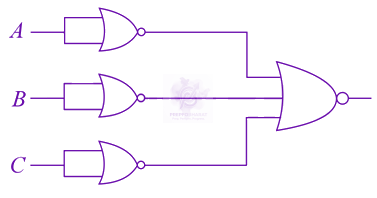
A particle $'P'$ is formed due to a completely inelastic collision of particles $'x'$ and $'y'$ having de-Broglie wavelengths $'{\lambda }_{x}'$ and $'{\lambda }_{y}'$ respectively. If $x$ and $y$ were moving in opposite directions, then the de-Broglie wavelength of $'P'$ is:
Taking the wavelength of first Balmer line in hydrogen spectrum $(n=3$ to $n=2)$ as $660 nm$ , the wavelength of the ${2}^{nd}$ Balmer line $(n = 4$ to $n = 2)$ will be :
The figure represents a voltage regulator circuit using a Zener diode. The breakdown voltage of the Zener diode is $6 V$ and the load resistance is, ${R}_{L}=4 k\Omega$ . The series resistance of the circuit is ${R}_{i}=1 k\Omega$ . If the battery voltage ${V}_{B}$ varies from $8 V$ to $16 V$ , what are the minimum and maximum values of the current through Zener diode? 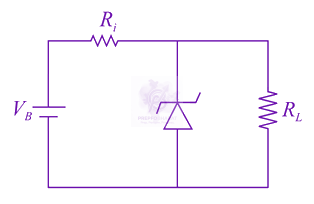
Light is incident normally on a completely absorbing surface with an energy flux of $25 W c{m}^{-2}$ . If the surface has an area of $25 c{m}^{2}$ , the momentum transferred to the surface in $\text{40} \text{min}$ time duration will be:
Radiation coming from transitions $n=2$ to $n=1$ of hydrogen atoms fall on ${He}^{+}$ ions in $n=1$ and $n=2$ states. The possible transition of helium ions as they absorb energy from the radiation is:
The electron in a hydrogen atom first jumps from the third excited state to the second excited state and subsequently to the first excited state. The ratio of the respective wavelengths $\frac{{\lambda }_{1}}{{\lambda }_{2}}$ of the photons emitted in this process is:
The circuit shown below contains two ideal diodes, each with a forward resistance of $50 \Omega$. If the battery voltage is $6 \mathrm{~V},$ the current through the $100 \Omega$ resistance (in Amperes) is: 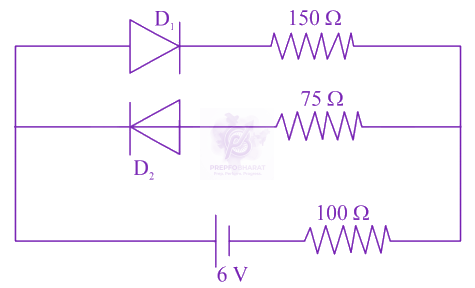
The stopping potential ${V}_{o}$ (in volt) as a function of frequency $(v)$ for a sodium emitter, is shown in the figure. The work function of sodium, form the data plotted in the figure, will be: (Given: Planck’s constant $(h)=6.63\times {10}^{-34} J s$ , electron charge $( \text{e} )$ $=1.6\times {10}^{-19} C)$ 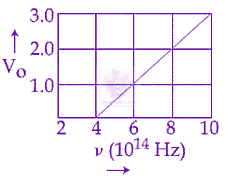
The electric field of light wave is given as $\vec{E }={10}^{–3}\mathrm{cos}(\frac{2\pi x}{5\times {10}^{–7}}-2\pi \times 6\times {10}^{14} t)\overset{^}{x}\frac{N}{C}$ . This light falls on a metal plate of work function $2 eV$ . The stopping potential of the photo-electrons is: Given, $E$ (in $eV$ ) $=\frac{12375}{\lambda (in Å)}$
A nucleus $A,$ with a finite de-broglie wavelength ${\lambda }_{A},$ undergoes spontaneous fission into two nuclei $B$ and $C$ of equal mass. $B$ flies in the same direction as that of $A,$ while $C$ flies in the opposite direction with a velocity equal to half of that of $B.$ The de-Broglie wavelengths ${\lambda }_{B}$ and ${\lambda }_{C}$ of B and C are respectively:
For the circuit shown below, the current through the Zener diode is 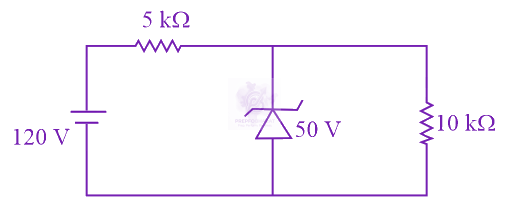
Two particles move at right angle to each other. Their de Broglie wavelengths are ${\lambda }_{1}$ and ${\lambda }_{2}$ respectively. The particles suffer perfectly inelastic collision. The de Broglie wavelength $\lambda$ of the final particle, is given by: