JEE Main Physics — Modern Physics previous year questions with solutions.
Four NOR gates are connected as shown in figure. The truth table for the given figure is : 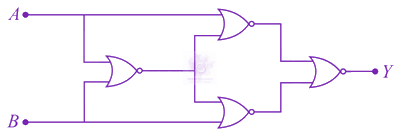
A particle of mass $9.1\times {10}^{-31}\mathrm{kg}$ travels in a medium with a speed of ${10}^{6}m{s}^{-1}$ and a photon of radiation of linear momentum ${10}^{-27}\mathrm{kg}m{s}^{-1}$ travels in a vacuum. The wavelength of the photon is ____ times the wavelength of the particle.
Two stream of photons, possessing energies equal to twice and ten times the work function of metal are incident on the metal surface successively. The value of ratio of maximum velocities of the photoelectrons emitted in the two respective cases is $x:3$ The value of $x$ is
The truth table for the following logic circuit is : 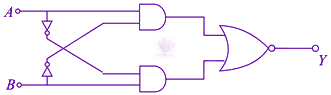
The zener diode has a ${V}_{z}=30V$. The current passing through the diode for the following circuit is___$\mathrm{mA}.$ 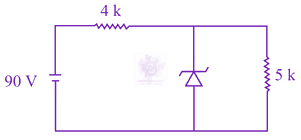
The wavelength of the photon emitted by a hydrogen atom when an electron makes a transition from $n=2$ to $n=1$ state is:
The recoil speed of a hydrogen atom after it emits a photon in going from $n=5$ state to $n=5$ state will be
Identify the logic operation carried out by the given circuit: 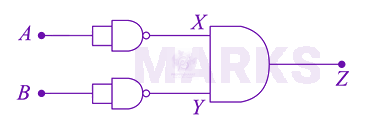
Statement I : To get a steady DC output from the pulsating voltage received from a full wave rectifier we can connect a capacitor across the output parallel to the load ${R}_{L}.$ Statement II : To get a steady DC output from the pulsating voltage received from a full wave rectifier we can connect an inductor in series with ${R}_{L}.$ In the light of the above statements, choose the most appropriate answer from the options given below :
The circuit contains two diodes each with a forward resistance of $50\Omega$ and with infinite reverse resistance. If the battery voltage is $6V$, the current through the $120\Omega$ resistance is _______ $\mathrm{mA}$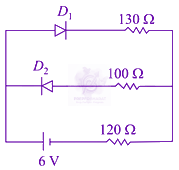
If ${\lambda }_{1}$ and ${\lambda }_{2}$ are the wavelengths of the third member of Lyman and first member of the Paschen series respectively, then the value of ${\lambda }_{1}:{\lambda }_{2}$ is :
If an electron is moving in the ${n}^{\text{th }}$ orbit of the hydrogen atom, then its velocity $({v}_{n})$ for the ${n}^{\text{th }}$ orbit is given as:
An electron and proton are separated by a large distance. The electron starts approaching the proton with energy $3\mathrm{eV}$. The proton captures the electrons and forms a hydrogen atom in second excited state. The resulting photon is incident on a photosensitive metal of threshold wavelength $4000A$ What is the maximum kinetic energy of the emitted photoelectron?
The following logic gate is equivalent to : 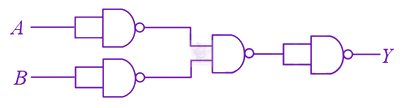
An oil drop of the radius $2\mathrm{mm}$ with a density $3g$ ${\mathrm{cm}}^{-3}$ is held stationary under a constant electric field $3.55\times {10}^{5}V{m}^{-1}$ in the Millikan's oil drop experiment. What is the number of excess electrons that the oil drop will possess? $(\text{consider}g=9.81m{s}^{-2})$.
An electron of mass $m$ and a photon have same energy $E.$ The ratio of wavelength of electron to that of photon is : ($c$ being the velocity of light)
The de-Broglie wavelength of a particle having kinetic energy $E$ is $\lambda .$ How much extra energy must be given to this particle so that the de-Broglie wavelength reduces to $75%$ of the initial value?
A particle is travelling $4$ times as fast as an electron. Assuming the ratio of de-Broglie wavelength of a particle to that of electron is $2:1,$ the mass of the particle is :-
The atomic hydrogen emits a line spectrum consisting of various series. Which series of hydrogen atomic spectra is lying in the visible region?
When radiation of wavelength $\lambda$ is incident on a metallic surface, the stopping potential of ejected photoelectrons is $4.8V$. If the same surface is illuminated by radiation of double the previous wavelength, then the stopping potential becomes $1.6V$. The threshold wavelength of the metal is:
In the given figure, the energy levels of hydrogen atom have been shown along with some transitions marked $A,B,C,D$ and $E$. The transitions $A,B$ and $C$ respectively represent 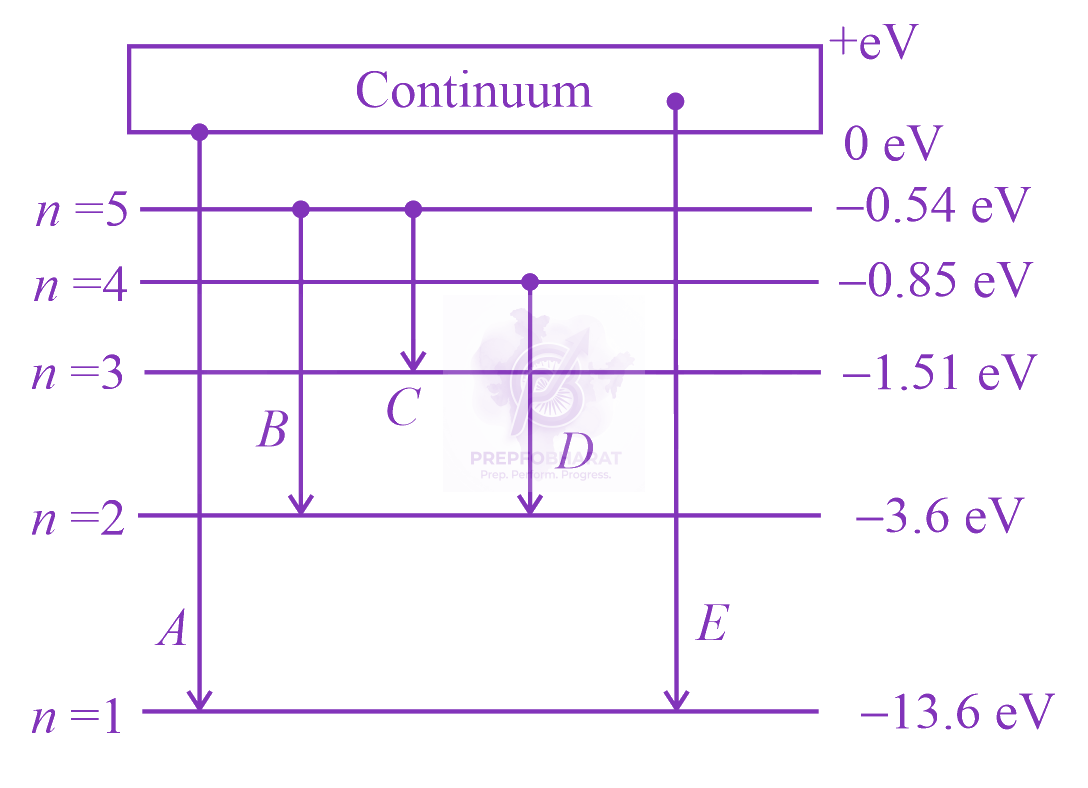
Given below are two statements: Statement $I:$ Two photons having equal linear momenta have equal wavelengths. Statement $\mathrm{II}:$ If the wavelength of the photon is decreased, then the momentum and energy of a photon will also decrease. In the light of the above statements, choose the correct answer from the options given below.
When radiation of wavelength $A$ is used to illuminate a metallic surface, the stopping potential is $V$. When the same surface is illuminated with radiation of wavelength $3A$, the stopping potential is $\frac{V}{4}$. If the threshold wavelength for the metallic surface is $n\lambda$ then value of $n$ will be :
The time period of revolution of electron in its ground state orbit in a hydrogen atom is $1.6\times {10}^{-16}s.$ The frequency of revolution of the electron in its first excited state (in ${s}^{-1}$ ) is: