JEE Main Physics — Modern Physics previous year questions with solutions.
If ${V}_{A}$ and ${V}_{B}$ are the input voltages (either $5V$ or $0V$) and ${V}_{0}$ is the output voltage then the two gates represented in the following circuits $(A)$ and $(B)$ are : 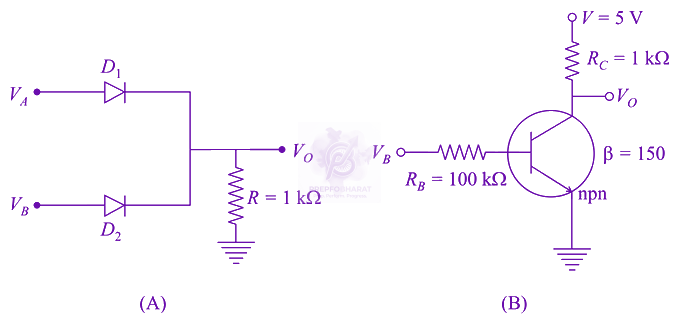
Consider two separate ideal gases of electrons and protons having same number of particles. The temperature of both the gases are same. The ratio of the uncertainty in determining the position of an electron to that of a proton is proportional to:
In connection with the circuit drawn below, the value of current flowing through $2k\Omega$ resistor is______$\times {10}^{-4}A.$ 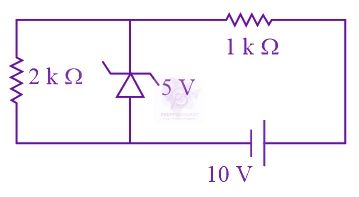
A moving proton and electron have the same de-Broglie wavelength. If $K$ and $P$ denote the $K.E.$ and momentum respectively. Then choose the correct option :
The de Broglie wavelength of a proton and $\alpha$-particle are equal. The ratio of their velocities is
The first three spectral lines of $H$-atom in the Balmer series are given ${\lambda }_{1},{\lambda }_{2},{\lambda }_{3}$ considering the Bohr atomic model, the wave lengths of first and third spectral lines $(\frac{{\lambda }_{1}}{{\lambda }_{3}})$ are related by a factor of approximately $x$ $\times {10}^{-1}$. The value of $x$, to the nearest integer, is ________.
For the forward biased diode characteristics shown in the figure, the dynamic resistance at ${I}_{D}=3\mathrm{mA}$ will be ________$\Omega .$ 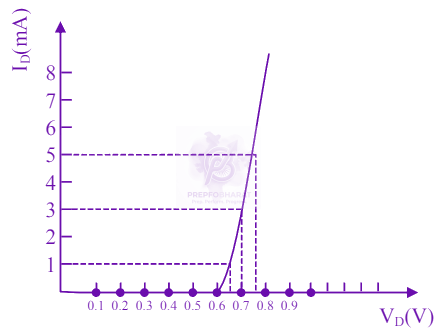
An electron having de-Broglie wavelength $\lambda$ is incident on a target in a $X$-ray tube. Cut-off wavelength of emitted $X$-ray is:
In the given figure, each diode has a forward bias resistance of $30\Omega$ and infinite resistance in reverse bias. The current ${I}_{1}$ will be : 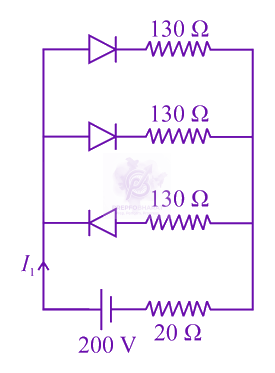
The de-Broglie wavelength associated with an electron and a proton were calculated by accelerating them through same potential of $100V$. What should nearly be the ratio of their wavelengths $?$ $({m}_{p}=1.00727u,{m}_{e}=0.00055u)$
Which one of the following will be the output of the given circuit? 
Consider the following statements: $A$. Atoms of each element emit characteristics spectrum. $B.$ According to Bohr's Postulate, an electron in a hydrogen atom revolves in a certain stationary orbit. $C.$ The density of nuclear matter depends on the size of the nucleus. $D.$ A free neutron is stable but a free proton decay is possible. $E.$ Radioactivity is an indication of the instability of nuclei. Choose the correct answer from the options given below.
Statement I: By doping silicon semiconductors with pentavalent material, the electrons density increases. Statement II: The $n-$type of semiconductor has a net negative charge. In the above statements, choose the most appropriate answer from the options given below:
A light beam of wavelength $500\mathrm{nm}$ is incident on a metal having work function of $1.25\mathrm{eV}$, placed in a magnetic field of intensity $B$. The electrons emitted perpendicular to the magnetic field $B$, with maximum kinetic energy are bent into a circular arc of radius $30\mathrm{cm}$. The value of $B$ is ________$\times {10}^{-7}T$. Given $hc=20\times {10}^{-26}Jm$, the mass of the electron$=9\times {10}^{-31}\mathrm{kg}$.
A particular hydrogen like ion emits radiation of frequency $2.92\times {10}^{15}\mathrm{Hz}$ when it makes transition from $n=3$ to $n=1$. The frequency in $\mathrm{Hz}$ of radiation emitted in transition from $n=2$ to $n=1$ will be:
Choose the correct waveform that can represent the voltage across $R$ of the following circuit, assuming the diode is ideal one: 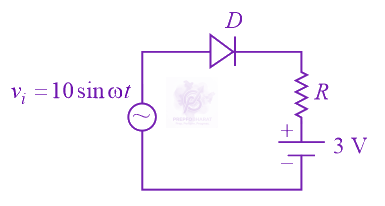
A free electron of $2.6\mathrm{eV}$ energy collides with a ${H}^{+}$ ion. This results in the formation of a hydrogen atom in the first excited state and a photon is released. Find the frequency of the emitted photon. $(h=6.6\times {10}^{-34}Js)$
Which level of the single ionized carbon has the same energy as the ground state energy of hydrogen atom?
$X$ different wavelength may be observed in the spectrum from a hydrogen sample if the atoms are excited to states with principal quantum number $n=6$? The value of $X$ is
LED is constructed from $Ga-As-P$ semiconducting material. The energy gap of this LED is $1.9\mathrm{eV}$. Calculate the wavelength of light emitted and its colour. $h=6.63\times {10}^{-34}J-s$ and $c=3\times {10}^{8}m{s}^{-1}$
In a photoelectric experiment, ultraviolet light of wavelength $280\mathrm{nm}$ is used with lithium cathode having work function $\phi =2.5\mathrm{eV}$. If the wavelength of incident light is switched to $400\mathrm{nm}$, find out the change in the stopping potential. $(h=6.63\times {10}^{-34}Js,c=3\times {10}^{8}{ms}^{-1})$
For the circuit shown below, calculate the value of ${I}_{z}:$ 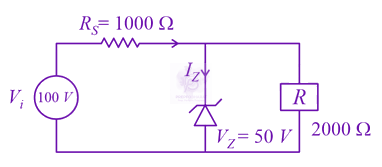
The temperature of an ideal gas in three dimensions is $300K.$ The corresponding de-Broglie wavelength of the electron approximately at $300K$ is: $[{m}_{e}=$mass of electron $=9\times {10}^{-31}\mathrm{kg}$, $h=$Planck constant $=6.6\times {10}^{-34}Js$, ${k}_{B}=$Boltzmann constant$=1.38\times {10}^{-23}J{K}^{-1}]$
What should be the order of arrangement of de-Broglie wavelength of electron $({\lambda }_{e})$, an $\alpha$-particle $({\lambda }_{\alpha })$ and proton $({\lambda }_{p})$ given that all have the same kinetic energy ?