JEE Main Physics — Electromagnetism previous year questions with solutions.
When a resistance of $5\Omega$ is shunted with a moving coil galvanometer, it shows a full scale deflection for a current of $250\mathrm{mA},$ however when $1050\Omega$ resistance is connected with it in series, it gives full scale deflection for $25$ volt. The resistance of galvanometer is$_________\Omega .$
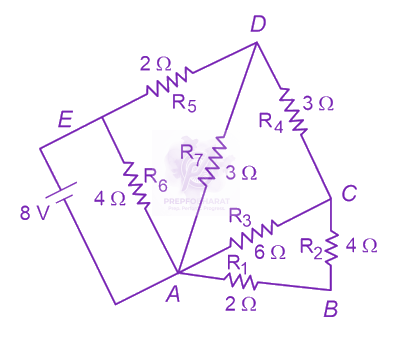 The current flowing through ${R}_{2}$ is :
A wire of resistance $160Ω$ is melted and drawn in a wire of one-fourth of its length. The new resistance of the wire will be
In the circuit diagram shown in figure given below, the current flowing through resistance $3\Omega$ is $\frac{x}{3}A$. The value of $x$ is ________. 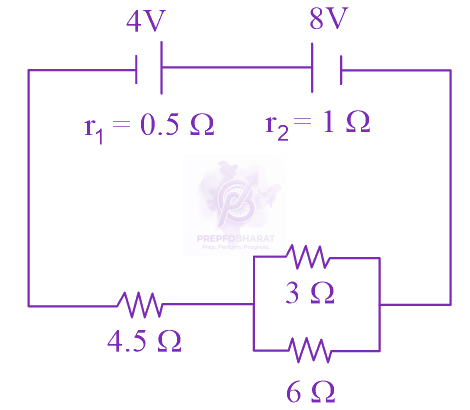
The number density of free electrons in copper is nearly $8\times {10}^{28}{m}^{-3}$. A copper wire has its area of cross-section $=2\times {10}^{-6}{m}^{2}$ and is carrying a current of $3.2A$. The drift speed of the electrons is _____$\times {10}^{-6}m{s}^{-1}$.
$10$ resistors each of resistance $10Ω$ can be connected in such as to get maximum and minimum equivalent resistance. The ratio of maximum and minimum equivalent resistance will be________.
The equivalent resistance of the circuit shown below between points $a$ and $b$ is : 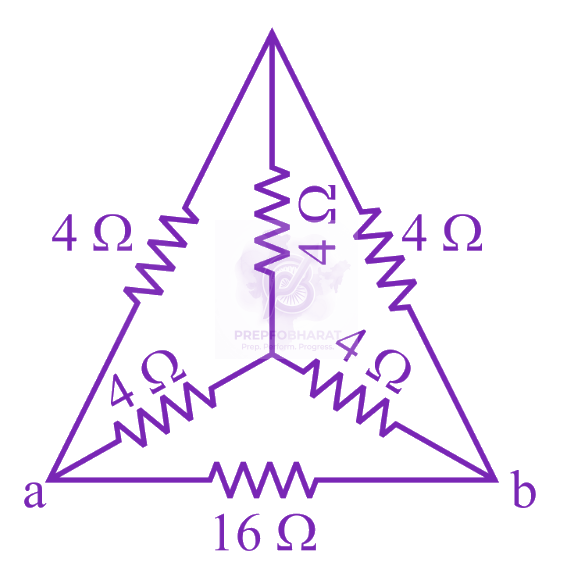
In the given circuit the value of $|\frac{{I}_{1}+{I}_{3}}{{I}_{2}}|$ is: 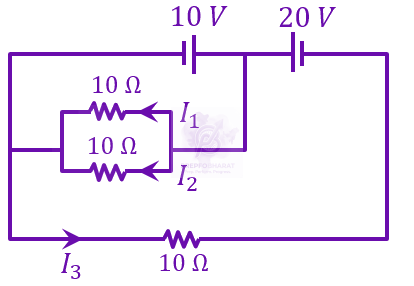
Two identical cells, when connected either in parallel or in series gives same current in an external resistance $5\Omega$. The internal resistance of each cell will be ______ $\Omega$.
The resistance of a wire is $5\Omega$. Its new resistance in ohm, if stretched to $5$ times of its original length will be :
The current flowing through a conductor connected across a source is $2A$ and $1.2A$ at ${0}^{o}C$ and ${100}^{o}C$ respectively. The current flowing through the conductor at ${50}^{o}C$ will be _____ $\times {10}^{2}\mathrm{mA}$.
Given below are two statements: Statement I : The diamagnetic property depends on temperature. Statement II : The induced magnetic dipole moment in a diamagnetic sample is always opposite to the magnetising field. In the light of given statements, choose the correct answer from the options given below
The current required to be passed through a solenoid of $15\mathrm{cm}$ length and $60$ turns in order to demagnetise a bar magnet of magnetic intensity $2.4\times {10}^{3}A{m}^{–1}$ is ________ $A$.
If the potential difference between $B$ and $D$ is zero, the value of $x$ is $\frac{1}{n}\Omega$. The value of $n$ is ______. 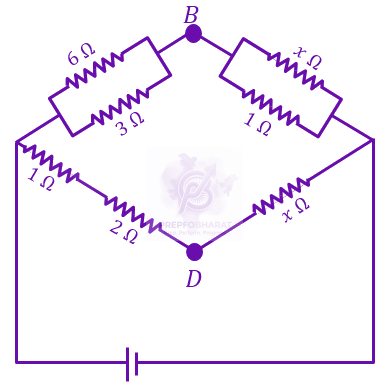
A $10\mu C$ charge is divided into two parts and placed at $1\mathrm{cm}$ distance so that the repulsive force between them is maximum. The charges of the two parts are:
Let $\sigma$ be the uniform surface charge density of two infinite thin plane sheets shown in figure. Then the electric fields in three different region ${E}_{I},{E}_{II}$ and ${E}_{III}$ 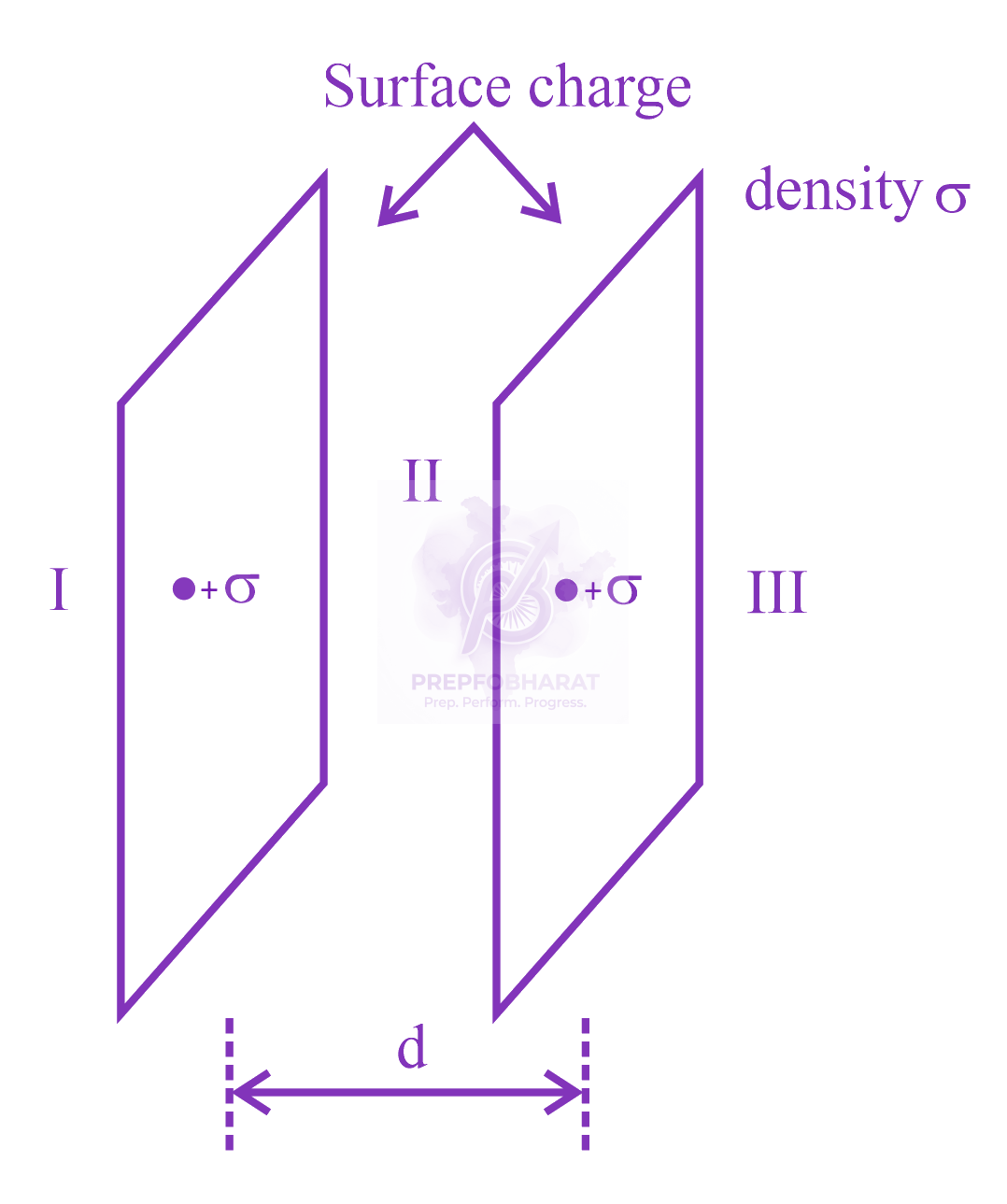
A square loop of side $2.0\mathrm{cm}$ is placed inside a long solenoid that has $50$ turns per centimetre and carries a sinusoidally varying current of amplitude $2.5A$ and angular frequency $700\mathrm{rad}{s}^{-1}$. The central axes of the loop and solenoid coincide. The amplitude of the emf induced in the loop is $x\times {10}^{-4}V$. The value of $x$ is ___________ $($ Take, $\pi =\frac{22}{7})$
An electric dipole of dipole moment is $6.0\times {10}^{-6}Cm$ placed in a uniform electric field of $1.5\times {10}^{3}N{C}^{-1}$ in such a way that dipole moment is along electric field. The work done in rotating dipole by $180^{\circ}$in this field will be_______$\mathrm{mJ}$.
Given below are two statements: one is labelled as Assertion $A$ and the other is labelled as Reason $R$ Assertion $A$: A bar magnet dropped through a metallic cylindrical pipe takes more time to come down compared to a non-magnetic bar with same geometry and mass. Reason $R$: For the magnetic bar, Eddy currents are produced in the metallic pipe which oppose the motion of the magnetic bar. In the light of the above statements, choose the correct answer from the options given below
A single current carrying loop of wire carrying current $I$ flowing in anticlockwise direction seen from $+vez$ direction and lying in $xy$ plane is shown in figure. The plot of $\hat{j}$ component of magnetic field $(By)$ at a distance $a$ (less than radius of the coil) and on $yz$ plane $vsz$ coordinate looks like 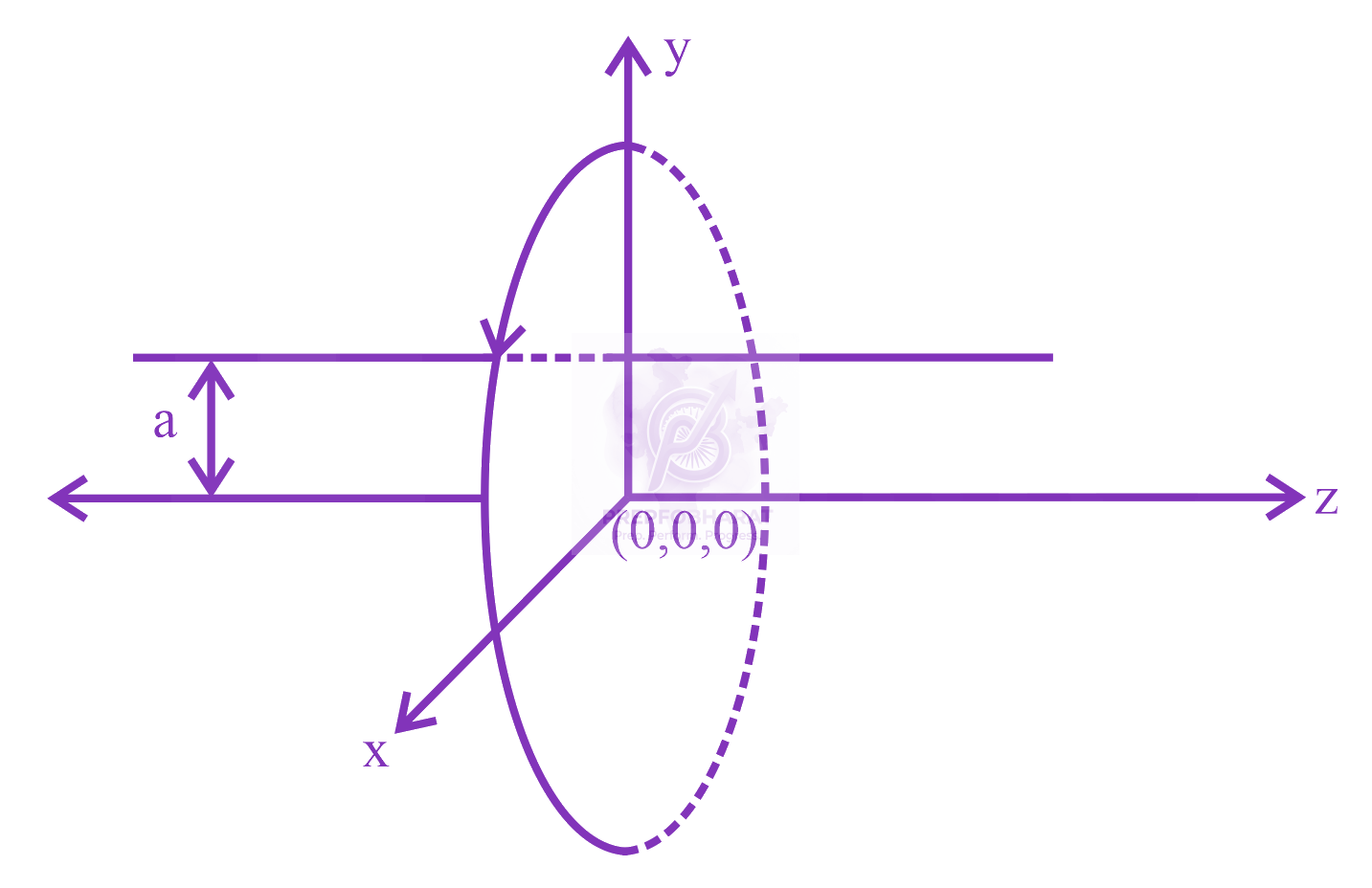
Find the magnetic field at the point P in figure. The curved portion is a semicircle connected to two long straight wires. 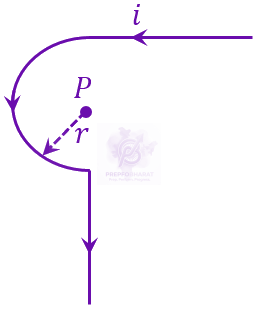
Which of the following Maxwell’s equation is valid for time varying conditions but not valid for static conditions:
The equivalent resistance between $AandB$ of the network shown in figure: 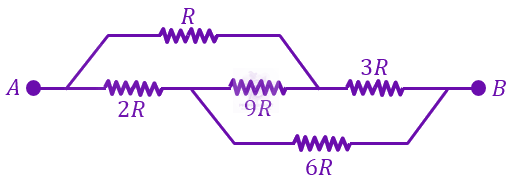
A cell of emf $90V$ is connected across series combination of two resistors each of $100\Omega$ resistance. A voltmeter of resistance $400\Omega$ is used to measure the potential difference across each resistor. The reading of the voltmeter will be: