JEE Main Physics — Electromagnetism previous year questions with solutions.
The amplitude of magnetic field in an electromagnetic wave propagating along $y$-axis is $6.0\times {10}^{–7}T$. The maximum value of electric field in the electromagnetic wave is
As per the given figure, if $\frac{dI}{dt}=-1A{s}^{-1}$, then the value of ${V}_{\mathrm{AB}}$ at this instant will be ______ $V$. 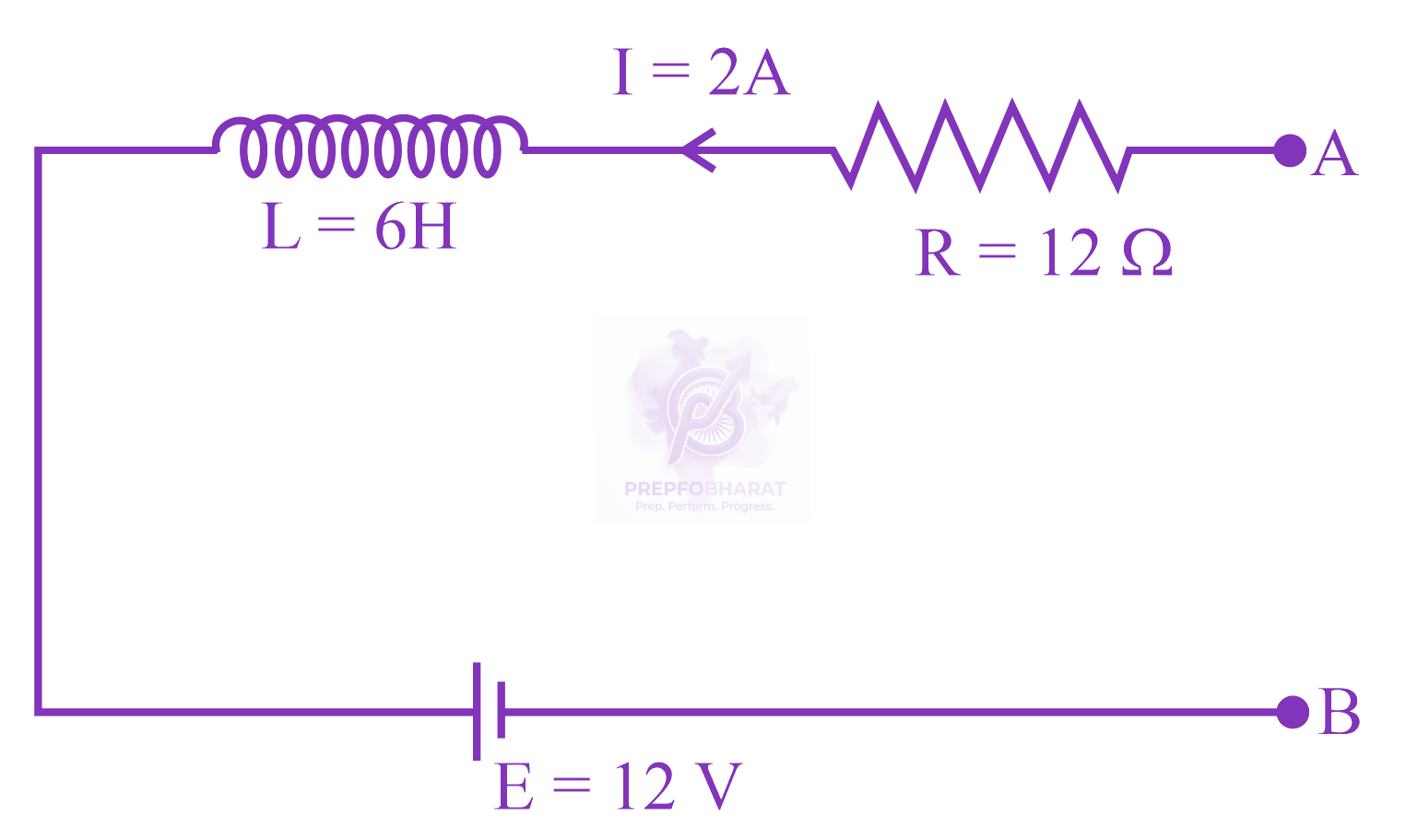
For a charged spherical ball, electrostatic potential inside the ball varies with $r$ as $V=2a{r}^{2}+b$. Here, $a$ and $b$ are constant and $r$ is the distance from the center. The volume charge density inside the ball is $-\lambda a\epsilon$. The value of $\lambda$ is ______. $\epsilon =$ permittivity of medium.
Given below are two statements: Statement I: If the number of turns in the coil of a moving coil galvanometer is doubled then the current sensitivity becomes double. Statement II: Increasing current sensitivity of a moving coil galvanometer by only increasing the number of turns in the coil will also increase its voltage sensitivity in the same ratio In the light of the above statements, choose the correct answer from the options given below:
The electric field in an electromagnetic wave is given as $\vec{E}=20\mathrm{sin}\omega (t-\frac{x}{c})\vec{j}N{C}^{-1}$, where $\omega$ and $c$ are angular frequency and velocity of electromagnetic wave respectively. The energy contained in a volume of $5\times {10}^{-4}{m}^{3}$ will be (Given ${\epsilon }_{0}=8.85\times {10}^{-12}{C}^{2}{N}^{-1}{m}^{-2}$)
The magnetic intensity at the centre of a long current carrying solenoid is found to be $1.6\times {10}^{3}A{m}^{-1}$. If the number of turns is $8$ per $\mathrm{cm}$, then the current flowing through the solenoid is $______A.$
A $12V$ battery connected to a coil of resistance $6Ω$ through a switch, drives a constant current in the circuit. The switch is opened in $1\mathrm{ms}$. The emf induced across the coil is $20V$. The inductance of the coil is :
Two charges of each magnitude $0.01C$ and separated by a distance of $0.4\mathrm{mm}$ constitute an electric dipole. If the dipole is placed in an uniform electric field $\vec{E}$ of $10\mathrm{dyne}\cdot {C}^{-1}$ making ${30}^{\circ }$ angle with $\vec{E},$ the magnitude of torque acting on dipole is:
The electric field due to a short electric dipole at a large distance $(r)$ from center of dipole on the equatorial plane varies with distance as :
Three point charges $q,-2q$ and $2q$ are placed on $x$ axis at a distance $x=0,x=\frac{3}{4}R$ and $x=R$ respectively from origin as shown. If $q=2\times {10}^{-6}C$ and $R=2\mathrm{cm}$, the magnitude of net force experienced by the charge $-2q$ is _____ $N$. 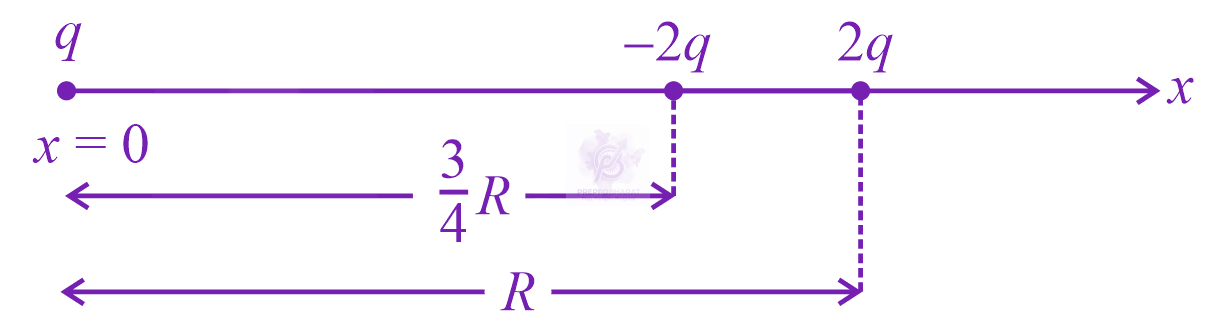
An electron revolves around an infinite cylindrical wire having uniform linear charge density $2\times {10}^{-8}$ $C{m}^{-1}$ in circular path under the influence of attractive electrostatic field as shown in the figure. The velocity of electron with which it is revolving is ______________ $\times {10}^{6}m{s}^{-1}$. Given mass of electron $=9\times {10}^{-31}\mathrm{kg}$ 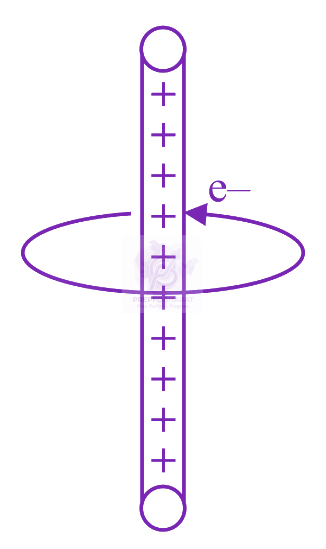
Two equal positive point charges are separated by a distance $2a$. The distance of a point from the centre of the line joining two charges on the equatorial line (perpendicular bisector) at which force experienced by a test charge ${q}_{0}$ becomes maximum is $\frac{a}{\sqrt{x}}$. The value of $x$ is ______.
As shown in the figure, a point charge $Q$ is placed at the centre of conducting spherical shell of inner radius $a$ and outer radius $b$. The electric field due to charge $Q$ in three different regions $I,II\text{and}III$ is given by : $(I:r<a,II:a<r<b,III:r>b)$ 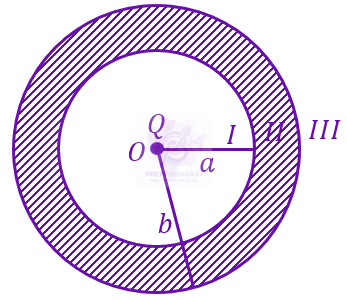
A point charge $2\times {10}^{–2}C$ is moved from $P$ to $S$ in a uniform electric field of $30N{C}^{–1}$ directed along positive $x$-axis. If coordinates of $P$ and $S$ are $(1,2,0)m\text{and}(0,0,0)m$ respectively, the work done by electric field will be
In a cuboid of dimension $2L\times 2L\times L$ , a charge $q$ is placed at the centre of the surface $S$ having area of $4{L}^{2}$ . The flux through the opposite surface to $S$ is given by
A uniform electric field of $10N{C}^{-1}$ is created between two parallel charged plates (as shown in figure). An electron enters the field symmetrically between the plates with a kinetic energy $0.5\mathrm{eV}.$ The length of each plate is $10\mathrm{cm}$. The angle $(\theta )$ of deviation of the path of electron as it comes out of the field is ______(in degree). 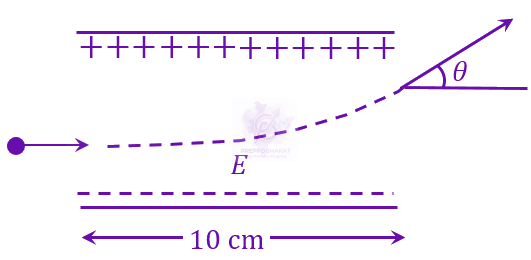
In the given figure the total charge stored in the combination of capacitors is $100\mu C$. The value of ‘$x$’ is ______________. 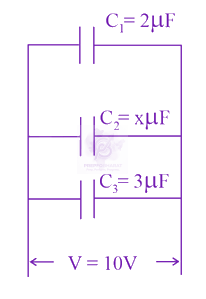
The equivalent capacitance of the combination shown is 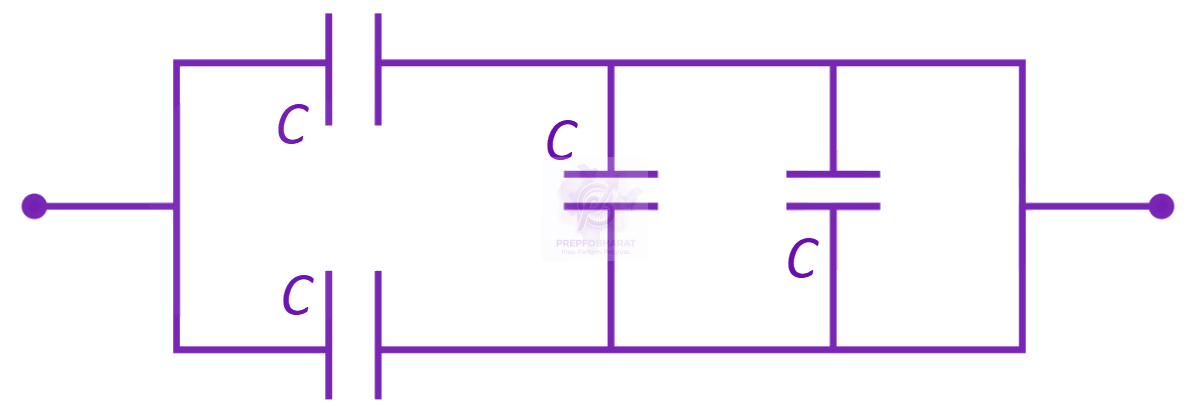
Two parallel plate capacitors ${C}_{1}$ and ${C}_{2}$ each having capacitance of $10\mu F$ are individually charged by a $100V$ D.C. source. Capacitor ${C}_{1}$ is kept connected to the source and a dielectric slab is inserted between it plates. Capacitor ${C}_{2}$ is disconnected from the source and then a dielectric slab is inserted in it. Afterwards the capacitor ${C}_{1}$ is also disconnected from the source and the two capacitors are finally connected in parallel combination. The common potential of the combination will be _____ $V$. (Assuming Dielectric constant $=10$)
A parallel plate capacitor with air between the plate has a capacitance of $15\mathrm{pF}$. The separation between the plate becomes twice and the space between them is filled with a medium of dielectric constant $3.5$. Then the capacitance becomes $\frac{x}{4}\mathrm{pF}$. The value of $x$ is____.
A straight wire carrying a current of $14A$ is bent into a semicircular arc of radius $2.2\mathrm{cm}$ as shown in the figure. The magnetic field produced by the current at the centre $O$ of the arc is ____ $\times {10}^{–4}T$ 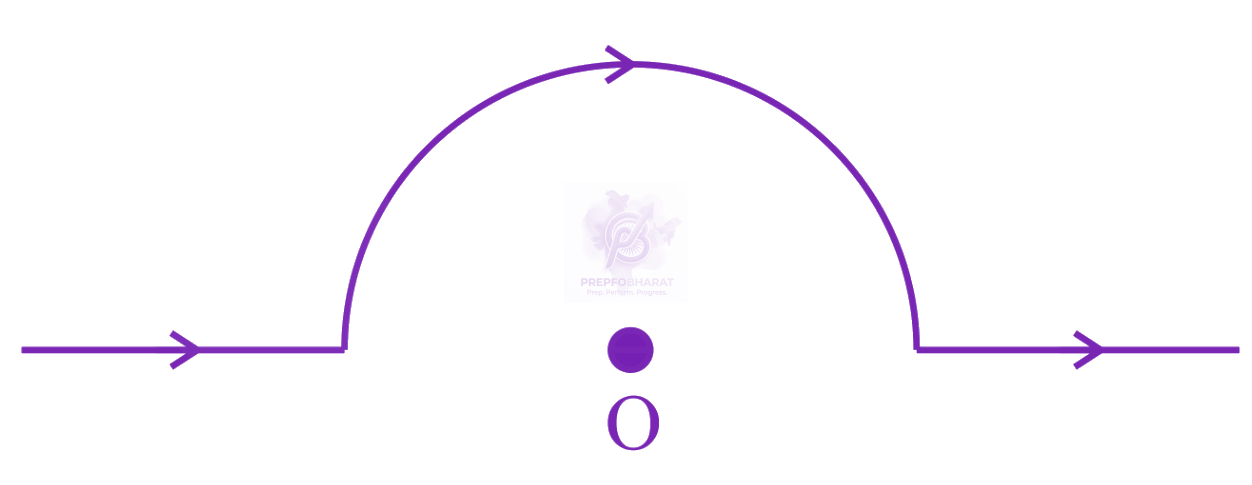
A current of $2A$ flows through a wire of cross-sectional area $25.0{\mathrm{mm}}^{2}$. The number of free electrons in a cubic meter are $2.0\times {10}^{28}$. The drift velocity of the electrons is _____ $\times {10}^{-6}{\mathrm{ms}}^{-1}$ (given, charge on electron $=1.6\times {10}^{-19}C$).
Given below are two statements: Statement I : The equivalent resistance of resistors in a series combination is smaller than least resistance used in the combination. Statement II : The resistivity of the material is independent of temperature. In the light of the above statements, choose the correct answer from the options given below:
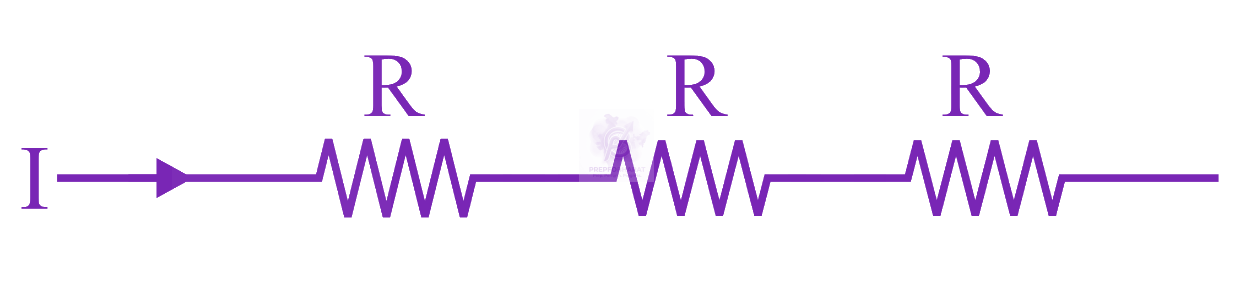
Different combination of $3$ resistors of equal resistance $R$ are shown in the figures. The increasing order for power dissipation is: (A) 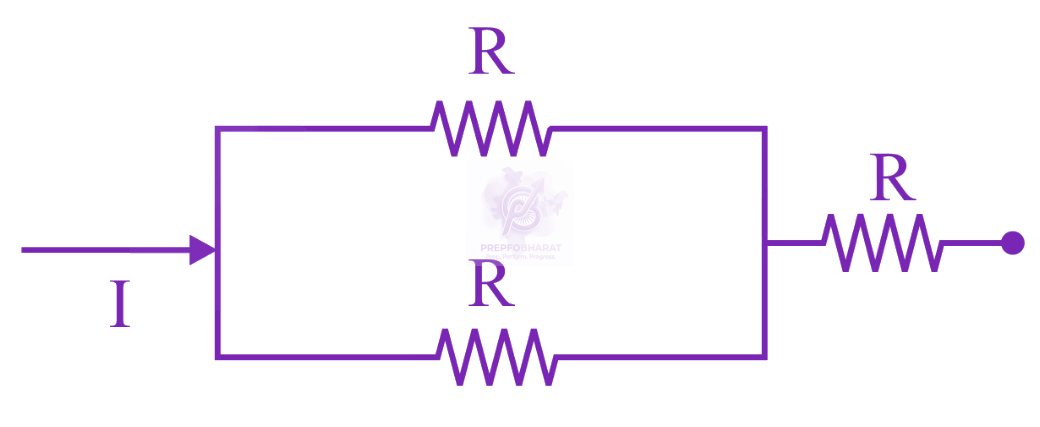 (B) 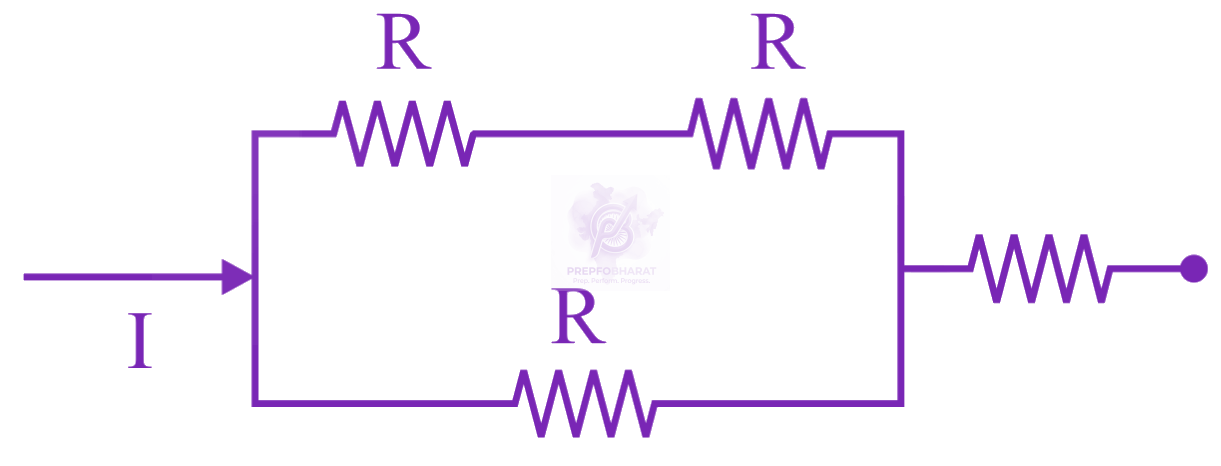 (C) 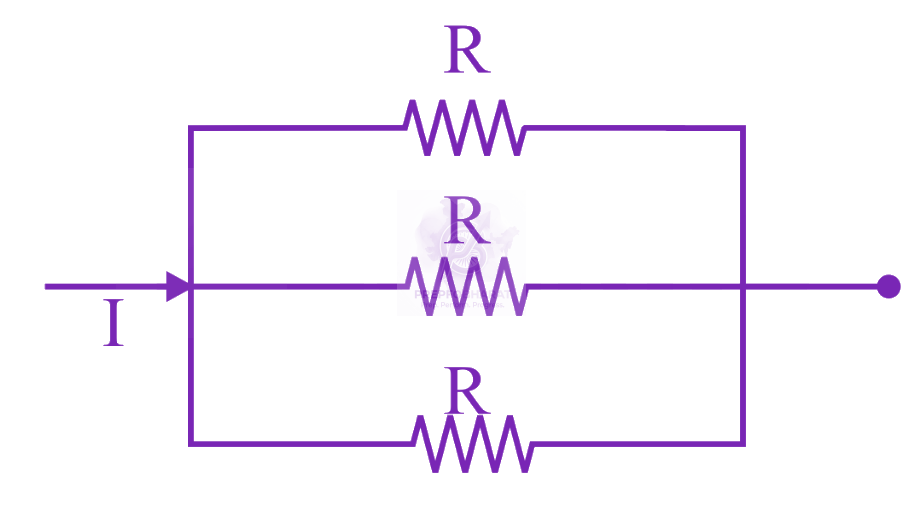 (D)