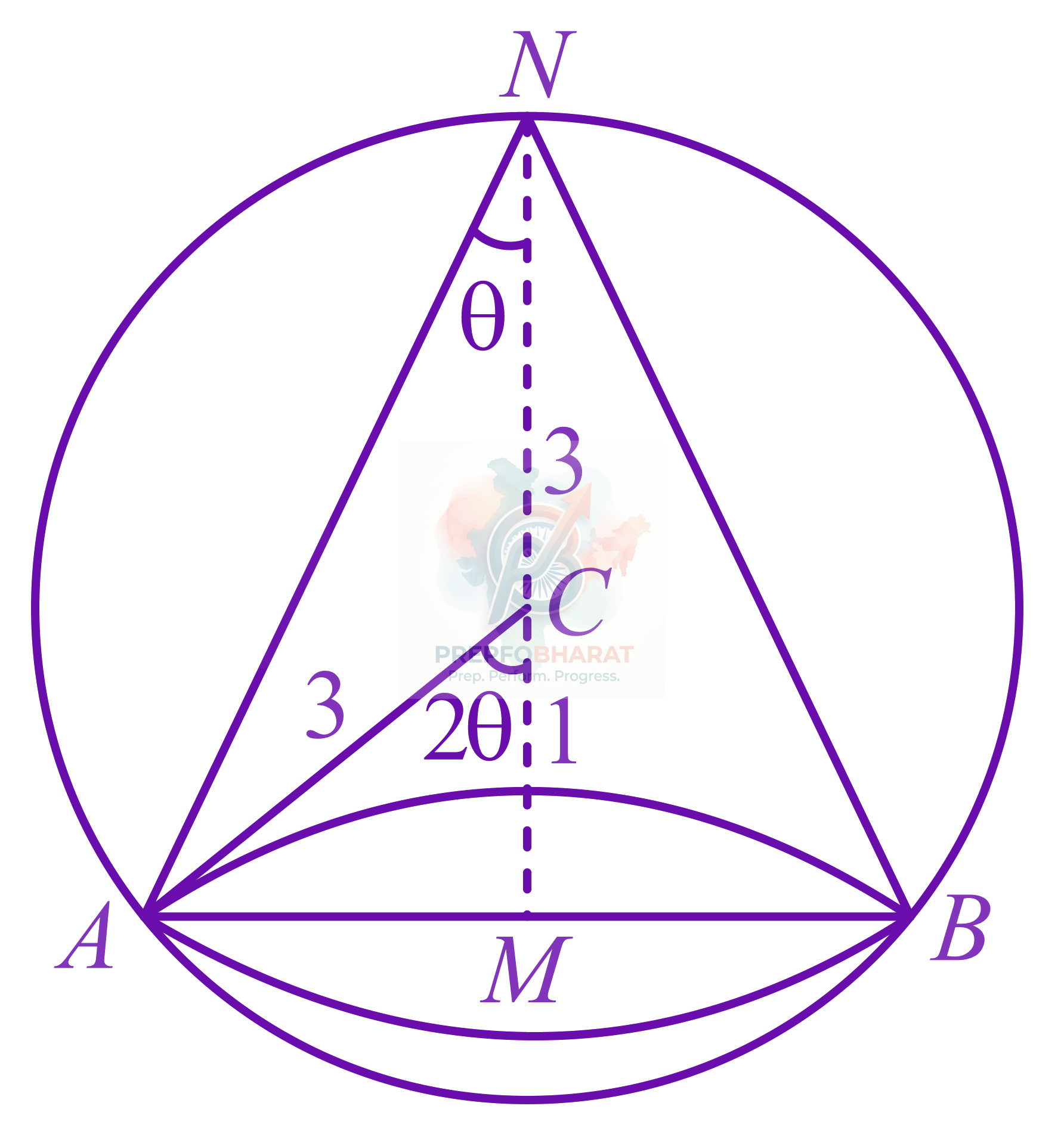
In \triangle AMC,AM=3\mathrm{sin}2\theta &MC=3\mathrm{cos}2\theta
V=31πr2h where, r is radius and h is height of cone
⇒V=31π(3sin2θ)2(3+3cos2θ)
(since, radius of cone =AM and height of cone =MC)
\Rightarrow V=\pi (36{\mathrm{sin}}^{2}\theta {\mathrm{cos}}^{2}\theta )(2{\mathrm{cos}}^{2}\theta ) [\because \mathrm{sin}2\theta =2\mathrm{sin}\theta \mathrm{cos}\theta &\mathrm{cos}2\theta =2{\mathrm{cos}}^{2}\theta -1]
=72πsin2θcos4θ
Differentiating both sides with respect to θ, we get
dθdv=72π[2sinθcos5θ−4sin3θcos3θ]
For maximum value, dθdV=0
⇒72π[2sinθcos5θ−4sin3θcos3θ]=0⇒tan2θ=21
Thus, volume is maximum when tanθ=21
Hence, curved surface area S=πrl
=πr(3+3cos2θ)2+(3sin2θ)2[∵l=r2+h2]
=π(3sin2θ)36cos2θ=18π(2sinθcos2θ)
=36π31.32=324π=83π