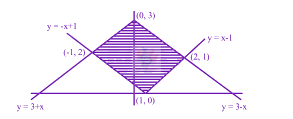
A=∫−10{(3+x)−(−x+1)}dx+∫01{(3−x)−(−x+1)}dx+∫12{(3−x)−(−x−1)}dx =∫−10(2+2x)dx+∫012dx+∫12(4−2x)dx =[2x−x2]−10+[2x]01+[4x−x2]12 =0−(−2+1)+(2−0)+(8−4)−(4−1) =1+2+4−3=4 sq. units
JEE Main 2003 — Mathematics Calculus
The area of the region bounded by the curves y=∣x−1∣ and y=3−∣x∣ is
Held on 30 Apr 2003 · Verified 6 Jul 2026.
6 sq. units
2 sq. units
3 sq. units
4 sq. units
Sign in to track your attempts and accuracy.
Sign in to keep a private note on this question. Nothing you write is ever public.
Let $f(x)=\lim _{\theta \rightarrow 0}\left(\frac{\cos \pi x-x^{\left(\frac{2}{\theta}\right)} \sin (x-1)}{1+x^{\left(\frac{2}{\theta}\right)}(x-1)}\right), x \in \mathbf{R}$. Consider the following two statements : (I) $f(x)$ is discontinous at $x=1$. (II) $f(x)$ is continous at $x=-1$. Then,
The area of the region $\{(x, y) : 0 \leq y \leq 6 - x, y^2 \geq 4x - 3, x \geq 0\}$ is:
The value of ∫₀¹ x·eˣ dx is:
Let $[\cdot]$ denote the greatest integer function. Then the value of $\displaystyle\int_0^3 \left(\dfrac{e^x + e^{-x}}{[x]!}\right) dx$ is :
Let $f: \mathbb{R} \rightarrow \mathbb{R}$ be a differentiable function such that $f\left(\dfrac{x+y}{3}\right) = \dfrac{f(x) + f(y)}{3}$ for all $x, y \in \mathbb{R}$, and $f'(0) = 3$. Then the minimum value of the function $g(x) = 3 + e^x f(x)$, is:
Work through every JEE Main Calculus PYQ, year by year.