S1:x2+y2≤25...(1) S2:lm of (1−3i)z+(1−3i)≥0lm of (1−3ix+iy+1)≥0lm of (4(x+iy)(1+3i))≥0⇒3x+y≥0...(2)S3:x≥0...(3) Area =125(π(5)2) 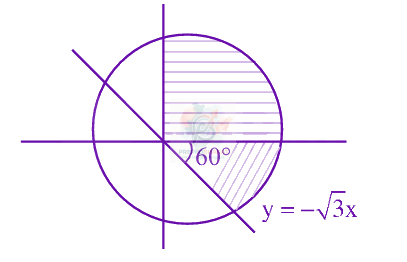
Let S_1=z ∈ C:|z| ≤ 5, S_2= z ∈ C: Im ( z+1-√3 i 1-√3 i ) ≥ 0 and S_3=z ∈ C: Re(z) ≥ 0. Then the area of the region S_1 ∩ S_2 ∩ S_3 is :
JEE Main 2024 — Mathematics Algebra
2024mcqhard
Let S1={z∈C:∣z∣≤5},S2={z∈C:Im(1−3iz+1−3i)≥0} and S3={z∈C:Re(z)≥0}. Then the area of the region S1∩S2∩S3 is :
Official previous-year question
Held on 5 Apr 2024 · Verified 6 Jul 2026.
Options
- A
12125π
- B
4125π
- C
24125π
- D
6125π
Did you get this right?
Sign in to track your attempts and accuracy.
Your note
Sign in to keep a private note on this question. Nothing you write is ever public.
JEE Main Algebra in other years
More JEE Main Algebra questions
If the quadratic equation $(\lambda+2)x^2-3\lambda x+4\lambda=0$, $\lambda \neq -2$, has two positive roots, then the number of possible integral values of $\lambda$ is:
2026medium
The value of $\frac{{ }^{100} \mathrm{C}_{50}}{51}+\frac{{ }^{100} \mathrm{C}_{51}}{52}+\ldots.+\frac{{ }^{100} \mathrm{C}_{100}}{101}$ is :
2026medium
Let $e_1$ and $e_2$ be two distinct roots of the equation $x^2 - ax + 2 = 0$. Let the sets $\{a \in \mathbb{R} : e_1 \text{ and } e_2 \text{ are the eccentricities of hyperbolas}\} = (\alpha, \beta)$, and $\{a \in \mathbb{R} : e_1 \text{ and } e_2 \text{ are the eccentricities of an ellipse and a hyperbola, respectively}\} = (\gamma, \infty)$. Then $\alpha^2 + \beta^2 + \gamma^2$ is equal to:
2026hard
Among the statements : I: If $\left|\begin{array}{ccc}1 & \cos \alpha & \cos \beta \\ \cos \alpha & 1 & \cos \gamma \\ \cos \beta & \cos \gamma & 1\end{array}\right|=\left|\begin{array}{ccc}0 & \cos \alpha & \cos \beta \\ \cos \alpha & 0 & \cos \gamma \\ \cos \beta & \cos \gamma & 0\end{array}\right|$, then $\cos ^{2} \alpha+\cos ^{2} \beta+\cos ^{2} \gamma=\frac{3}{2}$, and II : If $\left|\begin{array}{ccc}x^{2}+x & x+1 & x-2 \\ 2 x^{2}+3 x-1 & 3 x & 3 x-3 \\ x^{2}+2 x+3 & 2 x-1 & 2 x-1\end{array}\right|=\mathrm{p} x+\mathrm{q}$, then $\mathrm{p}^{2}=196 \mathrm{q}^{2}$,
2026hard
If $\left(\frac{1}{{ }^{15} \mathrm{C}_{0}}+\frac{1}{{ }^{15} \mathrm{C}_{1}}\right)\left(\frac{1}{{ }^{15} \mathrm{C}_{1}}+\frac{1}{{ }^{15} \mathrm{C}_{2}}\right) \cdots\left(\frac{1}{{ }^{15} \mathrm{C}_{12}}+\frac{1}{{ }^{15} \mathrm{C}_{13}}\right)=\frac{\alpha^{13}}{{ }^{14} \mathrm{C}_{0}{ }^{14} \mathrm{C}_{1} \cdots{ }^{14} \mathrm{C}_{12}}$, then $30 \alpha$ is equal to $\_\_\_\_$.
2026medium
Other Mathematics topics for JEE Main
Keep practicing Algebra
Work through every JEE Main Algebra PYQ, year by year.