Given,
S=1,2,3,……10
P(S)= power set of S
AR1B⇒(A∩Bc)∪(Ac∩B)=ϕ
Now for reflexive property, replacing B with A we get,
(A∩Ac)∪(Ac∩A) which ϕ always,
Now checking symmetric we will interchange A&B,
So, (B∩Ac)∪(Bc∩A) which is same as (A∩Bc)∪(Ac∩B), hence the relation is symmetric,
So, R1 is reflexive, symmetric
Now checking for transitive
(A∩Bc)∪(Ac∩B)=ϕ;
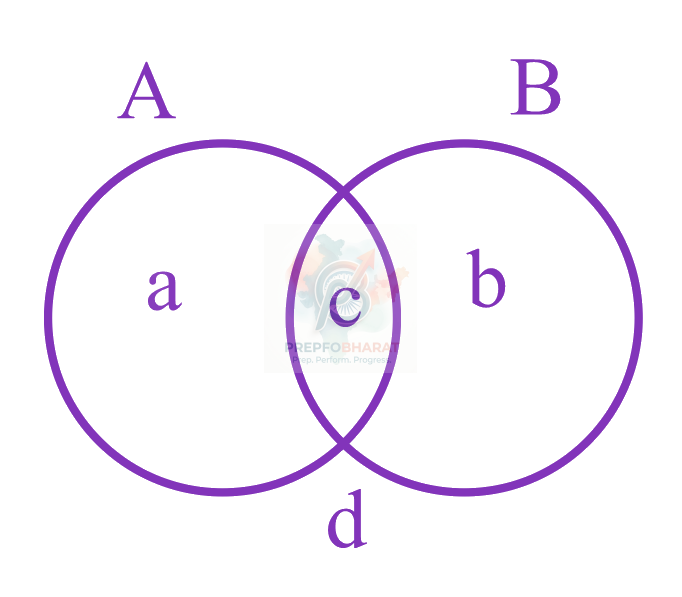
Now from diagram the elements in (A∩Bc)∪(Ac∩B) will be,
a∪b which is given as empty set ϕ
Hence, we can say that, a=ϕ=b⇒A=B
Now taking, (B∩Cc)∪(Bc∩C)=ϕ∴B=C
∴A=C equivalence.
Now solving,
R2≡A∪Bc=Ac∪B
Now for reflexive replacing B→A we get,
A∪Ac=Ac∪A which is true,
And for symmetric interchanging A⇔B we get,
B∪Ac=Bc∪A which is again true,
Hence, R2→ Reflexive, symmetric
Now for transitive,
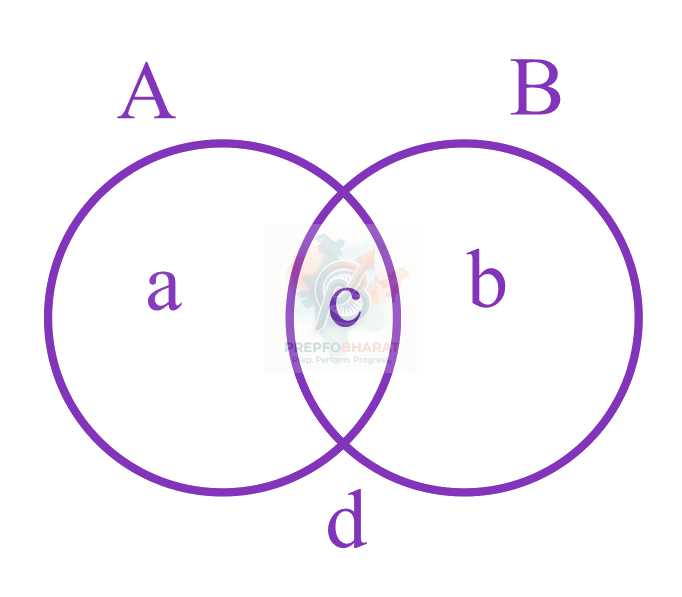
From diagram the elements inA∪Bc=Ac∪B⇒a,c,d=b,c,d
On comparing both side, we get a=b∴A=B
And, B∪Cc=Bc∪C⇒B=C
∴A=C∴A∪Cc=Ac∪C
∴ Equivalence
Hence, both given relation are equivalence.