We have,
C1:∣z1∣=9
C2:∣z2−3−4i∣=4
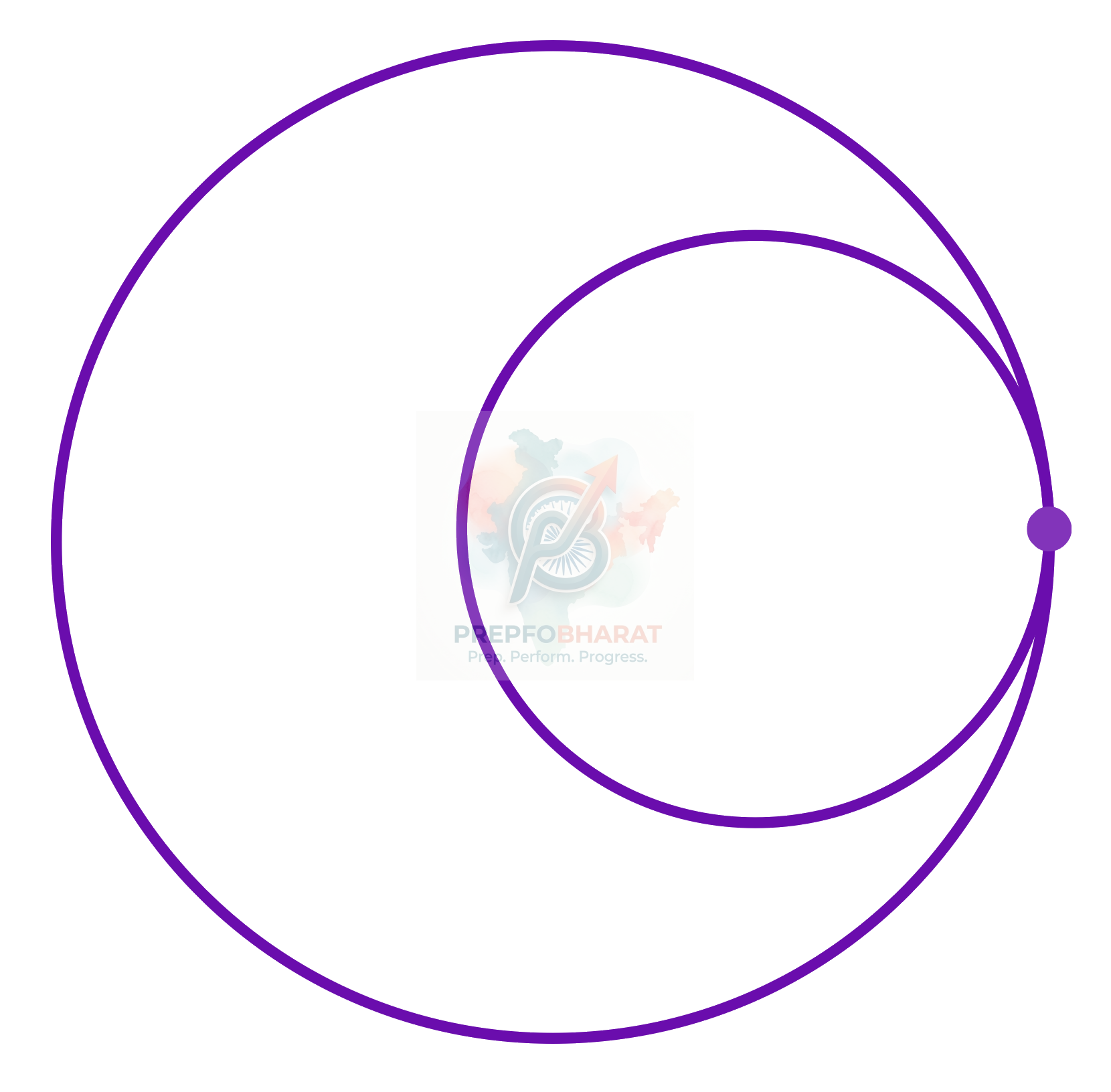
Centres of the circles are c1≡(0,0) and c2≡(3,4).
Radius of the circles are r1=9 and r2=4.
⇒c1c2=32+42=5 and r1−r2=5
Circles touch each other internally.
⇒∣z1−z2∣min=0 at the point of contact.
JEE Main 2019 — Mathematics Algebra
Let z1 and z2 be two complex numbers satisfying ∣z1∣=9 and ∣z2−3−4i∣=4. Then the minimum value of ∣z1−z2∣ is :
Held on 12 Jan 2019 · Verified 6 Jul 2026.
2
2
0
1
Sign in to track your attempts and accuracy.
Sign in to keep a private note on this question. Nothing you write is ever public.
The number of elements in the set $S = \left\{(r, k) : k \in \mathbb{Z} \text{ and } {}^{36}C_{r+1} = \dfrac{6\left({}^{35}C_r\right)}{(k^2 - 3)}\right\}$, is :
Suppose $\mathrm{a}, \mathrm{b}, \mathrm{c}$ are in A.P. and $\mathrm{a}^{2}, 2 \mathrm{~b}^{2}, \mathrm{c}^{2}$ are in G.P. If $\mathrm{a}<\mathrm{b}<\mathrm{c}$ and $\mathrm{a}+\mathrm{b}+\mathrm{c}=1$, then $9\left(\mathrm{a}^{2}+\mathrm{b}^{2}+\mathrm{c}^{2}\right)$ is equal to $\_\_\_\_$ .
Let $S=\left\{z \in \mathbb{C}: 4 z^{2}+\bar{z}=0\right\}$. Then $\sum_{z \in S}|z|^{2}$ is equal to:
Let $S=\{z: 3 \leqslant|2 z-3(1+i)| \leqslant 7\}$ be a set of complex numbers. Then $\min _{z \in S}\left|\left(z+\frac{1}{2}(5+3 i)\right)\right|$ is equal to :
Let $A = \begin{bmatrix} 1 & 0 & 0 \\ 3 & 1 & 0 \\ 9 & 3 & 1 \end{bmatrix}$ and $B = [b_{ij}]$, $1 \leq i, j \leq 3$. If $B = A^{99} - I$, then the value of $\dfrac{b_{31} - b_{21}}{b_{32}}$ is :
Work through every JEE Main Algebra PYQ, year by year.