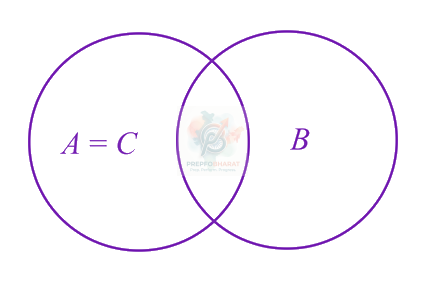
For A=C,A−C=ϕ
⇒ϕ⊆B
But A⊈B
Hence, If (A−C)⊆B, then A⊆B is not true
Let x∈C,⇒x∈(C∪A)∩(C∪B)
⇒x∈(C∪A) and x∈(C∪B)
⇒(x∈C or x∈A) and (x∈C or x∈B)
⇒x∈C or x∈(A∩B)
⇒x∈C or x∈C(asA∪B⊆C)
⇒x∈C
⇒(C∪A)∩(C∪B)⊆C .... (i)
Now x∈C⇒x∈(C∪A) and x∈(C∪B)
⇒x∈(C∪A)∩(C∪B)
⇒C⊆(C∪A)∩(C∪B) ..... (ii)
⇒ From (i) and (ii)
C=(C∪A)∩(C∪B)
Hence, (C∪A)∩(C∪B)=C is true
Let x∈A and x∈/B
⇒x∈(A−B)
⇒x∈C (asA−B⊆C)
Let x∈A and x∈B
⇒x∈(A∩B)
⇒x∈C (asA∩B⊆C)
Hence x∈A⇒x∈C
⇒A⊆C
Hence, If (A−B)⊆C, then A⊆C is true
as C⊇(A∩B)
⇒B∩C⊇(A∩B)
as A∩B=ϕ
⇒B∩C=ϕ
Hence, B∩C=ϕ is true
Alternate solution
Given
ϕ=A∩B⊆C
Let answer that
C=1,2,3,4,5,6
A=1,2,3
B=3,4,5
A∩B=3
Option (a)
B∩C=3,4,5=ϕ
Option (b) C∪A=1,2,3,4,5,6
C∪B=1,2,3,4,5,6
(C∪A)∩(C∪B)=1,2,3,4,5,6=C
Option (c) A−B=1,2,3⊆CA⊆C True
Option (d) A−C=ϕ⊆BA⊆C Not correct
∴ Option (d) is correct