Case −I
c−5>0
⇒c>5...(i)
Then, the graph of the quadratic is shown below
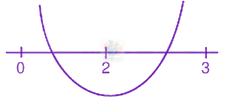
Hence, we have f(0)>0
⇒c−4>0
⇒c>4...(ii)
And f(2)<0
⇒4(c−5)−4c+c−4<0
⇒4c−20−4c+c−4<0
⇒c<24...(iii)
And f(3)>0
⇒9(c−5)−6c+c−4>0
⇒9c−45−6c+c−4>0
⇒4c−49>0
⇒c>449...(iv)
Hence, on taking the intersection of all the above inequalities, we get c∈(449,24).
Case −II
c−5<0
⇒c<5...(v)
Then, the graph of the quadratic is shown below
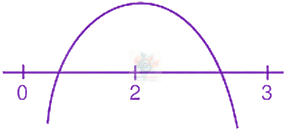
Hence, we have f(0)<0
⇒c<4...(vi)
And, f(2)>0
⇒c>24...(vii)
Also, f(3)<0
⇒c<449...(viii)
Hence, on taking the intersection of all the above inequalities, we get ⇒c∈ϕ
Hence, c∈(449,24)
Hence, the total number of element in S are 11.