JEE Main Chemistry — Physical Chemistry previous year questions with solutions.
A solution of sodium sulphate contains $92 g$ of ${\mathrm{Na}}^{+}$ ions per kilogram of water. The molality of ${\mathrm{Na}}^{+}$ ions in that solution in $\mathrm{mol} {\mathrm{kg}}^{-1}$ is:
A solution of $Ni{(N{O}_{3})}_{2}$ is electrolyzed between platinum electrode $0.1$ Faraday electricity. How many mole of $Ni$ will be deposited at the cathode?
A solution is prepared by dissolving 0.6 g of urea (molar mass $=60 g mo{l}^{-1}$) and $1.8 g$ of glucose (molar mass $=180 g mo{l}^{-1}$) in 100 mL of water at ${27}^{o}C.$ The osmotic pressure of the solution is: ($R=0.08206 L$$\text{ atm}$ ${K}^{-1} mo{l}^{-1}$)
A solution containing $62 g$ ethylene glycol in $250 g$ water is cooled to $-{10}^{o}C$ . If ${K}_{f}$ for water is $1.86 K \mathrm{kg} {\mathrm{mol}}^{-1}$ , the amount of water (in $g$ ) separated as ice is:
A process will be spontaneous at all temperatures if:
A process has $\Delta H=200 J mo{l}^{-1}$ and $\Delta S=40 J{K}^{-1}mo{l}^{-1}.$ Out of the values given below choose the minimum temperature above which the process will be spontaneous:
A mixture of $100 m\mathrm{mol}$ of $\mathrm{Ca}{(\mathrm{OH})}_{2}$ and $2g$ of sodium sulphate was dissolved in water and the volume was made up to $100 \mathrm{mL}.$ What is the mass of calcium sulphate formed and the concentration of ${\mathrm{OH}}^{-}$ in resulting solution, respectively? (Molar mass of $\mathrm{Ca}{(\mathrm{OH})}_{2}, {\mathrm{Na}}_{2}{\mathrm{SO}}_{4}$ and ${\mathrm{CaSO}}_{4}$ are $74, 143$ and $136g {\mathrm{mol}}^{-1},$ respectively; ${K}_{\mathrm{sp}}$ of $\mathrm{Ca}{(\mathrm{OH})}_{2}\mathrm{is} 5.5\times {10}^{-6}$)
A $10 \mathrm{mg}$ effervescent tablet containing sodium bicarbonate and oxalic acid releases $0.25 \mathrm{~mL}$ of $\mathrm{CO}_{2}$ at $\mathrm{T}=298.15 \mathrm{~K}$ and $\mathrm{P}=1$ bar. If molar volume of $\mathrm{CO}_{2}$ is $25.0 \mathrm{~L}$ under such condition, what is the percentage of sodium bicarbonate in each tablet? [Molar mass of $\left.\mathrm{NaHCO}_{3}=84 \mathrm{~g} \mathrm{~mol}^{-1}\right]$
A bacterial infection in an internal wound grows as ${N}^{'}(t)={N}_{0}exp(t)$ , where the time $t$ is in hours. A dose of antibiotic, taken orally, needs 1 hour to reach the wound. Once it reaches there, the bacterial population goes down as $\frac{dN}{dt}=-5{N}^{2}$ . What will be the plot of $\frac{{N}_{0}}{N}$ vs $t$ after $1$ hour?
Which of the following statements is false?
Which of the following salts is the most basic in aqueous solution?
Which of the following lines correctly show the temperature dependence of equilibrium constant $K,$ for an exothermic reaction? 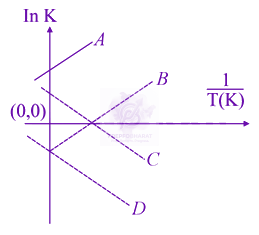
Which of the following is a Lewis acid?
Which of the following is a Lewis acid?
Which of the following are Lewis acids?
When an electric current is passes through acidified water, $112 \mathrm{~mL}$ of hydrogen gas at N.T.P. was collected at the cathode in $965$ seconds. The current passed, in ampere, is :
When an electric current is passed through acidified water, 112 mL of hydrogen gas at N.T.P was collected at the cathode in 965 seconds. The current passed, in ampere, is:
When 9.65 ampere current was passed for 1.0 hour into nitrobenzene in acidic medium, the amount of p-aminophenol produced is:
Two 5 molal solutions are prepared by dissolving a non-electrolyte, non-volatile solute separately in the solvents $\mathrm{X}$ and $\mathrm{Y}$. The molecular weights of the solvents are $\mathrm{M}_{\mathrm{X}}$ and $\mathrm{M}_{\mathrm{Y}}$, respectively where $\mathrm{M}_X=\frac{3}{4} \mathrm{M}_{\mathrm{Y}}$. The relative lowering of vapour pressure of the solution in $\mathrm{X}$ is " $\mathrm{m}$ " times that of the solution in Y. Given that the number of moles of solute is very small in comparison to that of solvent, the value of "m" is:
The ratio of mass percent of $C\mathrm{and}H$ of an organic compound $({C}_{X}{H}_{Y}{O}_{Z})$ is $6:1.$ If one molecule of the above compound $({C}_{X}{H}_{Y}{O}_{Z})$ contains half as much oxygen as required to burn one molecule of compound ${C}_{X}{H}_{Y}$ completely to ${\mathrm{CO}}_{2}$ and ${H}_{2}O.$ The empirical formula of the compound ${C}_{X}{H}_{Y}{O}_{Z}$ is
The minimum volume of water required to dissolve $0.1 \mathrm{~g}$ lead (II) chloride to get a saturated solution $\left(K_{\mathrm{SP}}\right.$ of $\mathrm{PbCl}_2=3.2 \times 10^{-8}$; atomic mass of $\mathrm{Pb}=207 \mathrm{~u})$ is :
The minimum volume of water required to dissolve 0.1 g lead (II) chloride to get a saturated solution ( ${K}_{sp}$ of ${PbCl}_{2}=3.2\times {10}^{-8}$ ;atomic mass of $Pb=207 u$ ) is:
The mass of a non-volatile, non-electrolyte solute (molar mass $= 50 g {\mathrm{mol}}^{-1}$) needed to be dissolved in 114 g octane to reduce its vapour pressure by 75 %, is:
The gas phase reaction $2{\mathrm{NO}}_{2}(g) \rightarrow {N}_{2}{O}_{4} (g)$ is an exothermic reaction. The decomposition of ${N}_{2}{O}_{4}$ , in equilibrium mixture of ${\mathrm{NO}}_{2} (g) \mathrm{and} {N}_{2}{O}_{4} (g)$ can be increased by: