JEE Main Chemistry — Physical Chemistry previous year questions with solutions.
For any given series of spectral lines of atomic hydrogen, let $\Delta \overset{-}{v}={\overset{-}{v}}_{max}-{\overset{-}{v}}_{min}$ be the difference in maximum and minimum wave number in $c{m}^{-1}$. The ratio $\Delta {\overset{-}{v}}_{Lyman}/\Delta {\overset{-}{v}}_{Balmar}$ is
Among the following, the set of parameters that represents path functions, is: i) $q+w$ ii) $q$ iii) $w$ iv) $H-TS$
Given: $(i)$ $\text{C}(\mathrm{graphite})+{O}_{2}(g)\rightarrow {\mathrm{CO}}_{2}(g);$ ${\Delta rH}^{\Theta }=x \mathrm{kJ} {\mathrm{mol}}^{-1}$ $(\mathrm{ii})$ $C(\mathrm{graphite})+\frac{1}{2}{O}_{2}(g)\rightarrow \mathrm{CO}(g);$ ${\Delta rH}^{\Theta }=y \mathrm{kJ} {\mathrm{mol}}^{-1}$ $(\mathrm{iii}) \mathrm{CO}(g)+\frac{1}{2}{O}_{2}(g)\rightarrow {\mathrm{CO}}_{2}(g);$ ${\Delta rH}^{\Theta }=z \mathrm{kJ} {\mathrm{mol}}^{-1}$ Based on the above thermochemical equations, find out which one of the following algebraic relationships is correct?
If ${K}_{\mathrm{sp}}$ of ${\mathrm{Ag}}_{2}{\mathrm{CO}}_{3}$ is $8\times {10}^{-12}$ , the molar solubility of ${\mathrm{Ag}}_{2}{\mathrm{CO}}_{3}$ in $0.1 M {\mathrm{AgNO}}_{3}$ is:
For the reaction of ${H}_{2}$ with ${I}_{2}$, the rate constant is $2.5\times {10}^{-4} d{m}^{3}mo{l}^{-1}{s}^{-1}$ at ${327}^{o}C$ and $1.0 d{m}^{3} mol-1{s}^{-1}$ at $527^{\circ}C$ . The activation energy for the reaction, in $kJ mol-1$ is: $(R=8.314 J{K}^{-1}mo{l}^{-1})$
The mole fraction of a solvent in aqueous solution of a solute is $0.8.$ The molality (in mol ${kg}^{-1}$ ) of the aqueous solution is:
$20 \mathrm{ml}$ of ${\text{0.1 M H}}_{2}{\mathrm{SO}}_{4}$ solution is added to $30 \mathrm{mL}$ of $0.2 M {\mathrm{NH}}_{4}\mathrm{OH}$ solution. The $\mathrm{pH}$ of the resultant mixture is: $[{\mathrm{pk}}_{b} \mathrm{of} {\mathrm{NH}}_{4}\mathrm{OH}=4.7]$
Given the equilibrium constant: $\mathrm{K}_{\mathrm{C}}$ of the reaction: $\mathrm{Cu}(\mathrm{s})+2 \mathrm{Ag}^{+}(\mathrm{aq}) \rightarrow \mathrm{Cu}^{2+}(\mathrm{aq})+2 \mathrm{Ag}(\mathrm{s})$ is $10 \times 10^{15}$ calculate the $E_{\text {cell }}^{0}$ of this reaction at $298 \mathrm{~K}$ $\left[2.303 \frac{\mathrm{RT}}{\mathrm{F}}\right.$ at $\left.298 \mathrm{~K}=0.059 \mathrm{~V}\right]$
${\wedge }_{m}^{o}$ for $\mathrm{NaCl}, \mathrm{HCl}$ and $\mathrm{NaA}$ are $126.4, 425.9$ and $100.5 S {\mathrm{cm}}^{2}{\mathrm{mol}}^{-1}$ respectively. If the conductivity of $0.001 M \mathrm{HA}$ is $5\times {10}^{-5}S {\mathrm{cm}}^{-1}$, degree of dissociation of $\mathrm{HA}$ is
What would be the molality of 20% (mass/mass) aqueous solution of $KI$ ? (molar mass of $KI=166 g mo{l}^{-1}$ )
The decreasing order of electrical conductivity of the following aqueous solutions is: $(A)$ $0.1 M$ Formic acid, $(B)$ $0.1 M$ Acetic acid, $(C)$ $0.1 M$ Benzoic acid.
In the cell, $\mathrm{Pt}(s)|{H}_{2}(g, 1\mathrm{bar})| \mathrm{HCl} (\mathrm{aq})|\mathrm{AgCl}(s)|\mathrm{Ag}(s)|\mathrm{Pt}(s),$the cell potential is $0.92 V$ when a ${10}^{-6}$ molar $\mathrm{HCl}$ solution is used. The standard electrode potential of $\mathrm{Ag}|\mathrm{AgCl}|{\mathrm{Cl}}^{-}$ electrode is: (Given, $\frac{2.303\mathrm{RT}}{F}=0.06 V$ at $298 K$)
The given plots represent the variation of the concentration of a reactant $R$ with time for two different reactions $(i)\mathrm{and}(\mathrm{ii})$. The respective orders of the reaction are (i) 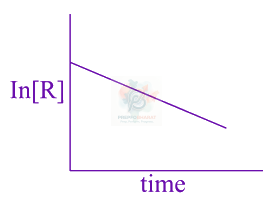 (ii) 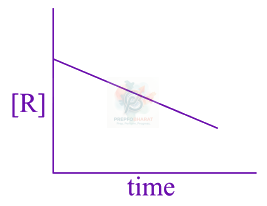
If $p$ is the momentum of the fastest electron ejected from a metal surface after the irradiation of light having wavelength $\lambda ,$ then for $1.5 p$ momentum of the photoelectron, the wavelength of the light should be: (Assume kinetic energy of ejected photoelectron to be very high in comparison to work function)
A solution of sodium sulphate contains $92 g$ of ${\mathrm{Na}}^{+}$ ions per kilogram of water. The molality of ${\mathrm{Na}}^{+}$ ions in that solution in $\mathrm{mol} {\mathrm{kg}}^{-1}$ is:
Consider the reaction $\mathrm{N}_{2}(\mathrm{~g})+3 \mathrm{H}_{2}(\mathrm{~g}) \rightleftharpoons 2 \mathrm{NH}_{3}(\mathrm{~g})$ The equilibrium constant of the above reaction is $\mathrm{K}_{\mathrm{P}}$. If pure ammonia is left to dissociate, the partial pressure of ammonia at equilibrium is given by (Assume that $\mathrm{P}_{\mathrm{NH}_{3}}< < \mathrm{P}_{\text {total }}$ at equilibrium)
For the cell $\mathrm{Zn}(\mathrm{s})\left|\mathrm{Zn}^{2+}(\mathrm{aq}) \| \mathrm{M}^{\mathrm{x}+}(\mathrm{aq})\right| \mathrm{M}(\mathrm{s}),$ different half cells and their standard electrode potentials are given below: 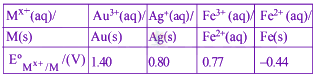 If $\mathrm{E}_{\mathrm{Zn}^{2+} / \mathrm{Zn}}^{\circ}=-0.76 \mathrm{~V},$ which cathode will give a maximum value of $E_{\text {cell }}^{0}$ per electron transferred?
The anodic half-cell of lead-acid battery is recharged using electricity of $0.05$ Faraday. The amount of ${\mathrm{PbSO}}_{4}$ electrolyzed in $g$ during the process is: (Molar mass of ${\mathrm{PbSO}}_{4}=303g {\mathrm{mol}}^{-1}$)
The osmotic pressure of a dilute solution of an ionic compound $XY$ in water is four times that of a solution $0.01 M BaC{l}_{2}$ in water. Assuming complete dissociation of the given ionic compounds in water, the concentration of $XY$ ( $in mol {L}^{-1}$ ) in solution is
Which one of the following statements regarding Henry's law is not correct?
The combination of plots which does not represent isothermal expansion of an ideal gas is $(A)$ 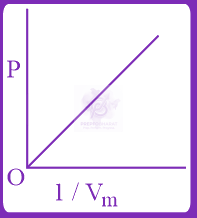 $(B)$ 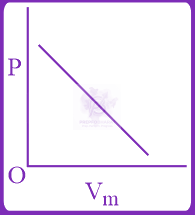 $(C)$ 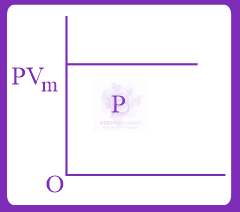 $(D)$ 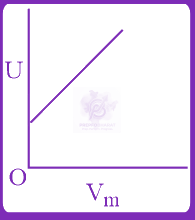
The percentage composition of carbon by mole in methane is:
$25 g$ of an unknown hydrocarbon upon burnig produces $88 g$ of $C{O}_{2}$ and $9g$ of ${H}_{2}O.$ This unknown hydrocarbon contains:
The reaction $2 \mathrm{X} \rightarrow \mathrm{B}$ is a zeroth order reaction. If the initial concentration of $\mathrm{X}$ is $0.2 \mathrm{M}$, the half-life is $6 \mathrm{~h}$. When the initial concentration of $X$ is $0.5 \mathrm{M}$, the time required to reach its final concentration of $0.2 \mathrm{M}$ will be