JEE Main Chemistry — Physical Chemistry previous year questions with solutions.
If the de Broglie wavelength of the electron in ${n}^{th}$ Bohr orbit in a hydrogenic atom is equal to $1.5 \pi {a}_{0}$ $({a}_{0}$ is Bohr radius$)$, then the value of $\frac{n}{z}$ is:
If solubility product of $Z{r}_{3}{(P{O}_{4})}_{4}$ is denoted by ${K}_{sp}$ and its molar solubility is denoted by $S$ , then which of the following relation between $S$ and ${K}_{sp}$ is correct?
If ${K}_{\mathrm{sp}}$ of ${\mathrm{Ag}}_{2}{\mathrm{CO}}_{3}$ is $8\times {10}^{-12}$ , the molar solubility of ${\mathrm{Ag}}_{2}{\mathrm{CO}}_{3}$ in $0.1 M {\mathrm{AgNO}}_{3}$ is:
If $p$ is the momentum of the fastest electron ejected from a metal surface after the irradiation of light having wavelength $\lambda ,$ then for $1.5 p$ momentum of the photoelectron, the wavelength of the light should be: (Assume kinetic energy of ejected photoelectron to be very high in comparison to work function)
If a reaction follows the Arrhenius equation, the plot $\ln k$ vs $\frac{1}{(\mathrm{RT})}$ gives straight line with a gradient $(-\mathrm{y})$ unit. The energy required to activate the reactant is:
Heat treatment of muscular pain involves radiation of wavelength of about $900 \mathrm{nm}$. Which spectral line of $\mathrm{H}$ atom is suitable for this purpose? $\left[\mathrm{R}_{\mathrm{H}}=1 \times 10^{5} \mathrm{~cm}^{-1} \cdot \mathrm{h}=6.6 \times 10^{-34} \mathrm{Js}, \mathrm{c}=3 \times 10^{8} \mathrm{~ms}^{-1}\right]$
Given the equilibrium constant: $\mathrm{K}_{\mathrm{C}}$ of the reaction: $\mathrm{Cu}(\mathrm{s})+2 \mathrm{Ag}^{+}(\mathrm{aq}) \rightarrow \mathrm{Cu}^{2+}(\mathrm{aq})+2 \mathrm{Ag}(\mathrm{s})$ is $10 \times 10^{15}$ calculate the $E_{\text {cell }}^{0}$ of this reaction at $298 \mathrm{~K}$ $\left[2.303 \frac{\mathrm{RT}}{\mathrm{F}}\right.$ at $\left.298 \mathrm{~K}=0.059 \mathrm{~V}\right]$
Given that, ${E}_{{O}_{2}/{H}_{2}O}^{o}=+1.23V;$ ${E}_{{S}_{2}{O}_{8}^{2-}/{\mathrm{SO}}_{4}^{2-}}^{o}=2.05V$ ${E}_{{\mathrm{Br}}_{2}/{\mathrm{Br}}^{-}}^{o}=+1.09V;$ ${E}_{{\mathrm{Au}}^{3+}/\mathrm{Au}}^{o}=1.4V$ The strongest oxidizing agent is
Given: $C{o}^{3+}+{e}^{-}\rightarrow C{o}^{2+};E^{\circ}=+1.81V$ ${Pb}^{3+}+{2e}^{-}\rightarrow {Pb}^{2+};E^{\circ}=+1.67V$ $C{e}^{4+}+{e}^{-}\rightarrow C{e}^{3+};E^{\circ}=+1.61V$ ${Bi}^{3+}+{3e}^{-}\rightarrow Bi;E^{\circ}=+0.20V$ Oxidizing power of the species will increase in the order:
Given: $(i)$ $\text{C}(\mathrm{graphite})+{O}_{2}(g)\rightarrow {\mathrm{CO}}_{2}(g);$ ${\Delta rH}^{\Theta }=x \mathrm{kJ} {\mathrm{mol}}^{-1}$ $(\mathrm{ii})$ $C(\mathrm{graphite})+\frac{1}{2}{O}_{2}(g)\rightarrow \mathrm{CO}(g);$ ${\Delta rH}^{\Theta }=y \mathrm{kJ} {\mathrm{mol}}^{-1}$ $(\mathrm{iii}) \mathrm{CO}(g)+\frac{1}{2}{O}_{2}(g)\rightarrow {\mathrm{CO}}_{2}(g);$ ${\Delta rH}^{\Theta }=z \mathrm{kJ} {\mathrm{mol}}^{-1}$ Based on the above thermochemical equations, find out which one of the following algebraic relationships is correct?
For the solution of the gases $w,x,y$ and $z$ in water at $298 K,$ the Henry's law constants $({K}_{H})$ are $0.5,2,35$ and $40 kbar,$ respectively. The correct plot for the given data is:
For the reaction, $2S{O}_{2}(g)+{O}_{2}(g)\rightleftharpoons 2S{O}_{3}(g),$ $\Delta H=-57.2 kJ mo{l}^{-1} and {K}_{c}=1.7\times {10}^{16}.$ Which of the following statements is incorrect?
For the reaction $2A+B\rightarrow C$ , the values of initial rate at different reactant concentrations are given in the table below. The rate law for the reactions is:<table class="pyq-table"><tbody><tr><th>$[A](mol{L}^{-1})$</th><th>$[B](mol{L}^{-1})$</th><th>$Initial Rate$ $(mol{L}^{-1}{s}^{-1})$</th></tr><tr><td>0.05</td><td>0.05</td><td>0.045</td></tr><tr><td>0.10</td><td>0.05</td><td>0.090</td></tr><tr><td>0.20</td><td>0.10</td><td>0.72</td></tr></tbody></table>
For the reaction, $2A+B\rightarrow$ products, when the concentration of $A$ and $B$ both were doubled, the rate of the reaction increased from $0.3 mol {L}^{-1}{s}^{-1}$ to $2.4 mol {L}^{-1}{s}^{-1}.$ When the concentration of $A$ alone is doubled, the rate increased from $0.3 mol {L}^{-1}{s}^{-1}$ to $0.6 mol {L}^{-1}{s}^{-1}.$ Which one of the following statements is correct?
For the reaction of ${H}_{2}$ with ${I}_{2}$, the rate constant is $2.5\times {10}^{-4} d{m}^{3}mo{l}^{-1}{s}^{-1}$ at ${327}^{o}C$ and $1.0 d{m}^{3} mol-1{s}^{-1}$ at $527^{\circ}C$ . The activation energy for the reaction, in $kJ mol-1$ is: $(R=8.314 J{K}^{-1}mo{l}^{-1})$
For the following reaction, the mass of water produced from $445 g$ of ${C}_{57}{H}_{110}{O}_{6}$ is: $2 {C}_{57}{H}_{110}{O}_{6}(s)+163{O}_{2}(g)\rightarrow 114 {\mathrm{CO}}_{2}(g)+110{H}_{2}O(l)$
For the following reaction, equilibrium constant are given: $S(s)+{O}_{2}(g)\rightleftharpoons S{O}_{2}(g);{K}_{1}={10}^{52}$ $2S(s)+3{O}_{2}(g)\rightleftharpoons 2S{O}_{3}(g);{K}_{2}={10}^{129}$ The equilibrium constant for the reaction, $2{SO}_{2}(g)+{O}_{2}(g)\rightleftharpoons 2S{O}_{3}(g)$ is:
For the equilibrium $2 \mathrm{H}_{2} \mathrm{O} \rightleftharpoons \mathrm{H}_{3} \mathrm{O}^{+}+\mathrm{OH}^{-} ;$ the value of $\Delta \mathrm{G}^{\circ}$ at $298 \mathrm{~K}$ is approximately:
For the chemical reaction $\mathrm{X} \rightleftharpoons \mathrm{Y},$ the standard reaction Gibbs energy depends on temperature $T$ (in $K$ ) as $\Delta_{\mathrm{r}} \mathrm{G}^{\circ}\left(\right.$ in $\left.\mathrm{kJ} \mathrm{mol}^{-1}\right)=120-\frac{3}{8} \mathrm{~T}$ The major component of the reaction mixture at $\mathrm{T}$ is :
For the cell $\mathrm{Zn}(\mathrm{s})\left|\mathrm{Zn}^{2+}(\mathrm{aq}) \| \mathrm{M}^{\mathrm{x}+}(\mathrm{aq})\right| \mathrm{M}(\mathrm{s}),$ different half cells and their standard electrode potentials are given below: 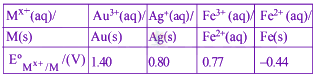 If $\mathrm{E}_{\mathrm{Zn}^{2+} / \mathrm{Zn}}^{\circ}=-0.76 \mathrm{~V},$ which cathode will give a maximum value of $E_{\text {cell }}^{0}$ per electron transferred?
For silver, ${C}_{p}(J{K}^{-1}mo{l}^{-1})=23+0.01T.$ If the temperature $(T)$ of $3$ moles of silver is raised from $300 K to 1000 K at 1 atm$ pressure, the value of $\Delta H$ will be close to:
For emission line of atomic hydrogen from ${n}_{i}=8$ to ${n}_{f}=n,$ the plot of wave number $(\overset{-}{v})$ against $(\frac{1}{{n}^{2}})$ will be: (The Rydberg constant, ${R}_{H}$ is in wave number unit)
For any given series of spectral lines of atomic hydrogen, let $\Delta \overset{-}{v}={\overset{-}{v}}_{max}-{\overset{-}{v}}_{min}$ be the difference in maximum and minimum wave number in $c{m}^{-1}$. The ratio $\Delta {\overset{-}{v}}_{Lyman}/\Delta {\overset{-}{v}}_{Balmar}$ is
${\wedge }_{m}^{o}$ for $\mathrm{NaCl}, \mathrm{HCl}$ and $\mathrm{NaA}$ are $126.4, 425.9$ and $100.5 S {\mathrm{cm}}^{2}{\mathrm{mol}}^{-1}$ respectively. If the conductivity of $0.001 M \mathrm{HA}$ is $5\times {10}^{-5}S {\mathrm{cm}}^{-1}$, degree of dissociation of $\mathrm{HA}$ is