JEE Main Chemistry — Physical Chemistry previous year questions with solutions.
Given that, ${E}_{{O}_{2}/{H}_{2}O}^{o}=+1.23V;$ ${E}_{{S}_{2}{O}_{8}^{2-}/{\mathrm{SO}}_{4}^{2-}}^{o}=2.05V$ ${E}_{{\mathrm{Br}}_{2}/{\mathrm{Br}}^{-}}^{o}=+1.09V;$ ${E}_{{\mathrm{Au}}^{3+}/\mathrm{Au}}^{o}=1.4V$ The strongest oxidizing agent is
The standard reaction Gibbs energy for a chemical reaction at an absolute temperature $\mathrm{T}$ is given by $\Delta \mathrm{G}^{\circ}=\mathrm{A}-\mathrm{BT}$ where A and $B$ are non-zero constants. Which of the following is true about this reaction?
The amount of sugar $({C}_{12}{H}_{22}{O}_{11})$ required to prepare $2L$ of its $0.1 M$ aqueous solution is:
For a reaction scheme $A\overset{{ k}_{1} }{\rightarrow }B\overset{{ k}_{2} }{\rightarrow }C,$ if the net rate of formation of B is set to be zero then the concentration of B is given by:
The freezing point of a $4%$ aqueous solution of $X$ is equal to the freezing point of a $12%$ aqueous solution of $Y$. If the molecular weight of $X$ is $A$, then the molecular weight of $Y$ will be
In the reaction of oxalate with permanganate in acidic medium, the number of electrons involved in producing one molecule of ${\mathrm{CO}}_{2}$ is:
Consider the given plots for a reaction obeying Arrhenius equation $(0^{\circ}C<T<300^{\circ}C):$ ($K$and ${E}_{a}$ are rate constant and activetion energy, respectively ) (I) 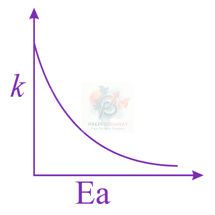 (II) 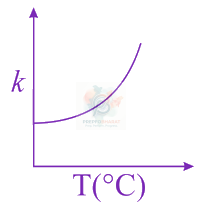
$1 g$ of a non-volatile non-electrolyte solute is dissolved in $100 g$ of two different solvents $A$ and B whose ebullioscopic constants are in the ratio of $1:5$. The ratio of the elevation in their boiling points, $\frac{\Delta {T}_{b}(A)}{\Delta {T}_{b}(B)}$, is: (assuming they have the same molar mass)
If the standard electrode potential for a cell is $2 V$ at $300 K,$ the equilibrium constant $(K)$ for the reaction. $Zn(s)+C{u}^{2+}(aq)\rightleftharpoons Z{n}^{2+}(aq)+Cu(s)$ at $300 K$ is approximately: $(R=8 J{K}^{-1}mo{l}^{-1}, F=96000 C mo{l}^{-1})$
For the solution of the gases $w,x,y$ and $z$ in water at $298 K,$ the Henry's law constants $({K}_{H})$ are $0.5,2,35$ and $40 kbar,$ respectively. The correct plot for the given data is:
The vapour pressures of pure liquids $A$ and $B$are $400$ and $600\mathrm{mm}\mathrm{Hg}$ respectively at $298 K.$On mixing the two liquids, the sum of their volumes is equal to the volume of the final mixture. The mole fraction of liquid $B$ is $0.5$ in the mixture. The vapour pressure of the final solution, the mole fractions of components $A$ and $B$ in the vapour phase, respectively are
Liquids $A$ and $B$ form an ideal solution in the entire composition range. At $350K,$ the vapour pressure of pure A and pure B are $7\times {10}^{3}\mathrm{Pa}$ and $12\times {10}^{3}\mathrm{Pa}$ , respectively. The composition of the vapour in equilibrium with a solution containing 40 mole percent of A at this temperature is:
What is the molar solubility of $AI{(OH)}_{3}$ in $0.2$ $M NaOH$ solution? Given that, solubility product of $\mathrm{Al}{(OH)}_{3}=2.4\times {10}^{-24}$ :
A solution of $Ni{(N{O}_{3})}_{2}$ is electrolyzed between platinum electrode $0.1$ Faraday electricity. How many mole of $Ni$ will be deposited at the cathode?
Consider the following reduction processes: ${\mathrm{Zn}}^{2+}+2{e}^{-}\rightarrow \mathrm{Zn}(s);{E}^{o}=-0.76 V$ ${\mathrm{Ca}}^{2+}+2{e}^{-}\rightarrow \mathrm{Ca}(s);{E}^{o}=-2.87 V$ ${\mathrm{Mg}}^{2+}+2{e}^{-}\rightarrow \mathrm{Mg}(s);{E}^{o}=-2.36 V$ ${\mathrm{Ni}}^{2+}+2{e}^{-}\rightarrow \mathrm{Ni}(s);{E}^{o}=-0.25 V$ The reducing power of the metals increases in the order:
$0.27 g$ of a long chain fatty acid was dissolved in $100{ cm}^{3}$ of hexane. $10 mL$ of this solution was added dropwise to the surface of water in a round watch glass. Hexane evaporates and a monolayer is formed. The distance from edge to centre of the watch glass is $10 cm$ . What is the height of the monolayer? [Density of fatty acid $=0.9 g c{m}^{-3};\pi =3]$
The ground state energy of a hydrogen atom is $-13.6 \mathrm{eV}$. The energy of second excited state of ${\mathrm{He}}^{+}$ ion in $\mathrm{eV}$ is:
Consider the following reversible chemical reactions: ${A}_{2}(g)+{B}_{2}(g)\overset{{k}_{1}}{\rightleftharpoons }2AB(g)$ .....(1) $6AB(g)\overset{{k}_{2}}{\rightleftharpoons }3{A}_{2}(g)+3{B}_{2}(g)$ .....(2) The relation between ${K}_{1}$ and ${K}_{2}$ is:
The minimum amount of ${O}_{2}(g)$ consumed per gram of reactant is for the reaction: (Given atomic mass: $Fe=56, O=16, Mg=24, P=31, C=12,H=1$ )
For the following reaction, equilibrium constant are given: $S(s)+{O}_{2}(g)\rightleftharpoons S{O}_{2}(g);{K}_{1}={10}^{52}$ $2S(s)+3{O}_{2}(g)\rightleftharpoons 2S{O}_{3}(g);{K}_{2}={10}^{129}$ The equilibrium constant for the reaction, $2{SO}_{2}(g)+{O}_{2}(g)\rightleftharpoons 2S{O}_{3}(g)$ is:
The reaction $\mathrm{MgO}(\mathrm{s})+\mathrm{C}(\mathrm{s}) \rightarrow \mathrm{Mg}(\mathrm{s})+\mathrm{CO}(\mathrm{g}),$ for which $\Delta \mathrm{H}^{\circ}=+491.1 \mathrm{~kJ} \mathrm{~mol}^{-1}$ and $\Delta \mathrm{S}^{\circ}=198.0 \mathrm{JK}^{-1} \mathrm{~mol}^{-1}$ is not feasible at $298 \mathrm{~K}$. Temperature above which reaction will be feasible is
An ideal gas is allowed to expand from $1 L$ to $10 L$ against a constant external pressure of $1$ bar. The work done in $kJ$ is:
Which one of the following equations does not correctly represent the first law of thermodynamics for the given processes involving an ideal gas? (Assume non- expansion work is zero)
For a diatomic ideal gas in a closed system, which of the following plots does not correctly describe the relation between various thermodynamic quantities?