JEE Main Chemistry — Physical Chemistry previous year questions with solutions.
The magnitude of the change in oxidising power of the ${\mathrm{MnO}}_{4}^{-}/{\mathrm{Mn}}^{2+}$ couple is $x\times {10}^{-4}V$ if the ${H}^{+}$ concentration is decreased from $1M$ to ${10}^{-4}M$ at $25^{\circ}C.$ (Assume concentration of ${\mathrm{MnO}}_{4}^{-}$ and ${\mathrm{Mn}}^{2+}$ to be same on change in ${H}^{+}$ concentration). The value of $x$ is __________. (Rounded off to the nearest integer) [Given: $\frac{2.303\mathrm{RT}}{F}=0.059$]
An inorganic Compound $'X'$ on treatment with concentrated ${H}_{2}{\mathrm{SO}}_{4}$ produces brown fumes and gives dark brown ring with ${\mathrm{FeSO}}_{4}$ in presence of concentrated ${H}_{2}{\mathrm{SO}}_{4}$. Also Compound $'X'$ gives precipitate $'Y'$, when its solution in dilute $\mathrm{HCl}$ is treated with ${H}_{2}S$ gas. The precipitate $'Y'$ on treatment with concentrated ${\mathrm{HNO}}_{3}$ followed by excess of ${\mathrm{NH}}_{4}\mathrm{OH}$ further gives deep blue coloured solution, Compound $'X'$ is:
The Azimuthal quantum number for the valence electrons of ${\mathrm{Ga}}^{+}$ ion is (Atomic number of $\mathrm{Ga}=31$)
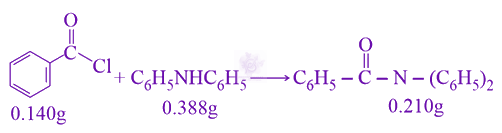 Consider the above reaction. The percentage yield of amide product is (Round off to the Nearest Integer). (Given : Atomic mass : $C:12.0u,H:1.0u$ $N:14.0u,O:16.0u,\mathrm{Cl}:35.5u)$
Given below are two statements : Statement I : The $E^{\circ}$ value of ${\mathrm{Ce}}^{4+}/{\mathrm{Ce}}^{3+}$ is $+1.74V$ Statement II : Ce is more stable in ${\mathrm{Ce}}^{4+}$ state than ${\mathrm{Ce}}^{3+}$ state. In the light of the above statements, choose the most appropriate answer from the options given below:
Consider the following cell reaction ${\mathrm{Cd}}_{(s)}+{\mathrm{Hg}}_{2}{\mathrm{SO}}_{4(s)}+\frac{9}{5}{H}_{2}{O}_{(l)}\rightleftharpoons {\mathrm{CdSO}}_{4}\cdot \frac{9}{5}{H}_{2}{O}_{(s)}+2{\mathrm{Hg}}_{(l)}.$ The value of ${E}_{\mathrm{cell}}^{0}$ is $4.315V$ at $25^{\circ}C.$ If $\Delta H^{\circ}=-825.2\mathrm{kJ}{\mathrm{mol}}^{-1},$ the standard entropy change $\Delta S^{\circ}$ in $J{K}^{-1}$ is _________ . (Nearest integer) [Given : Faraday constant $=96487C{\mathrm{mol}}^{-1}$]
The rate constant of a reaction increases by five times on increase in temperature from $27^{\circ}C$ to $52^{\circ}C$. The value of activation energy in ${\mathrm{kJmol}}^{-1}$ is ___ .(Rounded-off to the nearest integer) $[R=8.314J{K}^{-1}{\mathrm{mol}}^{-1}]$
$10.0\mathrm{mL}$ of $0.05M{\mathrm{KMnO}}_{4}$ solution was consumed in a titration with $10.0\mathrm{mL}$ of given oxalic acid dihydrate solution. The strength of given oxalic acid solution is ........ $\times {10}^{-2}g/L$. (Round off to the nearest integer)
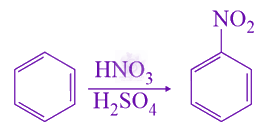 In the above reaction, $3.9g$ of benzene on nitration gives $4.92g$ of nitrobenzene. The percentage yield of nitrobenzene in the above reaction is _________ $%$. (Round off to the Nearest Integer). (Given atomic mass : $C:12.0u,H:1.0u$$O:16.0u,N:14.0u$)
The gas phase reaction $2A(g)\rightleftharpoons {A}_{2}(g)$ at $400K$ has $\Delta {G}^{o}=+25.2\mathrm{kJ}{\mathrm{mol}}^{-1}$. The equilibrium constant ${K}_{C}$ for this reaction is ___ $\times {10}^{-2}$. (Round off to the Nearest integer) Use : $R=8.3J{\mathrm{mol}}^{-1}{K}^{-1},\mathrm{ln}10=2.3 {\mathrm{log}}_{10}2=0.30,1\mathrm{atm}=1\mathrm{bar}$ antilog $(-0.3)=0.501$
For the reaction $2{\mathrm{NO}}_{2}(g)\rightleftharpoons {N}_{2}{O}_{4}(g),$ when $\Delta S=-176.0J{K}^{-1}$ and $\Delta H=-57.8\mathrm{kJ}{\mathrm{mol}}^{-1}$ the magnitude of $\Delta G$ at $298K$ for the reaction is _____ ${\mathrm{kJmol}}^{-1}$. (Nearest integer)
The number of $f$ electrons in the ground state electronic configuration of $\mathrm{Np}(Z=93)$ is ______ .(Integer answer)
For water at $100^{\circ}C$ and $1$ bar, ${\Delta }_{vap}H-{\Delta }_{vap}U=\underset{¯}{}\times {10}^{2}J{\mathrm{mol}}^{-1}$ (Round off to the Nearest Integer) [Use : $R=8.31J{\mathrm{mol}}^{-1}{K}^{-1}]$ [Assume volume of ${H}_{2}O(l)$ is much smaller than volume of ${H}_{2}O(g)$. Assume ${H}_{2}O(g)$ treated as an ideal gas]
If the standard molar enthalpy change for combustion of graphite powder is $-2.48\times {10}^{2}\mathrm{kJ}{\mathrm{mol}}^{-1}$, the amount of heat generated on combustion of $1g$ of graphite powder in $\mathrm{kJ}$ (Nearest integer):
For the reaction ${C}_{2}{H}_{6}\rightarrow {C}_{2}{H}_{4}+{H}_{2}$ the reaction enthalpy ${\Delta }_{r}H\mathrm{in}$ ${\mathrm{kJmol}}^{-1}$ is (Round off to the Nearest Integer). [Given : Bond enthalpies in ${\mathrm{kJmol}}^{-1}:C-C:$ $347,C=C:611;C-H:414,H-H:436]$
During which of the following processes, does entropy decrease ? (A) Freezing of water to ice at $0^{\circ}C$ (B) Freezing of water to ice at $-10^{\circ}C$ (C) ${N}_{2}(g)+3{H}_{2}(g)\rightarrow 2{\mathrm{NH}}_{3}(g)$ (D) Adsorption of $\mathrm{CO}(g)$ and lead surface (E) Dissolution of $\mathrm{NaCl}$ in water
The standard enthalpies of formation of ${\mathrm{Al}}_{2}{O}_{3}$ and $\mathrm{CaO}$ are $-1675\mathrm{kJ}{\mathrm{mol}}^{-1}$ and $-635\mathrm{kJ}{\mathrm{mol}}^{-1}$ respectively. For the reaction $3\mathrm{CaO}+2\mathrm{Al}\rightarrow 3\mathrm{Ca}+{\mathrm{Al}}_{2}{O}_{3}$ the standard reaction enthalpy ${\Delta }_{r}{H}^{0}=$ ________ $\mathrm{kJ}.$ (Round off to the Nearest Integer).
At $25^{\circ}C,50g$ of iron reacts with $\mathrm{HCl}$ to form ${\mathrm{FeCl}}_{2}$. The evolved hydrogen gas expands against a constant pressure of $1\mathrm{bar}$. The work done by the gas during this expansion is -_______ $J$. (Round off to the Nearest Integer) [Given : $R=8.314J{\mathrm{mol}}^{-1}{K}^{-1}$. Assume, hydrogen is an ideal gas] [Atomic mass off Fe is $55.85u$]
Five moles of an ideal gas at $293K$ is expanded isothermally from an initial pressure of $2.1\mathrm{MPa}$ to $1.3\mathrm{MPa}$ against at constant external pressure $4.3\mathrm{MPa}$. The heat transferred in this process is ___ ${\mathrm{kJmol}}^{-1}$. (Rounded-off to the nearest integer)[ Use $R=8.314J{\mathrm{mol}}^{-1}{K}^{-1}$]
For the reaction ${A}_{(g)}\rightarrow {B}_{(g)}$, the value of the equilibrium constant at $300K$ and $1\mathrm{atm}$ is equal to $100.0.$ The value of ${\Delta G}^{o}$ for the reaction at $300K$ and $1\mathrm{atm}$ in ${\mathrm{Jmol}}^{-1}$ is $-xR,$ where $x$ is (Rounded off to the nearest integer) $(R=8.31J{\mathrm{mol}}^{-1}{K}^{-1}\mathrm{and}\mathrm{ln}10=2.3)$
At $20^{\circ}C$, the vapour pressure of benzene is $70$ torr and that of methyl benzene is $20$ torr. The mole fraction of benzene in the vapour phase at $20^{\circ}C$ above an equimolar mixture of benzene and methyl benzene is $__\times {10}^{-2}.$ (Nearest integer)
The number of moles of ${\mathrm{NH}}_{3},$ that must be added to $2L$ of $0.80{\mathrm{MAgNO}}_{3}$ in order to reduce the concentration of ${\mathrm{Ag}}^{+}$ ions to $5.0\times {10}^{-8}M({K}_{\text{formation }}$ for ${[\mathrm{Ag}{({\mathrm{NH}}_{3})}_{2}]}^{+}=1.0\times {10}^{8})$ is __________. (Nearest integer) [Assume no volume change on adding ${\mathrm{NH}}_{3}$]
When $5.1g$ of solid ${\mathrm{NH}}_{4}\mathrm{HS}$ is introduced into a two litre evacuated flask at $27^{\circ}C,20%$ of the solid decomposes into gaseous ammonia and hydrogen sulphide. The ${K}_{p}$ for the reaction at $27^{\circ}C$ is $x\times {10}^{-2}$. The value of $x$ is (Integer answer) [Given $1R=0.082L\mathrm{atm}{K}^{-1}{\mathrm{mol}}^{-1}]$
The ${\mathrm{OH}}^{-}$ concentration in a mixture of $5.0\mathrm{mL}$ of $0.0504M{\mathrm{NH}}_{4}\mathrm{Cl}$ and $2\mathrm{mL}$ of $0.0210M{\mathrm{NH}}_{3}$ solution is $x\times {10}^{-6}M$. The value of $x$ is (Nearest integer) [Given ${K}_{w}=1\times {10}^{-14}$ and ${K}_{b}=1.8\times {10}^{-5}]$