JEE Main Chemistry — Physical Chemistry previous year questions with solutions.
For a given chemical reaction $A\rightarrow B$ at $300K$ the free energy change is $-49.4\mathrm{kJ}{\mathrm{mol}}^{-1}$ and the enthalpy of reaction is $51.4\mathrm{kJ}{\mathrm{mol}}^{-1}.$ The entropy change of the reaction is _________${\mathrm{JK}}^{-1}{\mathrm{mol}}^{-1}.$
The equilibrium constant ${K}_{c}$ at $298K$ for the reaction $A+B\rightleftharpoons C+D$ is $100.$ Starting with an equimolar solution with concentrations of $A,B,C$ and $D$ all equal to $1M$, the equilibrium concentration of $D$ is _____$\times {10}^{-2}M$. (Nearest integer)
$0.01$ moles of a weak acid $\mathrm{HA}({K}_{a}=2.0\times {10}^{-6})$ is dissolved in $1.0L$ of $0.1M\mathrm{HCl}$ solution. The degree of dissociation of $\mathrm{HA}$ is __________ $\times {10}^{-5}$ (Round off to the Nearest Integer). [Neglect volume change on adding $\mathrm{HA}$ and assume degree of dissociation $<<1$]
$1$ molal aqueous solution of an electrolyte ${A}_{2}{B}_{3}$ is $60%$ ionised. The boiling point of the solution at $1\mathrm{atm}$ is _____ $K$. (Rounded-off to the nearest integer) [Given ${K}_{b}$ for $({H}_{2}O)=0.52K\mathrm{kg}{\mathrm{mol}}^{-1}$]
$4.5g$ of compound $A(M.W.=90)$ was used to make $250\mathrm{mL}$ of its aqueous solution. The molarity of the solution in $M$ is $x\times {10}^{-1}.$ The value of $x$ is_____ (Rounded off to the nearest integer)
$100g$ of propane is completely reacted with $1000g$ of oxygen. The mole fraction of carbon dioxide in the resulting mixture is $x\times {10}^{-2}$. The value of $x$ is (Nearest integer)
In mildly alkaline medium, thiosulphate ion is oxidized by ${\mathrm{MnO}}_{4}^{-}$ to $"A"$. The oxidation state of sulphur in $"A"$ is_
Of the following four aqueous solutions, the total number of those solutions whose freezing point is lower than that of $0.10{\mathrm{MC}}_{2}{H}_{5}\mathrm{OH}$ is (Integer answer) (i) $0.10M{\mathrm{Ba}}_{3}{({\mathrm{PO}}_{4})}_{2}$ (ii) $0.10M{\mathrm{Na}}_{2}{\mathrm{SO}}_{4}$ (iii) $0.10M\mathrm{KCl}$ (iv) $0.10M{\mathrm{Li}}_{3}{\mathrm{PO}}_{4}$
According to the following figure, the magnitude of the enthalpy change of the reaction $A+B\rightarrow M+N$ in $\mathrm{kJ}{\mathrm{mol}}^{-1}$ is equal to __________ . (Integer answer) 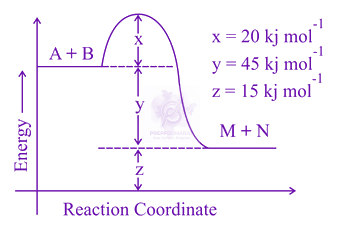
$1.46g$ of a biopolymer dissolved in a $100\mathrm{mL}$ water at $300K$ exerted an osmotic pressure of $2.42\times {10}^{-3}\mathrm{bar}$ The molar mass of the biopolymer is $-\times {10}^{4}g$ ${\mathrm{mol}}^{-1}.$ (Round off to the Nearest Integer) [Use: $R=0.083L$ bar ${\mathrm{mol}}^{-1}{K}^{-1}]$
The molarity of the solution prepared by dissolving $6.3g$ of oxalic acid $({H}_{2}{C}_{2}{O}_{4}\cdot 2{H}_{2}O)$ in $250\mathrm{mL}$ of water in $\mathrm{mol}{L}^{-1}$ is $x\times {10}^{-2}.$ The value of $x$ is _________ . (Nearest integer) [Atomic mass : $H:1.0,C:12.0,0:16.0J$]
Sodium oxide reacts with water to produce sodium hydroxide. $20.0g$ of sodium oxide is dissolved in $500\mathrm{mL}$ of water. Neglecting the change in volume, the concentration of the resulting $\mathrm{NaOH}$ solution is _________ $\times {10}^{-1}M.$ (Nearest integer) [Atomic mass : $\mathrm{Na}=23.0,O=16.0,H=1.0$]
If $80g$ of copper sulphate ${\mathrm{CuSO}}_{4}\cdot 5{H}_{2}O$ is dissolved in deionised water to make $5L$ of solution. The concentration of the copper sulphate solution is $x\times {10}^{-3}\text{ mol }{L}^{-1}.$ The value of $x$ is _____. $[\text{Atomic masses }\mathrm{Cu}:63.54u,S:32u,O:16u,H:1u]$
Which one of the following $0.10M$ aqueous solutions will exhibit the largest freezing point depression?
$40g$ of glucose (Molar mass $=180)$ is mixed with $200\mathrm{mL}$ of water. The freezing point of solution is $__K$. (Nearest integer) [Given : ${K}_{f}=1.86K\mathrm{kg}{\mathrm{mol}}^{-1};$ Density of water $=1.00g{\mathrm{cm}}^{-3};$ Freezing point of water $=273.15K]$
$2$ molal solution of a weak acid $\mathrm{HA}$ has a freezing point of $3.885^{\circ}C.$ The degree of dissociation of this acid is ______$\times {10}^{-3}.$ (Round off to the Nearest Integer). $[$Given : Molal depression constant of water $=1.85K\mathrm{kg}{\mathrm{mol}}^{-1}$ Freezing point of pure water$=0^{\circ}C]$
A solute $A$ dimerizes in water. The boiling point of a $2$ molal solution of $A$ is $100.52C\circ$. The percentage association of $A$ is ___ . (Round off to the Nearest integer) Use : ${K}_{b}$ for water $=0.52K\mathrm{kg}{\mathrm{mol}}^{-1}$ Boiling point of water $=100^{\circ}C$
If a compound $\mathrm{AB}$ dissociates to the extent of $75%$ in an aqueous solution, the molality of the solution which shows a $2.5K$ rise in the boiling point of the solution is ___ molal. (Rounded-off to the nearest integer) $[{K}_{b}=0.52K\mathrm{kg}{\mathrm{mol}}^{-1}]$.
${\mathrm{AB}}_{2}$ is $10%$ dissociated in water to ${A}^{2+}$ and ${B}^{-}$. The boiling point of $10.0$ molal aqueous solution of ${\mathrm{AB}}_{2}$ is-- $C\circ$. (Round off to the Nearest Integer). [Given : Molal elevation constant of water ${K}_{b}=0.5K\mathrm{kg}{\mathrm{mol}}^{-1}$ boiling point of pure water$=100^{\circ}C$]
If the conductivity of mercury at $0^{\circ}C$ is $1.07\times {10}^{6}S{m}^{-1}$ and the resistance of a cell containing mercury is $0.243\Omega ,$ then the cell constant of the cell is $x\times {10}^{4}{m}^{-1}.$ The value of $x$ is ______ . (Nearest integer)
For the cell $\mathrm{Cu}(s)|{\mathrm{Cu}}^{2+}(\mathrm{aq})(0.1M)\|{\mathrm{Ag}}^{+}(\mathrm{aq})(0.01M)|\mathrm{Ag}(s)$ the cell potential ${E}_{1}=0.3095V$. For the cell $\mathrm{Cu}(s)|{\mathrm{Cu}}^{2+}(\mathrm{aq})(0.01M)\|{\mathrm{Ag}}^{+}(\mathrm{aq})(0.001M)|\mathrm{Ag}(s)$ the cell potential $=x\times {10}^{-2}V.$ Find value of x (Round off the Nearest Integer). [ Use $:\frac{2.303\mathrm{RT}}{F}=0.059J$ ]
For the galvanic cell, $\mathrm{Zn}(s)+{\mathrm{Cu}}^{2+}(0.02M)\rightarrow {\mathrm{Zn}}^{2+}(0.04M)+\mathrm{Cu}(s)$ ${E}_{\mathrm{cell}}=\ldots \times {10}^{-2}V$ (Nearest integer) $[\mathrm{Use}:{E}^{0}\mathrm{Cu}/{\mathrm{Cu}}^{2+}=-0.34V,{E}_{\mathrm{Zn}/{\mathrm{Zn}}^{2}+}=+0.76V,\frac{2.303\mathrm{RT}}{F}=0.059V]$
Potassium chlorate is prepared by electrolysis of $\mathrm{KCl}$ in basic solution as shown by following equation. $6{\mathrm{OH}}^{-}+{\mathrm{Cl}}^{-}\rightarrow {\mathrm{ClO}}_{3}^{-}+3{H}_{2}O+6{e}^{-}$ A current of $\mathrm{xA}$ has to be passed for $10h$ to produce $10.0g$ of potassium chlorate. the value of $x$ is __________. (Nearest integer) (Molar mass of ${\mathrm{KClO}}_{3}=122.6g{\mathrm{mol}}^{-1}F=96500C$)
A $\mathrm{KCl}$ solution of conductivity $0.14S{m}^{-1}$ shows a resistance of $4.19\Omega$ in a conductivity cell. If the same cell is filled with an $\mathrm{HCl}$ solution, the resistance drops to $1.03\Omega$. The conductivity of the HCl solution is ____$\times {10}^{-2}S{m}^{-1}$. (Round off to the Nearest Integer).